Craftsman bungalows
Low gable roofs with exposed rafter tails and wide eaves, where gutter overflow rots the tails first.
Maryland
Takoma Park grew up around the B&O rail stop in the late 1800s and early 1900s, and its streets still hold Victorians, foursquares and Craftsman bungalows with deep porches. A large part of the city sits in its own historic district, so roof work here starts with knowing what can change and what has to stay.
Takoma Park roof jobs often involve slate, old metal porch roofs and shingle roofs on 1900s to 1930s bungalows, with historic review for visible changes inside the historic district. Porch roof repairs commonly run $590-$2,140, and slate repairs start around $470. Expect added time for approvals. Call (202) 771-7443 and we'll walk the roof and explain which historic review rules apply.
Takoma Park, Maryland has its own historic district, separate from Takoma on the DC side of Eastern Avenue. For houses inside it, a visible change in roofing material, like swapping slate for asphalt or replacing a standing seam porch roof with membrane, usually needs historic review before work starts. Like-for-like repairs are treated differently than replacements, and we explain where your job falls.
We put together the material samples, photos of the existing roof and a written scope so the application tells reviewers exactly what's planned. The city and the county permit office may both play a role in the approval, and we confirm the current steps for the address rather than guess. Our post on historic district roof rules covers the DC side for comparison.
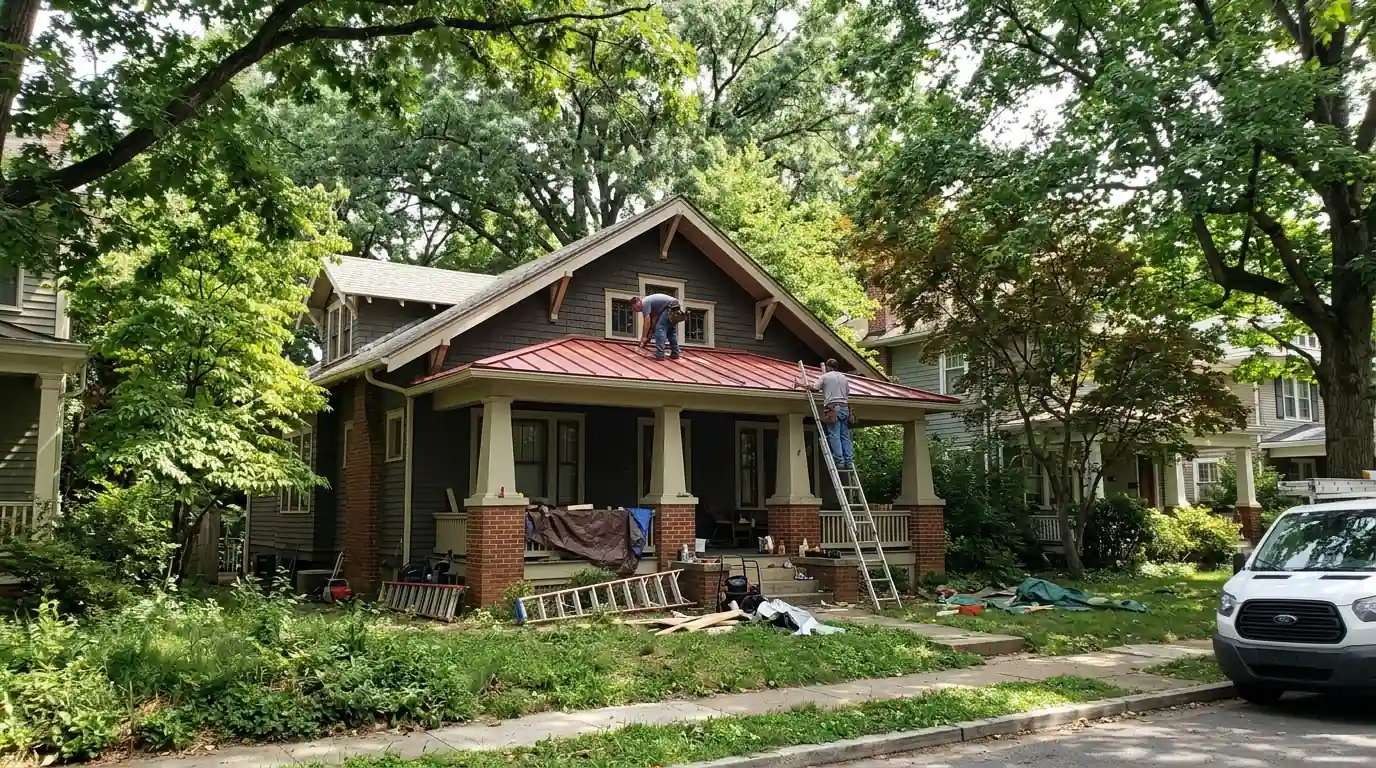
Along Carroll Avenue, Philadelphia Avenue and the streets around Old Town, many houses are 1910s and 1920s Craftsman bungalows with low-pitched gable roofs, wide eaves, exposed rafter tails and a full-width front porch. Foursquares carry a hipped roof with a single dormer. A few houses were ordered as Sears kits and assembled on site, and their rafters and spaced board sheathing are lighter than modern framing.
That lighter framing matters when choosing materials. Before recommending slate on a bungalow that currently wears shingles, we check the rafter size and span from the attic. Exposed rafter tails also need care: we pull gutters gently, repair rotted tails with matched wood, and avoid pushing new drip edge into old paint lines.
Many Takoma Park porches still carry terne-coated or galvanized standing seam metal that was painted every few years until someone stopped. Rust starts at the seams and around the gutter edge. We clean and treat sound panels, solder or replace rusted sections, and repaint with a proper metal roof primer. When a porch needs full replacement, standing seam metal in a matching profile keeps the look historic reviewers expect.
Slate roofs on the larger Victorians and foursquares mostly fail at the nails and flashing. Slipped slates, rusted valley metal and old tar patches over flashing are the usual findings. Our slate roof repair crew swaps broken pieces with salvaged slate and copper hooks, and redoes valleys in copper rather than coating them.
Takoma Park protects its trees, and the canopy over streets like Maple Avenue and Tulip Avenue is dense. Big limbs over a roof mean clogged gutters, moss on shaded slopes and real storm risk. We don't trim regulated trees ourselves; we tell you where branches are rubbing the roof so you can have an arborist handle the permit side.
Lots are narrow and parking is tight near the Takoma Metro and the Old Town shops on Laurel Avenue. We use a small trailer instead of a roll-off when the street won't take one, and we carry slate and metal by hand from the curb. After storms, we can tarp a bungalow the same day while repairs are planned with the historic review timeline in mind.
Low gable roofs with exposed rafter tails and wide eaves, where gutter overflow rots the tails first.
Painted terne or galvanized standing seam on many porches rusts at the seams once the paint lapses.
Larger houses near Old Town still have slate with copper or galvanized valleys that need periodic attention.
Inside the Takoma Park historic district, visible material changes go through historic review before work begins.
Kit homes and early bungalows have smaller rafters, so heavy materials need a framing check first.
Slate repair for Victorian mansards, turrets and steep DC roofs: broken slates replaced with copper hooks or nail-and-bib, plus valley and flashing rebuilds.
Slate Roof Repair detailsSoldered repairs, repainting and partial replacement for tin, terne, standing seam and copper roofs on DC bay fronts, porches, turrets and mansards.
Metal Roof Repair detailsStanding seam steel and aluminum roofs for porches, bays, low-pitch additions and whole homes, with concealed clips and site-formed panels.
Standing Seam Metal Roofing detailsTargeted fixes for open seams, slipped slate, lifted shingles and failed flashing on DC rowhouses, porch roofs and detached homes, sized to the actual damage.
Roof Repair detailsArchitectural shingle roofs for colonials, Cape Cods and split-levels, with ice barrier at eaves, new valley metal and balanced ridge venting.
Asphalt Shingle Roofing detailsLeaking seams, sagging runs, crushed downspouts and clogged alley tie-ins fixed on the spot, so you keep sound gutters instead of replacing them early.
Gutter Repair detailsIf the house is in the historic district, that change usually needs historic review and may not be approved for a prominent slope. We can price both a slate repair and a replacement, and help you prepare the application if a material change is the goal.
No. Takoma in DC has its own historic district under DC rules, while Takoma Park, Maryland has a separate one on the Maryland side. We confirm which rules apply based on the address.
It depends on the scope and the historic review calendar, so we check the current timeline before setting a start date. Emergency tarping and urgent leak stops can still happen right away.
Call any hour. We answer 24/7 and tell you when a roofer can be at your house.