Bungalows and Cape Cods
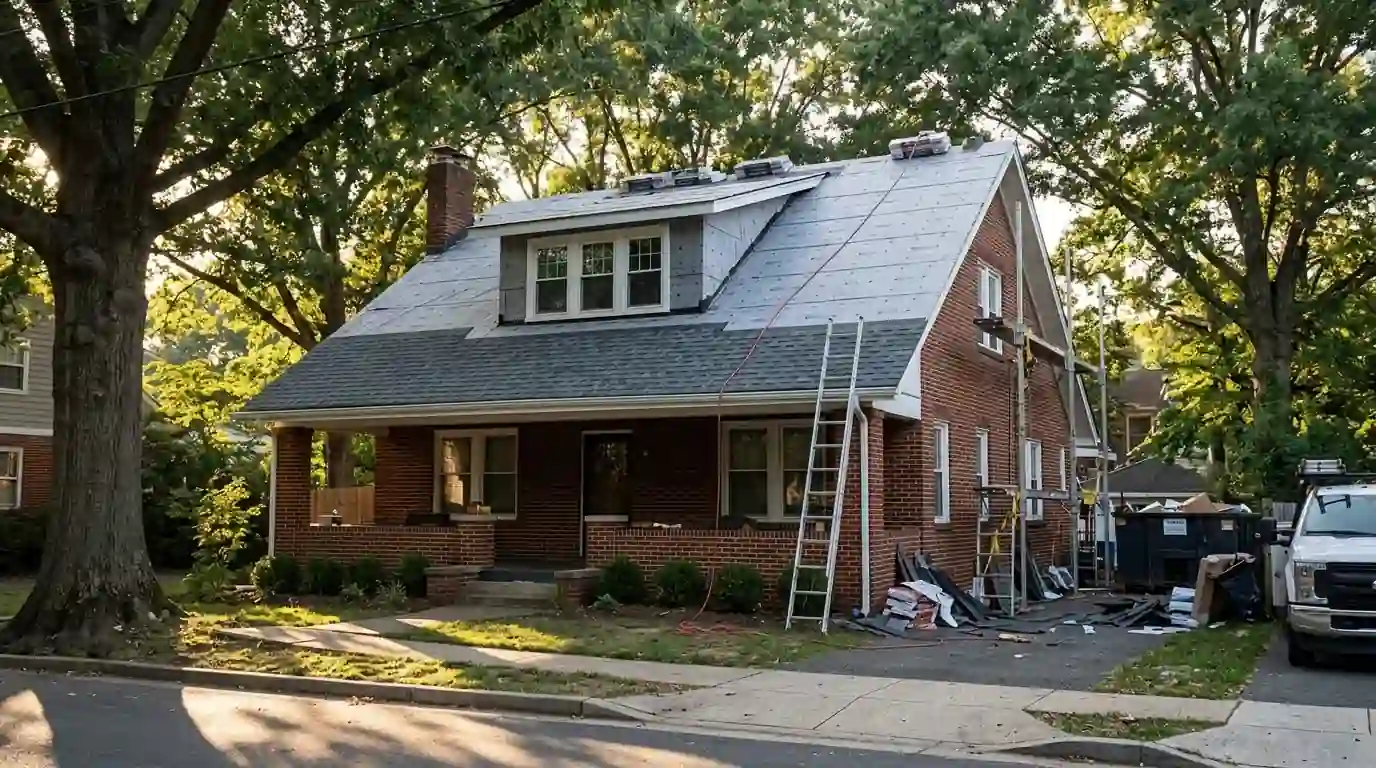
Most were built between the 1920s and the 1940s with board sheathing, small dormers and one or two brick chimneys that need step and counter flashing.
Northern Virginia
Arlington's older roofs sit under some of the heaviest street canopy in Northern Virginia, on houses built between the 1920s and the 1940s with chimneys, dormers and small porches that each want their own flashing. That mix is most of what we fix and replace across the county.
Most Arlington County roofs we work on are pitched asphalt over 1920s to 1940s framing, often with a flat porch or rear addition tacked on. A leak at a chimney or dormer typically runs $385-$1,140 to repair. A full shingle tear-off on a bungalow or Cape Cod usually falls between $11,800 and $21,600, depending on decking, layers and access. The line at (202) 771-7443 never closes.
In Lyon Park, Cherrydale and Ashton Heights, a typical bungalow has a broad front gable, a shed dormer and a brick chimney that has been repointed more than once. The original board sheathing is often still up there under two layers of shingles, and the planks have gaps that modern nails miss.
When we tear off one of these roofs, we expect to swap some boards, mostly at the eaves and around the chimney where water sat for years. We cover the whole deck in synthetic underlayment, run ice and water membrane along the eaves and valleys, and step-flash every sidewall course by course instead of trusting a bead of caulk.
Catalog kit homes show up here too, and their roof framing is lighter than you might guess. We check the rafters from the attic before anyone loads bundles on the roof, so a pallet of shingles never ends up stacked over a cracked rafter.
Along Columbia Pike, Langston Boulevard and around Buckingham, three-story brick garden apartments from the late 1930s and 1940s hold a big share of Arlington's housing. Many have been converted to condos, so the roof belongs to an association and decisions run through a board and a property manager.
Those buildings tend to mix pitched sections with flat connectors, internal drains and long runs of gutter. We map every drain and scupper, photograph each roof plane, and hand the board a written scope with options it can phase across budget years. Our condo and multifamily roofing work always starts with that roof map.
Residents still need to get in and out while we work, so we stage material early in the morning, keep walkways covered and tarp the courtyard plantings before any old shingle comes down.
The oaks, maples and tulip poplars that shade Westover, Bluemont and Arlington Ridge are part of why people live here, but they drop limbs in summer thunderstorms and fill valleys with leaves every November. A clogged valley pushes water sideways under shingles, and that is one of the most frequent leak calls we answer from the county.
When a storm puts a limb through a roof, we tarp it the same day, then come back to replace broken rafters and decking once the tree crew clears the wood. Shaded slopes also grow moss and black algae streaks, so we often suggest algae-resistant shingles and better attic airflow when a roof here is replaced.
Before a full replacement, we confirm with the county permit office whether your scope needs a permit, since replacing sheathing or rafters can change the answer. Narrow lots near Clarendon and Ballston often have no room for a big roll-off, so we bring a smaller dump trailer and haul debris out daily.
Some streets sit inside residential permit parking zones, and we plan crew parking around that so your neighbors are not boxed in. If your house also has a low-slope rear porch roof, ask us to look at it on the same visit, because that is where flat roof repair most often saves a kitchen ceiling.
Most were built between the 1920s and the 1940s with board sheathing, small dormers and one or two brick chimneys that need step and counter flashing.
Three-story brick buildings, many now condo-owned, with pitched sections tied to flat connectors, internal drains and long gutter runs.
A few brick colonials near Glebe Road and Arlington Ridge still carry slate, and cracked pieces can usually be swapped one at a time on copper hooks.
Shaded north slopes stay damp, grow algae and hold wet leaves in valleys far longer than open roofs do.
Material often goes up by ladder hoist from the front, with tarps laid over shrubs, walkways and window wells.
Full tear-off and new roof systems for DC rowhouses, Victorians and suburban colonials, from low-slope membranes to shingle, slate and metal.
Roof Replacement detailsNew step, apron, counter and cricket flashing around brick chimneys on slate, shingle and flat roofs, cut into mortar joints instead of glued to the face.
Chimney Flashing Repair detailsLow-slope roof repair for DC rowhouses and additions: modified bitumen, EPDM, TPO and coated roll roofing, plus ponding areas, curbs and parapet base flashing.
Flat Roof Repair detailsShared roofs on condo buildings, co-ops and small apartment buildings repaired or replaced with clear reports for boards and simple notices for residents.
Condo and Multifamily Roofing detailsSlate repair for Victorian mansards, turrets and steep DC roofs: broken slates replaced with copper hooks or nail-and-bib, plus valley and flashing rebuilds.
Slate Roof Repair detailsLeaking seams, sagging runs, crushed downspouts and clogged alley tie-ins fixed on the spot, so you keep sound gutters instead of replacing them early.
Gutter Repair detailsYes. Many bungalows have a small low-slope roof over the front porch or a rear kitchen addition, and it often fails long before the main shingle roof. We strip it to the deck, replace soft boards, and install a modified bitumen or EPDM membrane tucked under the siding and wall flashing.
If the slate is sound and only a few pieces are cracked, keeping it usually makes sense. Our article on whether to repair or replace a slate roof walks through the signs, and on site we can tell you which way your roof leans.
Chimney leaks are among the most common calls from those neighborhoods. We cut a reglet into the mortar joint, set new counter flashing, replace the step flashing and add a cricket behind wide chimneys so water stops piling up there.
Our phone is answered 24/7 at (202) 771-7443. Arlington sits between our Washington, DC office and the Woodbridge head office, so a crew with tarps can usually be at your house the same day.
Call any hour. We answer 24/7 and tell you when a roofer can be at your house.