Historic district
Mount Pleasant is a designated historic district, and visible roof work goes to preservation staff.
Washington, DC neighborhoods
Mount Pleasant climbs from 16th Street toward Rock Creek Park on some of the steepest residential blocks in Northwest. Its rowhouses, porch-front Wardman rows and early apartment buildings sit inside a historic district, which shapes how any visible roof work gets done.
Mount Pleasant is a designated historic district, so front-facing roof changes go to the Historic Preservation Office along with the DOB permit. The most common jobs are box gutter relining, slate front repairs and flat roof replacements on the rear. Box gutter relining often runs $1,480-$4,370 per run; flat roof replacement typically falls between $8,240 and $14,650.
Because the whole neighborhood is a historic district, we start every job by asking one question: can this part of the roof be seen from a public street? On many blocks of Lamont, Kenyon and Newton Streets, the slope of the hill means rear roofs show from the street below, so the answer is not always obvious.
When work is visible, we gather photos, measure the existing materials and write a scope that puts back matching slate, metal or trim. Preservation staff can often sign off on in-kind repairs quickly. Changes in material, a new skylight or a rooftop deck take longer and may need a hearing.
Our permit and historic filing guide covers the process citywide. We still check current requirements for each address, because rules and staff guidance shift over time.
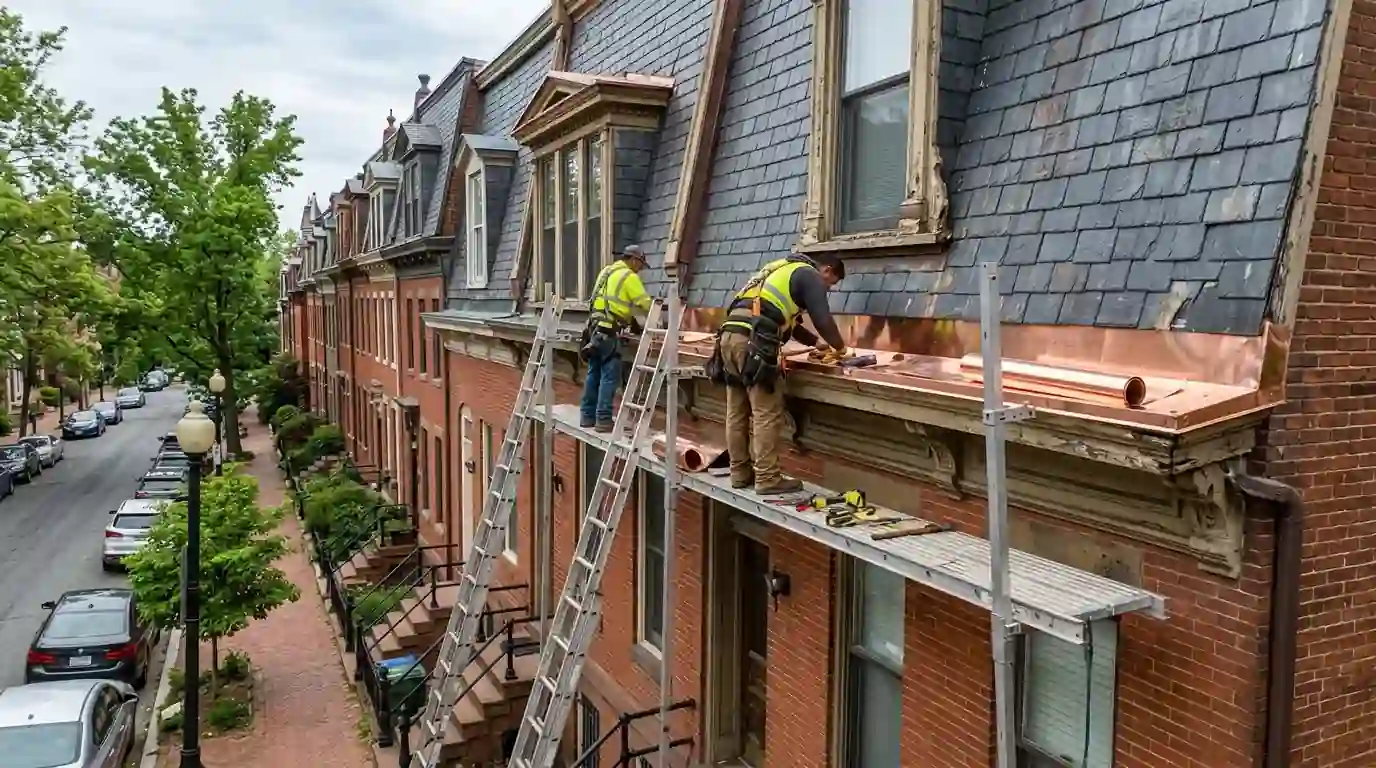
Many Mount Pleasant rowhouses have a built-in gutter sitting behind the front cornice, lined with tin or copper when the house was built. Over decades, the lining splits at the seams, gets patched with tar and starts holding water instead of moving it. The leak shows up inside the front wall or along the top of the bay window.
We strip the old lining down to the wood trough, replace rotted boards and reline in soldered copper or a fully adhered membrane, depending on what the preservation staff expects and what you prefer. A new outlet and downspout connection at the end of each run finishes it. Our box gutter repair page shows how the relining goes together.
Victorian rows near Mount Pleasant Street carry slate on short front mansards, while Wardman-era porch-front rows to the north have low-slope porch roofs and simple cornices. Both styles share flat main roofs that drain to the rear, often toward alleys that drop steeply downhill.
The neighborhood's early twentieth century apartment buildings, some with decorative cornices along Park Road and Mount Pleasant Street, have larger flat roofs with internal drains. Those buildings usually need drain cleaning, curb flashing and membrane work planned with a condo board or building manager. We cover that in our multifamily roofing work.
Steep alleys behind Hobart Place and Irving Street make debris trailers hard to park. We often stage from the uphill end, lower debris by rope and carry roll goods by hand. Homes backing onto Rock Creek Park sit under tall trees, so gutters and scuppers there fill with leaves every fall and need clearing before winter. Where a downspout runs into an old terra cotta drain at the base of the wall, we check that it still flows, since a blocked boot backs water up into the gutter above.
Mount Pleasant is a designated historic district, and visible roof work goes to preservation staff.
Built-in cornice gutters lined with old tin are a frequent source of front wall leaks.
Victorian rows, Wardman porch-fronts and early apartment buildings share the same steep blocks.
Steep grades mean some rear slopes are visible from the street below, which affects approval.
Homes near Rock Creek Park sit under heavy tree cover that clogs gutters and scuppers.
Relining and rebuilding the built-in box gutters hidden behind DC rowhouse cornices, plus the rotted wood, outlet tubes and downspouts around them.
Box Gutter Repair detailsSlate repair for Victorian mansards, turrets and steep DC roofs: broken slates replaced with copper hooks or nail-and-bib, plus valley and flashing rebuilds.
Slate Roof Repair detailsTear-off and new low-slope roofs for rowhouses and flats, with tapered insulation for ponding, new parapet flashing and reflective cool roof membranes.
Flat Roof Replacement detailsRepairs to the steep slate fronts of Victorian and Second Empire rowhouses: slipped and broken slates, rusted nails, dormer cheeks, built-in gutters and the flat-to-mansard joint.
Mansard Roof Repair detailsShared roofs on condo buildings, co-ops and small apartment buildings repaired or replaced with clear reports for boards and simple notices for residents.
Condo and Multifamily Roofing detailsLeaking seams, sagging runs, crushed downspouts and clogged alley tie-ins fixed on the spot, so you keep sound gutters instead of replacing them early.
Gutter Repair detailsSince the lining sits inside the gutter and is mostly hidden, membrane relining is often acceptable. Visible profiles and cornice trim should match the original. We confirm with staff for your address.
Yes. Visibility from any public street counts, so a rear roof seen from below may need the same filing as a front slope. We check sight lines on the first visit.
In-kind repairs often clear in days to a couple of weeks. Material changes or new features can take longer. We start the filing early so the roof work is not held up.
Yes, including drains, parapets and full membrane replacement. Call (202) 771-7443 to set up a walk-through with your building manager.
Call any hour. We answer 24/7 and tell you when a roofer can be at your house.