Water sheets over the front edge
Rain pouring over the lip in a steady curtain, even in a moderate storm, means the trough or the outlet is blocked.
Gutters, trim and commercial
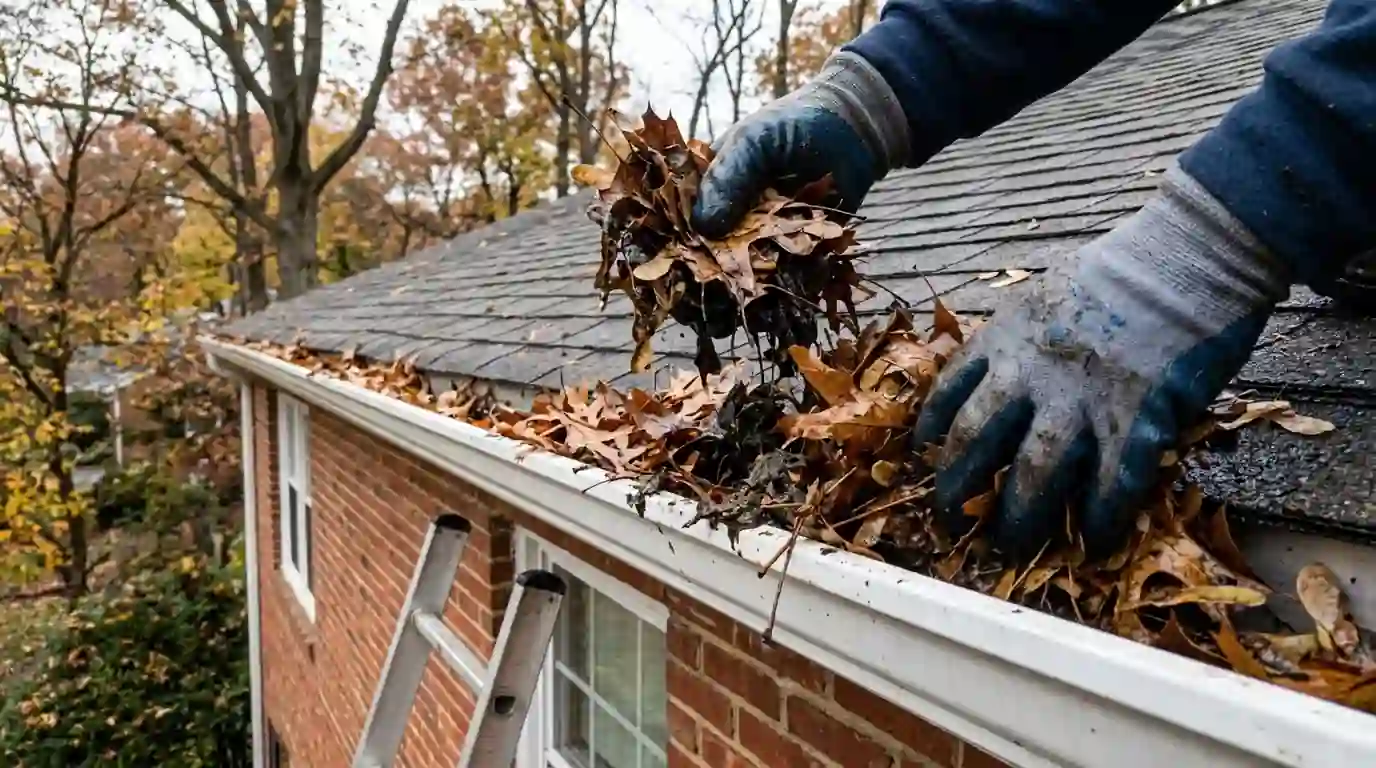
Gutters full of wet leaves stop being gutters. Once the troughs fill, rain spills over the front edge, soaks the fascia and lands right where your foundation meets the soil.
Materials we install
Gutter cleaning means emptying the troughs by hand, flushing every downspout, clearing conductor heads and elbows, and checking that hangers, seams and outlets still work. Most homes around Washington need it once in late fall after leaf drop and again in spring for seeds and catkins. A typical visit runs about $165-$465, with steep, tall or heavily wooded houses costing more.
Rain pouring over the lip in a steady curtain, even in a moderate storm, means the trough or the outlet is blocked.
Grass, maple seedlings or moss along the trough mean there's been a layer of wet sludge sitting there for at least a season.
If the gutter overflows while the downspout barely trickles, the clog is in the outlet, an elbow or the ground boot.
Packed wet leaves can weigh several pounds per foot, and that load bends hangers and pulls screws loose.
Dark streaks on siding, mud splashed on the foundation or a trench worn in the mulch all point to overflow.
Standing water on the rear of a flat roof a day after rain usually means the scupper or head is plugged.
Upper Northwest has some of the heaviest canopy in the region. Streets in Chevy Chase DC, the Palisades and Spring Valley sit under old white oaks, red maples and tulip poplars that can top 90 feet, and the same is true of older lots in Bethesda, McLean and Takoma Park. One mature oak can drop enough leaves to fill a 40-foot gutter run twice over.
Different trees clog gutters in different ways. Willow oak leaves are small and narrow, so they pack down into a dense mat that water can't pass through. Maple leaves are broad and slide toward the outlet, where they plug the downspout in a single wad. Tulip poplars shed seed cones that break apart into hundreds of papery pieces through the winter.
Then there's the grit. Asphalt shingles shed granules every time it rains, and that sand settles under the leaves. After a few seasons it forms a layer of sludge that holds water against the gutter bottom, adds weight to the hangers and gives seedlings a place to sprout.
Timing matters more than most people think. Oaks around Washington hang on to their leaves late, and many don't finish dropping until early December. A cleaning in mid-October looks great for two weeks, then the gutters fill right back up before the first freeze.
We schedule most fall cleanings from mid-November into the second week of December, once the bulk of the canopy is down. That gets the gutters clear before winter, when packed leaves freeze in place and turn the trough into a dam that pushes meltwater back under the roof edge.
The second visit belongs in late spring. Oak catkins, maple helicopters, poplar blossoms and pine pollen all come down from April into May, and they're lighter than leaves but clog downspout screens just as well. Houses with only a street tree or two can often skip the spring round; houses under a full canopy usually can't.
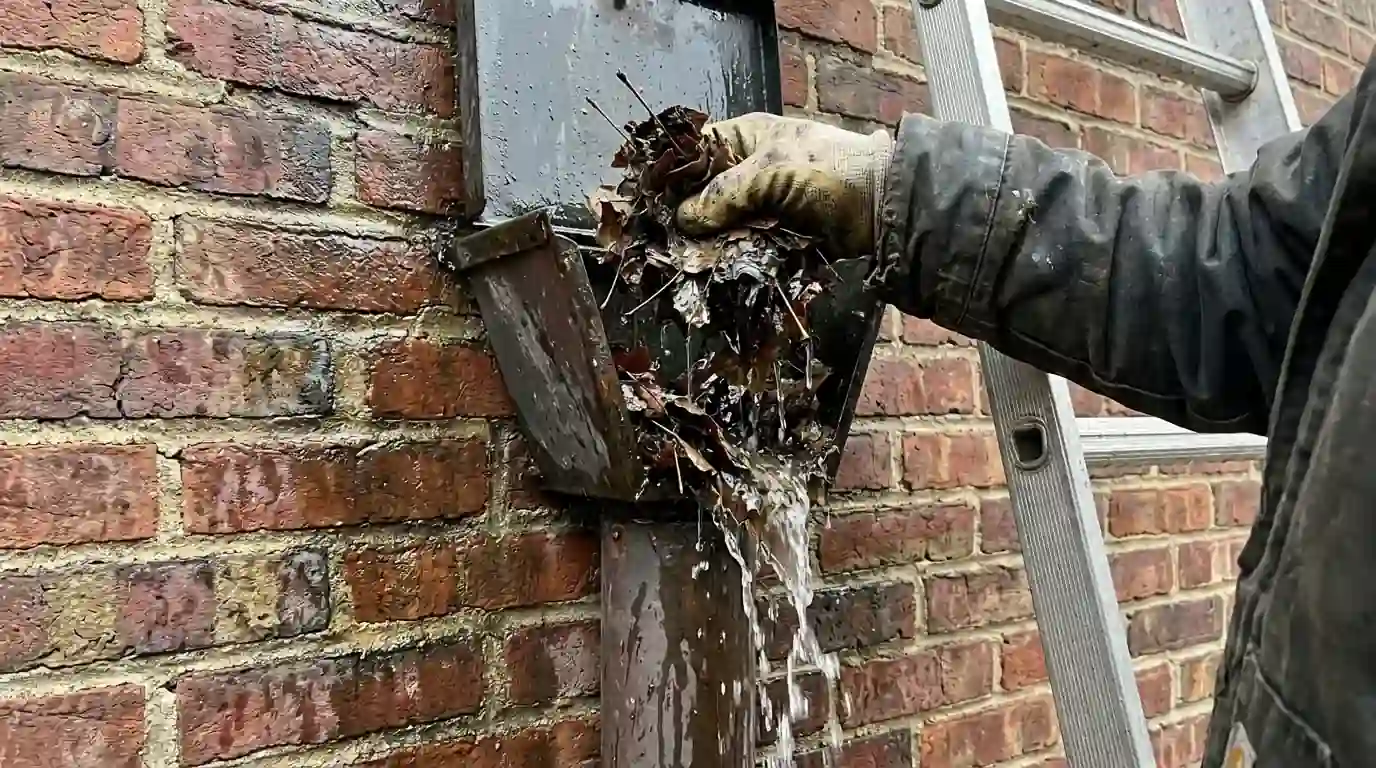
We clean gutters by hand, not with a leaf blower aimed at the roof. Blowing wet debris out of a trough sprays it across the siding, the windows and your neighbor's car, and it leaves the fine sludge behind. Hand scooping gets the troughs down to bare metal.
Every visit covers the same list, and you'll get photos of anything that needs attention:
Rowhouses drain differently from detached homes. The main roof usually slopes to the back, so a single rear gutter or a scupper and conductor head handles all the water from the slab. On a three-story house that gutter can sit 35 feet above an alley that's too narrow for a long extension ladder at a safe angle.
On those houses we reach the gutter from the roof, either through your roof hatch or by ladder from a lower rear addition, and we work along the edge on a tie-off. Where the alley is wide enough and the gutter is only two stories up, we clean from a ladder at ground level, which goes faster and keeps foot traffic off an older membrane.
Conductor heads are the clog we see most on rowhouses. A single fistful of leaves from an alley ailanthus or a neighbor's maple can seal the outlet, and then the whole roof ponds until the water finds a seam. We pull the debris out of the head, run water through the leader below it and check the strainer basket.
Built-in gutters hidden behind a pressed metal or wood cornice collect silt and leaves just like hanging gutters, but they're easy to forget because you can't see them from the street. On many Victorian rowhouses the front box gutter only gets cleaned when it overflows into the front bedroom.
We clean these by hand from the roof side with plastic scoops, because a metal trowel can punch through a thin old tin lining. While the trough is empty we look at the lining, the solder seams and the outlet tube. If the bottom shows rust pinholes or the seams are open, that's a job for box gutter relining, not something another cleaning will fix.
An empty gutter tells you a lot. Once the leaves are out and water is running, sagging spans show up as standing puddles, and leaking corners drip where you can see them. Rot along the fascia board shows up as soft wood under the back edge of the trough.
Small fixes, like driving a loose hanger screw or resealing a single end cap, we usually handle during the visit and note on your photos. Anything bigger gets priced separately so you can decide. Sagging runs, split seams and rusted sections go to our gutter repair work, and we'll tell you if a run is past fixing.
If you're cleaning the same gutters three or four times a year, it may be time to stop fighting the trees. A good micro-mesh guard won't end upkeep entirely, but it cuts it down a lot under heavy oak and poplar cover. Our page on gutter guards for wooded lots explains which types hold up here. To schedule a cleaning, call (202) 771-7443.
Price depends mostly on height, total gutter length, roof pitch and how much debris is up there. These are typical ranges for the DC area in 2026.
| Job | Typical range |
|---|---|
| One-story home, up to about 140 feet of gutter | $165-$295 |
| Two-story colonial or split-level, light to medium leaves | $235-$465 |
| Rowhouse rear gutter and conductor head, cleaned from the roof | $185-$385 |
| Front box gutter behind a cornice, hand cleaned | $215-$440 |
| Three-story or steep roof under heavy oak or poplar canopy | $395-$745 |
| Underground drain line jetting, added to a visit | $105-$265 |
Gutters that haven't been touched in several years take longer, and slate or steep roofs add safety setup time. We'll give you a firm number once we've seen the house and the gutters.
We look at the roof type, gutter height and access points, and decide whether to work from ladders or from the roof.
Tarps go over plantings, walkways and air conditioning units under the work area to catch anything that falls.
Each trough gets emptied down to the metal, and the debris goes into bags, not onto your lawn.
We run a hose through every section and down every leader, clearing elbows and boots until water flows freely.
While water is running, we watch seams, corners and hangers, tighten what's loose and note anything that needs real repair.
You get before and after photos of each side, and we take the bags with us when we leave.
Under a full oak or tulip poplar canopy, plan on two cleanings: one after the leaves finish falling in late November or early December, and one in late spring. Houses right against a wooded park edge sometimes need a third visit in early fall. A house with one street tree can usually get by with a single cleaning each year.
Often, yes. If the alley gives us room to set a ladder safely, or there's a lower rear addition to step up from, we never need to come inside. When the only way up is a roof hatch, we'll ask to use it and lay drop cloths along the path.
We bag it and take it with us. If you'd rather keep the leaves for compost, tell us and we'll leave the bags by your bin.
If a clean gutter still overflows, the problem is usually a blocked underground drain, a gutter that's pitched away from the outlet, or a gutter that's too small for the roof area above it. We test the downspout and the ground connection during every cleaning so you'll know which one it is.
It is when nobody walks on the slate. We work from ladders or ladder standoffs that rest on the gutter and wall, never on the roof surface, since a single footstep can crack old slate. That setup takes a little longer, which is why slate houses sit at the higher end of the price range.
These are the places we drive to most for this work. We cover all 45 areas on our service area list.
Leaking seams, sagging runs, crushed downspouts and clogged alley tie-ins fixed on the spot, so you keep sound gutters instead of replacing them early.
Gutter Repair detailsStainless micro-mesh and solid-hood guards fitted for oak, tulip poplar and pine cover, so the gutters keep flowing between cleanings.
Gutter Guards detailsRelining and rebuilding the built-in box gutters hidden behind DC rowhouse cornices, plus the rotted wood, outlet tubes and downspouts around them.
Box Gutter Repair detailsSpring and fall roof visits that clear gutters and drains, reseal flashing and vents and catch small failures before they turn into ceiling stains.
Roof Maintenance detailsCall and a roofer will answer, any hour of any day. We stop the leak first and fix it properly once the roof is dry.