Turrets and towers
Corner and mid-block turrets with slate, metal or copper caps are signature features and common leak points.
Washington, DC neighborhoods
Bloomingdale has some of the most photographed rowhouses in the city, with rounded turrets and corner towers along First Street and Rhode Island Avenue NW. When a summer cloudburst dumps an inch of rain in an hour, those towers and the flat roofs behind them get tested hard.
Most Bloomingdale leaks show up during heavy downpours, when rear scuppers and downspouts cannot keep up and water backs up against parapets and turret bases. Fixes include enlarging scuppers, adding overflow drains and reflashing turret caps. Drain and scupper work often runs $890-$2,740; turret cap repairs are typically $1,350-$4,960, depending on material and height.
Bloomingdale sits low compared with the ridge to the north, and the neighborhood has a long history of storm flooding at street level. On the roofs, the problem is volume. A typical rowhouse roof here drains through one rear scupper into a leader box and downspout sized decades ago. In a short, intense storm, that outlet backs up, water rises against the parapet and finds every gap in the base flashing.
We start storm-related visits by running water across the roof with a hose to watch where it goes. Low spots, a crushed leader box or a scupper half blocked by old patching usually explain the leak. Enlarging the scupper, setting a new leader head and adding a secondary overflow at the side wall gives the roof somewhere to send water when the main outlet is overwhelmed. Our drain and scupper repair page explains sizing and placement.
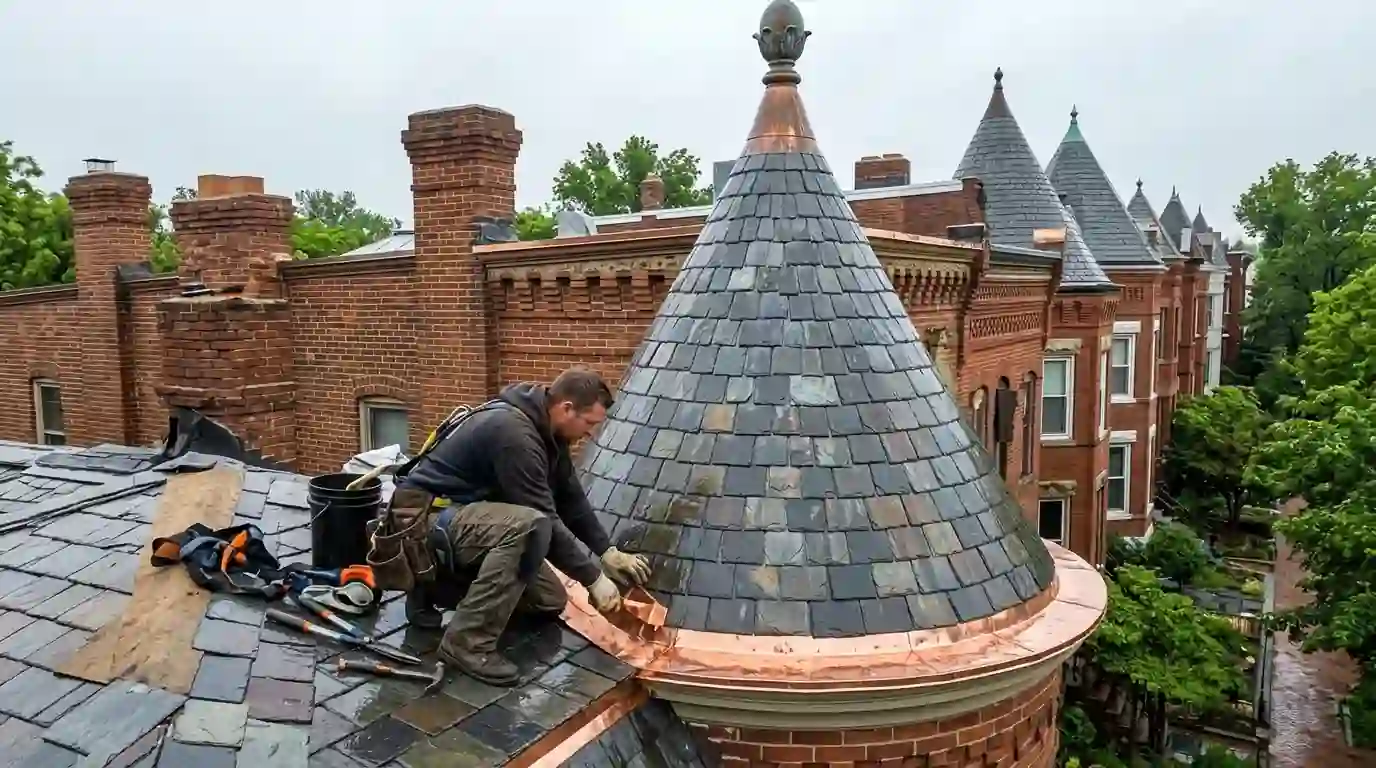
The conical and polygonal turret roofs that give Bloomingdale its look are often clad in slate, pressed metal or copper. Each one has a finial at the top and a curved transition at the base where it meets the flat roof. Both spots crack and open over time, and wind-driven rain gets in.
Curved roofs need small pieces, hand-bent flashing and patience. We remove loose slates or metal shingles near the failure, reflash the base with lead-coated copper and reset the finial on a new collar. When a turret cap needs full replacement, copper roofing formed in tapered panels is the long-lasting choice and suits the style of the block.
Street trees here are smaller than in Upper Northwest, but summer thunderstorms still bring down branches onto porch roofs and bay tops. After a storm, we tarp damaged areas the same day and document the damage with photos for insurance. If your adjuster needs a written scope, our insurance claim roof help covers what we provide.
Wind is the other storm hazard. Gusts that roll up from the south across the open ground around the McMillan reservoir site catch loose membrane edges and peel back metal drip trim at the front cornice. Once an edge lifts, the next storm gets under it. We refasten edge metal with a continuous cleat and seal the membrane to it so the roof holds as a single piece.
Most Bloomingdale roofs can handle ordinary rain. Preparing for the heavy summer storms is a short list of practical steps, and most of them cost far less than repairing ceiling plaster after a leak.
Our crew can do all of these during one visit, usually in a morning, working from the rear alley with a ladder and a small hoist. Many blocks between Rhode Island Avenue and Channing Street have alleys that fit a pickup.
Corner and mid-block turrets with slate, metal or copper caps are signature features and common leak points.
Curved front bays end in small roofs whose base flashing works loose with age.
Most flat roofs drain through one undersized scupper, which overflows in heavy rain.
Bloomingdale is not on DC's list of designated historic districts, so roof work goes through a standard DOB permit.
Brick rows from about 1890 to 1915 share parapets and continuous roof lines.
Leaking scuppers through rowhouse parapets, rusted conductor heads and clogged internal roof drains rebuilt so flat roofs empty fast after a storm.
Roof Drain and Scupper Repair detailsRepairs after thunderstorm gusts, nor'easters, hail and fallen limbs: lifted membrane, creased shingles, cracked slate, torn flashing and punctured decking around DC.
Storm Damage Roof Repair detailsSoldered and standing seam copper for bay roofs, turrets, dormers, cupolas and entry roofs, plus copper valleys, caps and built-in gutter liners.
Copper Roofing detailsLow-slope roof repair for DC rowhouses and additions: modified bitumen, EPDM, TPO and coated roll roofing, plus ponding areas, curbs and parapet base flashing.
Flat Roof Repair detailsWe trace roof leaks from the ceiling stain back to the real entry point, then fix that cause: seams, flashing, vent boots, skylights, parapets and drains.
Roof Leak Repair detailsSlate repair for Victorian mansards, turrets and steep DC roofs: broken slates replaced with copper hooks or nail-and-bib, plus valley and flashing rebuilds.
Slate Roof Repair detailsThat pattern usually points to a drainage limit, not a hole. Water backs up when the scupper cannot keep pace and rises above the flashing. Enlarging the outlet or adding an overflow typically solves it.
Yes. Turret caps are separate small roofs, and we work on them from a ladder or a small scaffold. We check the flat roof joint at the base at the same time.
Slate and painted metal shingles are also common and look right on these houses. Copper costs more but lasts longest and needs the least upkeep.
We answer 24/7 and will tarp or patch as soon as it is safe to be on the roof. Call (202) 771-7443.
Call any hour. We answer 24/7 and tell you when a roofer can be at your house.