Cleaning more than twice a year
If you or a crew clear the gutters every season, guards cut that work to a quick inspection.
Gutters, trim and commercial
If you're on a ladder every fall pulling wet oak leaves out of your gutters, and again in spring for the maple seeds, the trees are winning. The right guard keeps most of that out so the water reaches the downspouts.
Materials we install
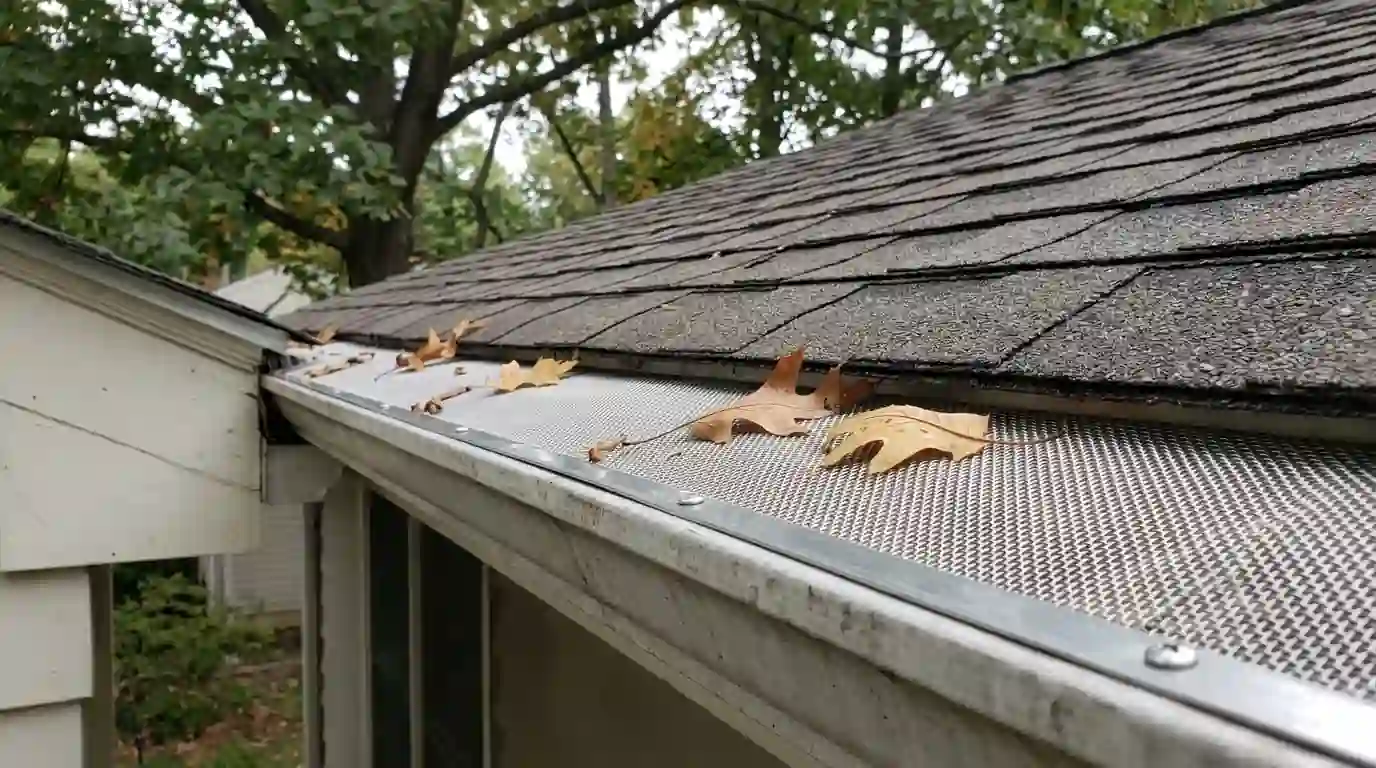
Gutter guards are covers fitted over the gutter trough that let rain in and keep leaves, needles and seed pods out. They earn their cost on houses under heavy tree cover where gutters clog more than once a year. Around Washington, DC, quality stainless micro-mesh guards typically run $9-$17 per linear foot installed, and the final price depends on gutter condition, roof type and height.
If you or a crew clear the gutters every season, guards cut that work to a quick inspection.
Needles slip past basic screens and knit together in elbows, so they call for fine mesh.
Plants sprouting in the trough mean the debris sits wet for weeks at a time.
Gutters that work fine all summer but spill in October are telling you leaves are the problem, not size.
Frozen leaf packs in the gutter help ice build at the roof edge where meltwater can back up.
Two-story and steep roofs make ladder cleaning risky, and guards reduce how often anyone climbs.
Not every house does. A rowhouse on a treeless block in Trinidad or Eckington may only see a handful of leaves blown in from the street, and a cleaning once a year handles that for far less money. We'll say so if that's your situation.
The math changes under big canopy. Upper Northwest streets around Chevy Chase DC and Tenleytown, older lots in Bethesda and Arlington, and wooded subdivisions in Fairfax and Burke sit under oaks, tulip poplars, maples and white pines. Those gutters can fill in a single October week, then pack again with helicopter seeds in May.
A clogged gutter does more harm than people expect. Overflow soaks the fascia and soffit, runs down the siding, and pools at the foundation. In winter, a gutter full of frozen leaves helps ice build at the eave, which can force meltwater back under the shingles.
Stainless steel micro-mesh over a rigid aluminum frame is what we install most. The mesh is fine enough to stop pine needles and the gritty shingle granules that wash off asphalt roofs, and the frame keeps it from sagging under a wet load of leaves. It handles the heavy downpours we get in July without much overshoot.
Solid surface or reverse-curve hoods rely on water sticking to a rounded nose and wrapping into the gutter. They shed leaves well, but in a hard storm on a steep roof some water sails right past. We fit them mainly where the roof pitch is low and the debris is mostly large leaves.
Snap-in plastic screens and foam inserts sold at big box stores are cheap, but they warp in summer sun, hold onto pine needles and turn into a second layer of clogging. We pull a lot of them off houses before fitting something that lasts.
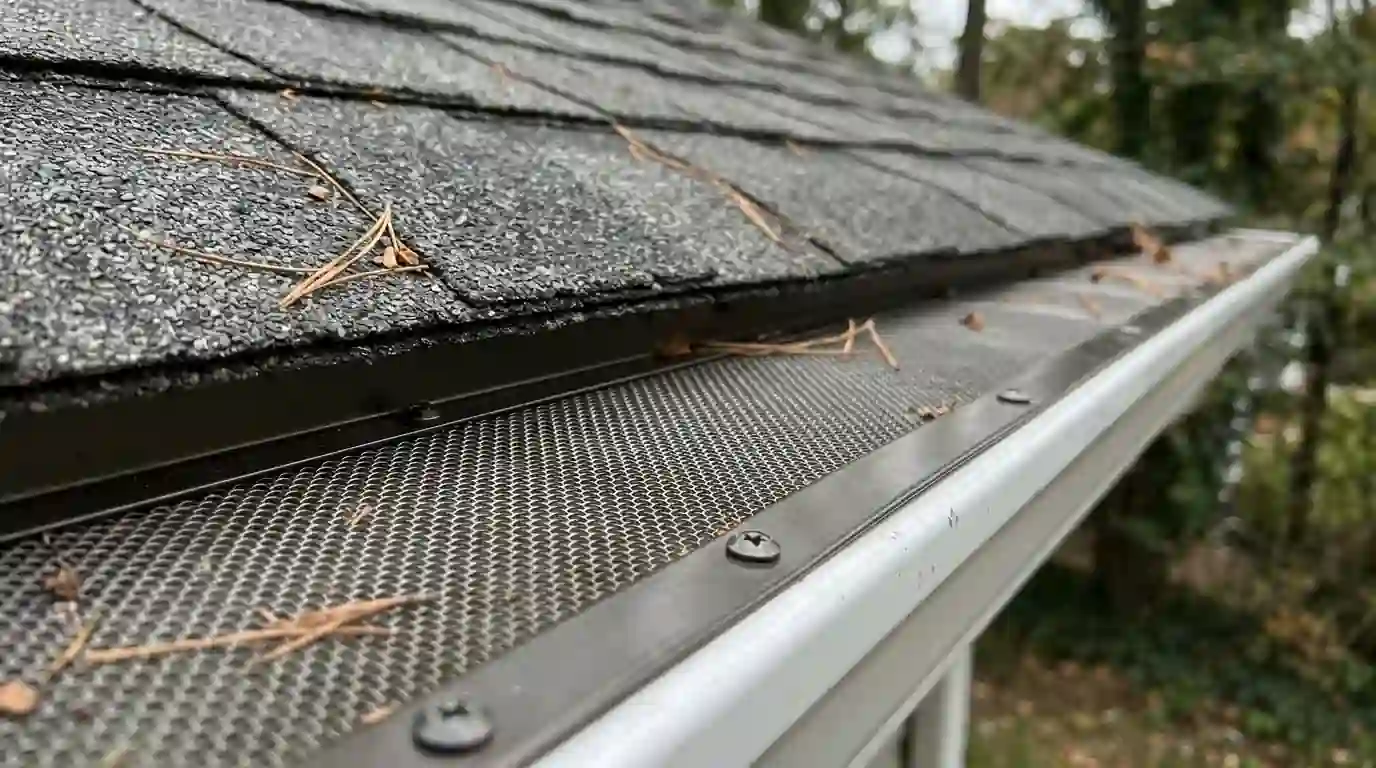
Good micro-mesh guards slide under the first course of shingles at the back edge and screw to the front lip of the gutter. We lift the shingle tab gently with a flat bar so the sealant strip isn't torn, and we never nail through the shingles to hold the guard down. Done carelessly, that back-edge detail can void a shingle warranty or start a leak.
On slate and tile roofs we use a guard that fastens to the gutter only, with no part going under the roofing. Lifting slate to tuck a guard under it cracks pieces, and those slates are often a century old. Standing seam metal gets a similar gutter-mounted guard set below the panel drip.
Before any guard goes on, the gutter has to be sound and pitched correctly. A guard on a sagging, leaking run just hides the problem. If the troughs need work first, we'll handle the gutter repairs during the same visit.
Rowhouses get a different treatment. The rear gutter on a Capitol Hill or Bloomingdale house often catches debris from a single street tree or an alley ailanthus, plus whatever blows across the flat roofs next door. A short run of mesh over that one gutter costs little and keeps the downspout boot below from packing with leaves.
Where the roof drains through a parapet opening into a conductor head, we fit a domed strainer or a mesh cap over the head instead of a gutter guard. Those strainers sit at the outlet where clogs actually happen, and we can reach them from the roof during routine checks. A blocked head on a flat roof backs water up against the parapet, which is a far bigger problem than an overflowing eave gutter.
No guard ends gutter upkeep for good. Pollen, maple flowers and fine dust can form a mat on top of micro-mesh, especially under oaks in spring. A soft brush on a pole, or a light rinse from the ground, usually clears it. Most homeowners with good guards go from four cleanings a year to a quick check once or twice.
Guards also don't fix undersized gutters. If water overflowed a clean 5-inch gutter before, it will still overflow with a guard on top. In that case, upsizing the gutter and downspouts comes first and the guard follows.
We include a guard check in our roof maintenance visits, so the mesh gets brushed off when we're already on the roof. Call (202) 771-7443 and tell us what trees hang over your house; it tells us most of what we need to know.
Prices below are typical 2026 installed ranges in DC, Maryland and Northern Virginia, including cleaning the gutters first.
| Job | Typical range |
|---|---|
| Stainless micro-mesh, per linear foot | $9-$17 |
| Reverse-curve hood, per linear foot | $11-$19 |
| Rowhouse rear gutter, mesh guard installed | $265-$585 |
| Average two-story colonial, mesh guards | $1,385-$2,940 |
| Gutter repairs before guards, per visit | $225-$615 |
Height, the number of corners and valleys, slate or tile roofing and any gutter repair needed first push the price up. We measure and look at the gutters before giving you a number.
We identify the debris you get, the roof covering and the gutter size before picking a guard.
The troughs and downspouts are emptied and flushed so nothing is trapped under the new guard.
Loose hangers, bad seams and sags are corrected first, since a guard should sit on a working gutter.
Guards are cut to length, notched at corners and miters, and fitted around downspout outlets.
Mesh tucks under the first shingle course or mounts to the gutter only on slate, tile and metal.
We run water across the guard to confirm it drains into the gutter instead of overshooting.
Yes, fine stainless mesh stops needles from entering the gutter, which is where cheaper screens fail. Needles can rest on top of the mesh until wind or rain moves them along, and a light brushing once a year clears what stays.
They can. On slate we use guards that fasten to the gutter itself, front lip and back edge, with nothing slid under the slate. That keeps old, brittle slates from cracking.
Good mesh guards take in a large volume of water and rarely overshoot. Hood-style guards can lose some water on steep roofs in a downpour. We match the guard type to your roof pitch for that reason.
In most cases, yes, as long as the gutters are pitched correctly and the seams don't leak. We fix those problems first so the guard sits on a sound trough.
They help a little by keeping frozen leaf packs out of the gutter. Ice dams mainly come from heat escaping the attic, so ventilation and insulation do more of the work.
These are the places we drive to most for this work. We cover all 45 areas on our service area list.
Seamless gutters formed on site and sized for DC rowhouse rear roofs and tree-heavy lots, with downspouts routed where the water can actually go.
Gutter Installation detailsLeaking seams, sagging runs, crushed downspouts and clogged alley tie-ins fixed on the spot, so you keep sound gutters instead of replacing them early.
Gutter Repair detailsSpring and fall roof visits that clear gutters and drains, reseal flashing and vents and catch small failures before they turn into ceiling stains.
Roof Maintenance detailsAttic and roof cavity ventilation for DC rowhouses and suburban homes: ridge and soffit vents, baffles, bath fan ducting and fixes for winter condensation.
Roof and Attic Ventilation detailsCall and a roofer will answer, any hour of any day. We stop the leak first and fix it properly once the roof is dry.