Ponding near the outlet
Water standing two days after rain, close to a drain or scupper, means the outlet is blocked or set too high.
Gutters, trim and commercial
When a flat roof can't get rid of water fast enough, it backs up against the parapet, finds every weak seam and ends up in the top-floor ceiling. The fault is usually at the outlet: a scupper, a drain bowl or a conductor head that's clogged, rusted or poorly flashed.
Materials we install
Roof drain and scupper repair fixes the openings that let water off a low-slope roof: scuppers cut through parapet walls, internal drains in the roof field and the conductor heads and leaders that carry water down. You need it when water ponds near an outlet, leaks show up below one or the metal is rusted through. Most DC repairs run $465-$2,340 per outlet, depending on what we find under the membrane.
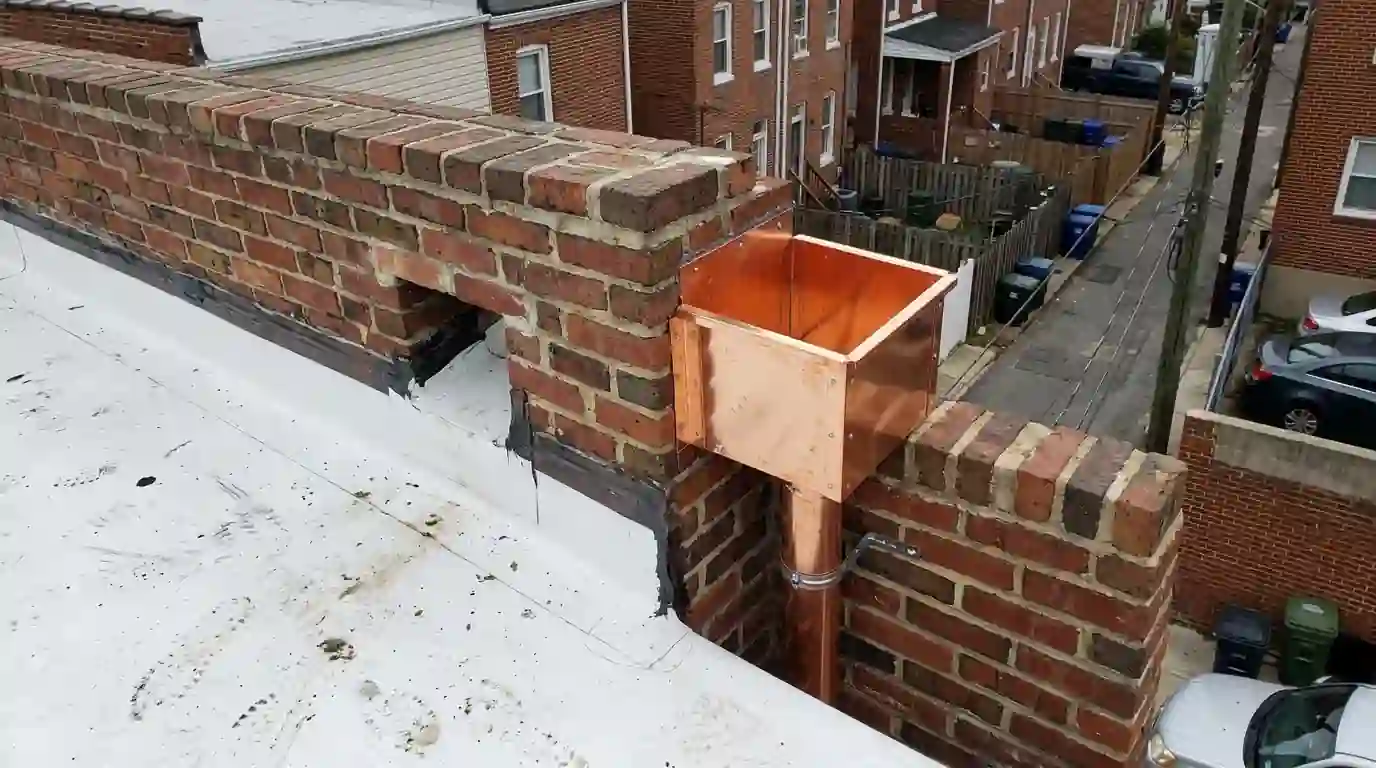
Most DC rowhouse roofs slope gently from front to back. Water runs toward the rear wall and leaves through a scupper, a rectangular opening through the back parapet, into a conductor head bolted to the brick. From there a leader pipe carries it down to the yard, the alley or an underground line. On houses without a rear parapet, the roof edge drains straight into a hanging gutter instead.
Larger rowhouses, corner buildings and apartment buildings often have internal drains instead: a cast iron drain bowl set into the roof with a clamping ring and a strainer dome, connected to a pipe that runs down inside the building. Churches and small commercial roofs may have both, with overflow scuppers set slightly higher than the main drains as a backup.
Every one of these outlets is a hole through the waterproofing. That's why they leak more often than the open field of the roof, and why we look at them first on any flat roof repair call.
A scupper is a metal box lined through the wall, with flanges that lap onto the roof membrane and onto the face of the brick. Old scuppers were often galvanized steel or lead-coated copper set in tar, and decades later the solder joints have opened and the tar has cracked. Water running through the box drops into the wall cavity instead of out the other side.
We also see scuppers that are simply too small. A 4-inch opening may have been fine for the original roof, but after a deck or a rear addition was added, more roof area drains through it. In a July cloudburst it can't keep up, and water rises over the membrane flashing at the parapet base. Widening the opening or adding a second scupper solves that.
Brick around the scupper suffers too. Water that misses the conductor head runs down the wall, washes out mortar and stains the brick white. When the masonry is that far gone, we coordinate with parapet and coping repair so the wall and the outlet are fixed together.
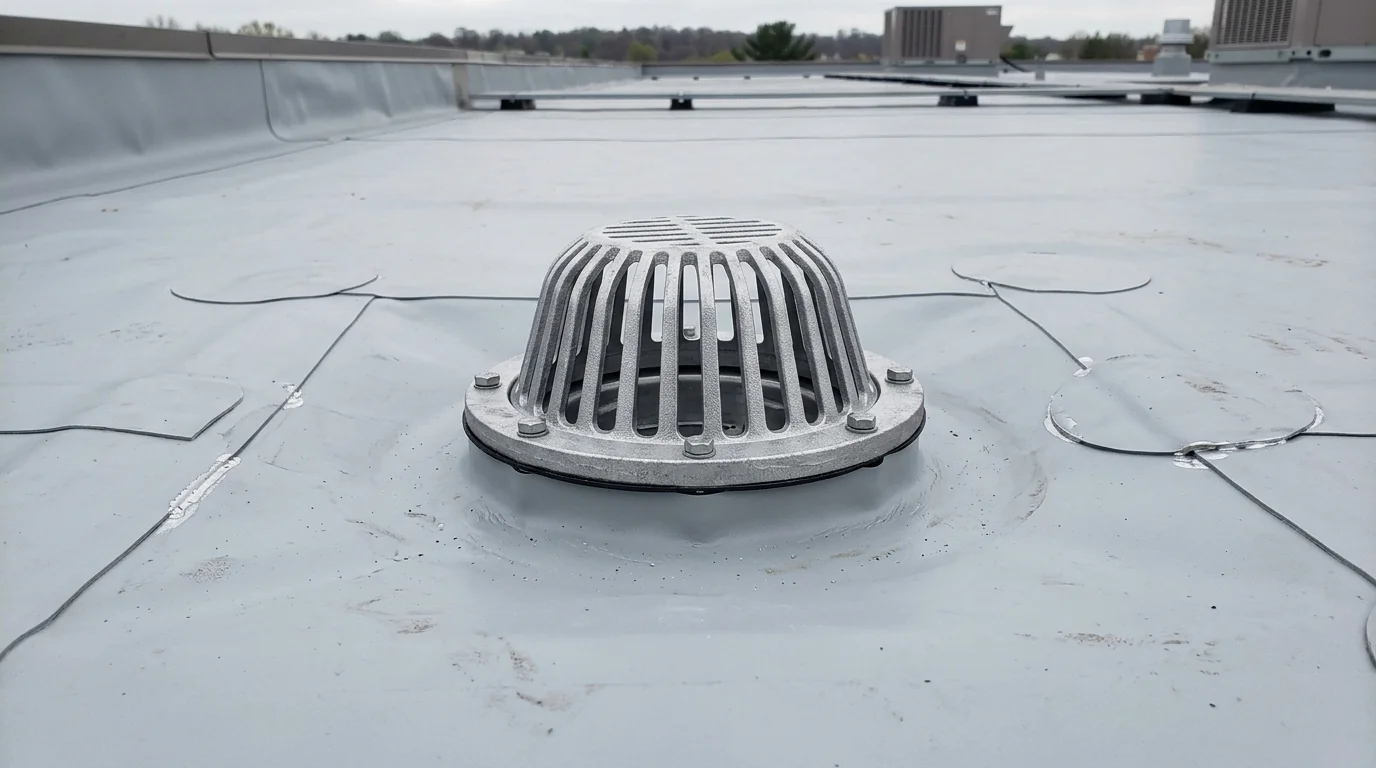
Internal drains fail in a few predictable ways. The clamping ring that squeezes the membrane against the drain bowl loosens or rusts, letting water slip under the roof. The strainer dome goes missing, and leaves and gravel wash into the pipe. Or the roof around the drain has sagged, leaving the drain sitting higher than the puddle it's supposed to empty.
When we replace a membrane at a drain, we lower the bowl area with tapered insulation, called a sump, so water flows toward it from every side. We set the new membrane in sealant on the bowl flange, torque the clamping ring evenly and add a cast aluminum or iron strainer dome. Retrofit drain inserts with their own built-in clamp work well when the old bowl is cracked and can't be removed without opening the ceiling below.
If water backs up out of the drain rather than draining down, the problem is in the pipe below the roof. We'll scope what we can reach from the top and tell you if a plumber needs to clear the line from inside the building.
The conductor head is the box on the outside of the wall that catches water from the scupper. Rust, a clogged outlet or a head that's too shallow will spill water over its sides and down the brick. We replace rusted heads with heavier-gauge aluminum or copper boxes sized to the scupper, with a mesh screen to keep leaves out of the leader.
Leaders on DC rowhouses often run into cast iron or clay pipe at ground level. If that pipe is blocked, the head fills and overflows no matter how new it is, so we flush the line and check it during the repair. The same tie-in issues come up with rear gutters, which we cover on our gutter repair page.
Leaves blown from street trees, tennis balls, roof deck debris and loose gravel pile up at the low point of a flat roof, which is right where the outlet sits. A clogged scupper on a roof with a high parapet can hold several inches of water in a hard rain, and that weight sits on joists that weren't sized for it.
A quick clearing in late fall and early spring prevents most emergency calls. We include drain and scupper checks in every scheduled maintenance visit. If water is ponding on your roof right now, call (202) 771-7443 and we'll come clear the outlet and find the source of the leak.
Water standing two days after rain, close to a drain or scupper, means the outlet is blocked or set too high.
Orange streaks below the conductor head show the box or leader is rusting through.
Efflorescence around the scupper means water is soaking through the masonry instead of draining away.
On a rowhouse, a top-floor stain near the rear wall often traces straight to the scupper flashing.
A conductor head overflowing in normal rain is too small or clogged at its outlet.
An open drain bowl lets gravel and leaves into the pipe, where clogs are much harder to reach.
We clear the outlet and run water across the roof to watch how fast it drains and where it leaks.
The old membrane flashing is cut back so we can see the metal, the clamp and the deck around the outlet.
Rusted scupper boxes are replaced with soldered metal, and cracked drains get a retrofit insert.
Tapered insulation is added around the outlet so the surrounding roof slopes toward it.
New membrane is set into the outlet flange and heat-welded or torched to match the existing roof.
Conductor heads, screens and leaders are replaced, and the ground connection is flushed and tested.
Prices are typical for 2026 in the District and nearby suburbs and assume the roof membrane around the outlet can be tied into.
| Job | Typical range |
|---|---|
| Clear outlet and reseal flashing | $465-$865 |
| Rowhouse scupper box replacement through parapet | $1,185-$2,340 |
| Conductor head and leader replacement | $545-$1,290 |
| Retrofit internal drain insert with new flashing | $935-$1,960 |
| Add overflow scupper to an existing parapet | $1,385-$2,690 |
Copper versus aluminum, the parapet's masonry condition, the roof membrane type and wet decking under the outlet all move the price. We look at the outlet and the roof around it before committing to a number.
In a light rain, water passes through the box and away. In a downpour, water rises above the scupper's membrane flashing or overwhelms a small conductor head, finding gaps that sit dry the rest of the time. Enlarging the opening or reflashing higher on the wall usually solves it.
If your roof has a parapet on all sides and only one drain, an overflow is a smart backup. It sits slightly above the main outlet and lets water escape if the main drain clogs, rather than letting it build against the walls.
Usually it can. A retrofit drain insert slides into the old pipe and seals with its own gasket, then the new membrane clamps to the insert. That avoids opening the ceiling below to reach the old bowl.
Copper lasts longest and suits historic brick facades. Heavy-gauge aluminum costs less and works well on rear walls that aren't on view. Either way, we size the head to the scupper so it doesn't overflow.
These are the places we drive to most for this work. We cover all 45 areas on our service area list.
Low-slope roof repair for DC rowhouses and additions: modified bitumen, EPDM, TPO and coated roll roofing, plus ponding areas, curbs and parapet base flashing.
Flat Roof Repair detailsRepairs to the brick walls that rise above rowhouse roofs: loose coping, cracked caps, open mortar, failed through-wall flashing and the membrane where it meets the parapet.
Parapet Wall and Coping Repair detailsRelining and rebuilding the built-in box gutters hidden behind DC rowhouse cornices, plus the rotted wood, outlet tubes and downspouts around them.
Box Gutter Repair detailsSpring and fall roof visits that clear gutters and drains, reseal flashing and vents and catch small failures before they turn into ceiling stains.
Roof Maintenance detailsCall and a roofer will answer, any hour of any day. We stop the leak first and fix it properly once the roof is dry.