Rust holes or pinholes
Daylight through the metal or orange-edged holes mean the steel is perforated. Solder patches before the hole widens.
Rowhouse and specialty roofing
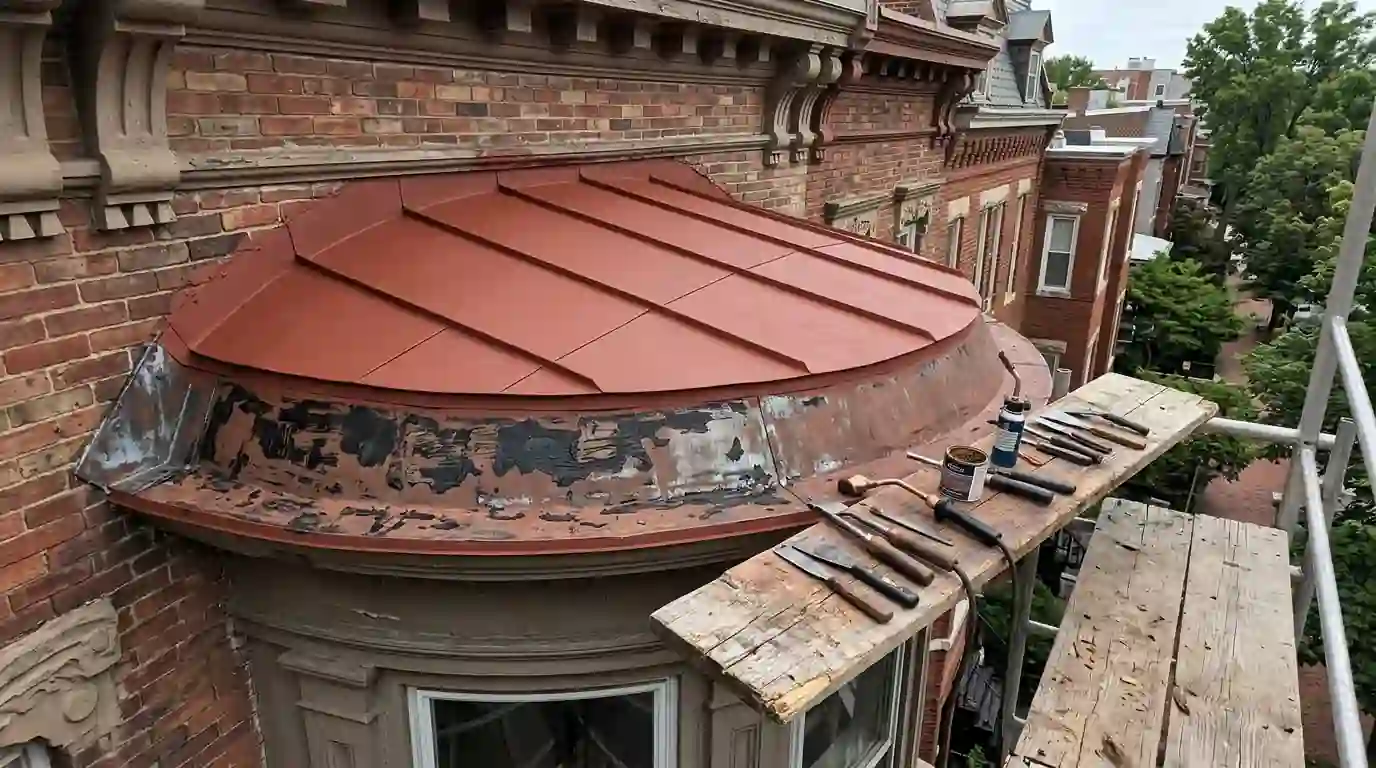
The small tin roofs over DC bay windows and front porches were built to be soldered and painted, not smeared with tar. When they rust or split, the right repair keeps the original metal working instead of burying it.
Materials we install
Metal roof repair covers soldered patches, seam work, refastening and repainting on tin, terne, galvanized, copper and standing seam roofs. It's needed when you see rust holes, open seams, loose panels or peeling paint on bay, porch, mansard or main roofs. Small soldered repairs often run $315-$690, while repainting a typical bay roof costs about $1,180-$2,460.
Plenty of Washington rowhouses have a projecting front bay, round or square, and the roof over that bay is often flat-seam tin or terne dating back to the original construction. Front porches on Wardman-era rowhouses in Petworth and Columbia Heights frequently have low-slope metal roofs too, as do porch roofs on Victorians in Mount Pleasant and LeDroit Park.
Steep metal shows up on turrets, mansard dormers and some main roofs on detached houses in Takoma Park and Chevy Chase. Newer standing seam roofs, painted steel or aluminum, cap additions and modern homes across the region.
Each type has its own repair method. Flat-seam tin is soldered. Standing seam panels are re-crimped and refastened at clips. Copper is soldered with a different flux and never painted.
Tin roofs are steel sheets with a thin metallic coating, and terne roofs use a similar alloy coating. Both depend on paint for long life. Once the paint wears through, rust starts at seams and low spots where water lingers, then eats pinholes through the sheet.
Small rust holes are cleaned to bright metal and soldered with a patch of the same material. Larger areas get a new sheet soldered in, with seams locked and folded the way the original was. We wire-brush or grind the surrounding rust, apply a rust-inhibiting primer made for metal roofs, and finish with a compatible topcoat.
Painting matters more than most owners expect. A well-kept terne roof can last a very long time, while a neglected one fails in a fraction of that. Most painted tin roofs we see need fresh paint every seven to ten years in DC sun.
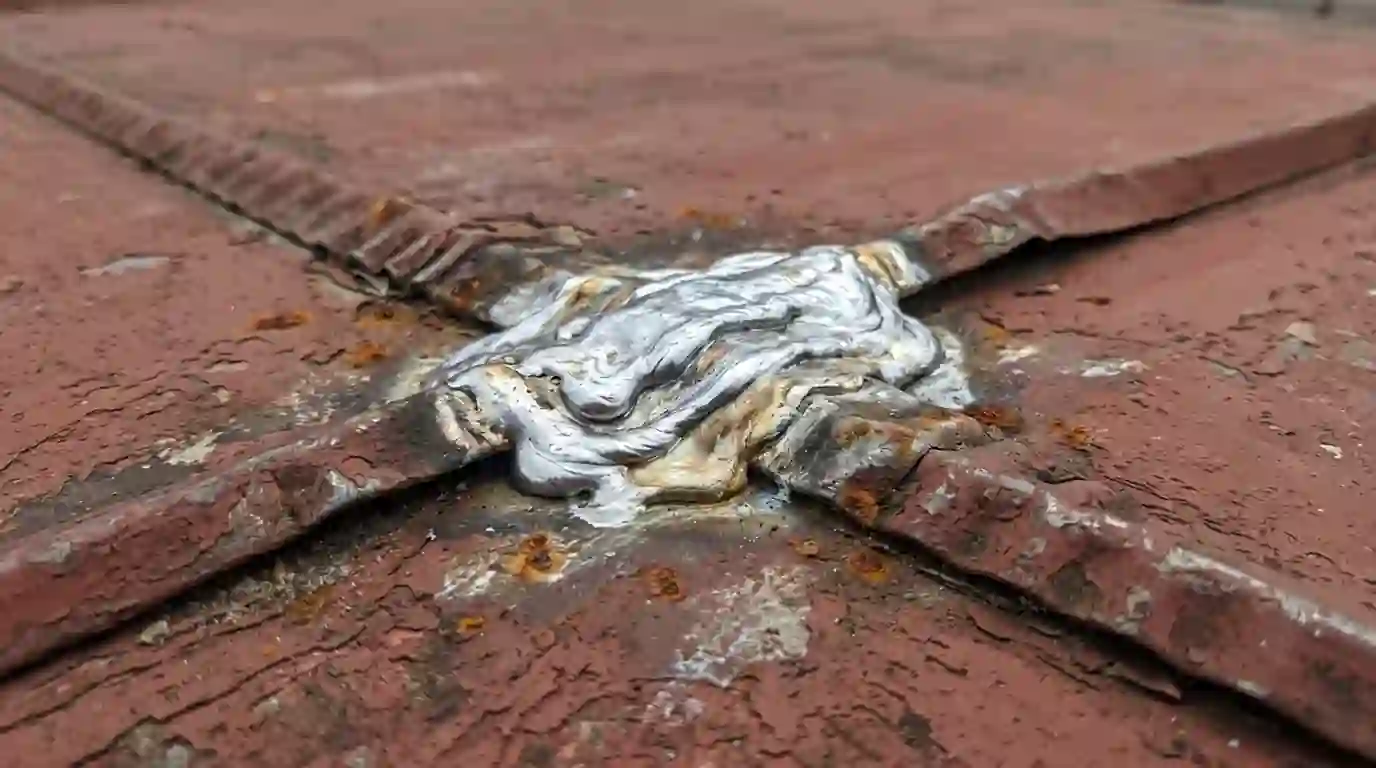
We find a lot of bay roofs and porch roofs buried under black roofing cement or silver-painted fabric. It seemed like a quick fix at the time. The problem is that asphalt holds moisture against steel, and as it cracks it funnels water straight into the rust it was meant to cover.
Repairing a tarred metal roof means scraping the asphalt off, which is slow, then judging whether the metal under it can be saved. Sometimes it can. Sometimes the tar has hidden so much rust that a new bay roof in terne-coated stainless or copper is the better spend.
If your metal roof has already been tarred, don't add another layer. Call us before the next bucket comes out.
Standing seam roofs fail in different ways. Panels can pull loose from their clips in high wind, seams can open where they were never fully crimped, and exposed-fastener metal roofs lose their screw washers over time, leaving open holes.
We re-seat panels on their clips, re-seam with hand or power seamers, and replace failed fasteners with new screws and EPDM washers. Snow guards, pipe boots and ridge closures get checked too, since those are common leak points. Where a panel is damaged beyond saving, we fabricate a new one in the same profile and color.
If the roof is past repair, our standing seam metal roofing page covers full replacement.
Most bay and porch roofs meet a brick wall at the back, where the metal turns up and gets a counterflashing set into the mortar. That joint often fails before the roof itself does, so we repoint and reset the counterflashing when it's loose.
Bay roofs also sit right under the front box gutter on many rowhouses, and their downspouts sometimes empty onto the bay. We check that path too, since a broken downspout can dump water onto a sound bay roof and make it look like it's the one leaking.
Copper covers turret caps, bay roofs and dormer tops on some of the finest Victorian houses in the area. It doesn't rust, but it does fail: solder joints crack from expansion, thin sheets wear through where water runs over them for a century, and nails from long-ago repairs leave holes.
We clean old copper to bright metal around the damage, tin the edges and solder in a patch of matching weight. On a weathered green roof, the new copper will look bright for a while and then darken over a few seasons. Owners who want a closer match right away can have the patch chemically darkened, which we do with care so it doesn't stain the surrounding metal.
Never mix copper with steel or aluminum fasteners or flashings. Dissimilar metals corrode each other where they touch, and we often trace leaks to exactly that kind of mismatched repair. We use copper nails, copper cleats and a solder suited to copper on every copper job.
Daylight through the metal or orange-edged holes mean the steel is perforated. Solder patches before the hole widens.
Bare metal showing through paint is where rust starts. Repaint before it spreads.
Cracked solder or opened seams let water straight through, especially at low spots.
Past tar patching traps moisture against the steel and usually hides rust.
Standing seam panels pulled off their clips can lift and tear in the next wind.
Stains inside the bay often trace to the roof above it or its wall flashing.
We check every seam, fastener and painted surface, and probe rust spots to see how deep they go.
Tar, loose paint and old patches come off so we can see sound metal.
Holes get soldered patches, seams are resoldered or recrimped, and loose fasteners are replaced.
Counterflashing at the brick wall is reset or replaced where water was getting behind.
Tin and terne get a metal roof primer and a compatible topcoat. Copper stays bare.
We run water over repaired areas and give you photos of each fix.
Small bay and porch roofs make up most metal repair work in the District. These are typical 2026 ranges; the true cost comes after we see the metal.
| Job | Typical range |
|---|---|
| Soldered patch on tin or terne, per area | $315-$690 |
| Scrape tar and repaint a bay roof | $1,180-$2,460 |
| Refasten and reseal a standing seam section | $540-$1,370 |
| Replace a bay roof in terne-coated stainless | $3,860-$6,940 |
| Replace a bay roof in 16 oz copper | $4,720-$8,710 |
Access height, the amount of tar to remove, rust depth, roof shape (round bays cost more than square ones) and the paint or metal chosen move the price.
Often, if rust hasn't eaten through large areas. We clean, solder patches and repaint. When rust is widespread under old tar, a new bay roof in terne-coated stainless or copper is usually the smarter spend.
A rust-inhibiting primer made for metal roofs, followed by a compatible topcoat. Ordinary house paint doesn't hold up, and asphalt-based coatings trap moisture.
Solder makes a permanent metal-to-metal joint that moves with the roof. Sealant hardens, pulls away and fails within a few years.
Round bays use tapered pieces of metal formed to the curve. We cut and form patches or new pieces on site and solder them in place, which takes longer than a square bay.
No. Copper weathers to brown and then green on its own and needs no paint. Painting it hides problems and adds upkeep.
Wind can push water sideways into seams that weren't fully crimped or into end laps and ridge closures that have shrunk. We look for those spots, re-seam them and replace worn closures so rain from any direction stays out.
These are the places we drive to most for this work. We cover all 45 areas on our service area list.
Standing seam steel and aluminum roofs for porches, bays, low-pitch additions and whole homes, with concealed clips and site-formed panels.
Standing Seam Metal Roofing detailsSoldered and standing seam copper for bay roofs, turrets, dormers, cupolas and entry roofs, plus copper valleys, caps and built-in gutter liners.
Copper Roofing detailsRepairs to the steep slate fronts of Victorian and Second Empire rowhouses: slipped and broken slates, rusted nails, dormer cheeks, built-in gutters and the flat-to-mansard joint.
Mansard Roof Repair detailsRelining and rebuilding the built-in box gutters hidden behind DC rowhouse cornices, plus the rotted wood, outlet tubes and downspouts around them.
Box Gutter Repair detailsCall and a roofer will answer, any hour of any day. We stop the leak first and fix it properly once the roof is dry.