A slate on the lawn or sidewalk
That's a missing piece leaving underlayment or bare deck exposed. Replace it before the next rain.
Rowhouse and specialty roofing
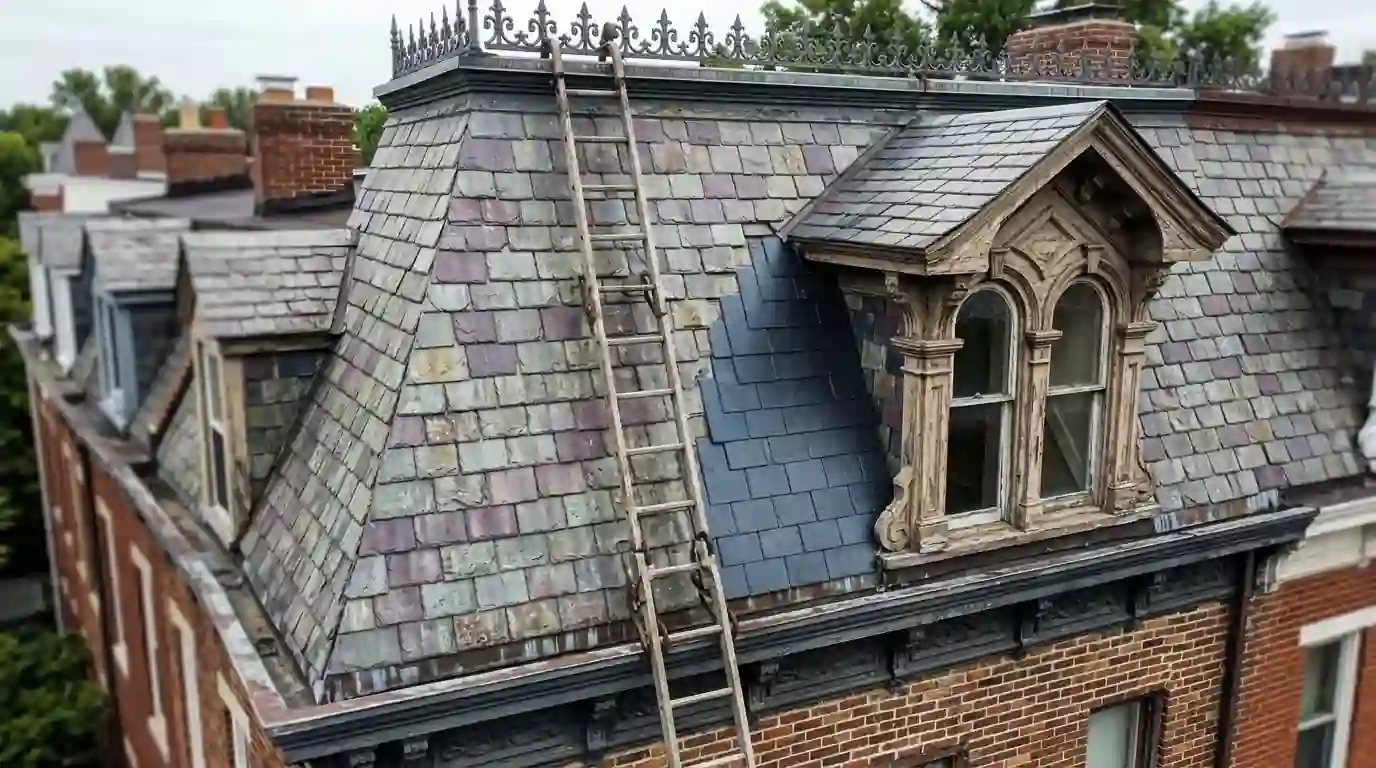
A slipped slate on a Victorian mansard isn't a reason to replace the roof. Most slate roofs around Washington need targeted repair of individual pieces, worn nails and tired flashing long before the stone itself gives out.
Materials we install
Slate roof repair means replacing broken or missing slates, fixing failed nails and rebuilding valleys or flashing on an existing slate roof without stripping it. You need it when slates crack, slide or leave gaps after wind or ice. Small repairs often run $465-$1,280; reflashing a valley or working a mansard section costs more, and access is the biggest variable.
Slate came into wide use in Washington during the late 1800s, and it's still everywhere: steep front mansards on rowhouses in Logan Circle and LeDroit Park, turrets and conical towers on corner houses, and full gable roofs on the detached Victorians of Cleveland Park and Takoma. Many of those roofs carry Buckingham slate from central Virginia, a dark blue-black stone that barely changes color in a century.
The stone usually outlasts everything holding it. Original iron nails rust through, and the slate slides down until it hangs on the course below. Valleys and step flashing made of terne or early copper wear thin. Ice working into a cracked corner in January splits pieces that were sound in the fall.
So when someone says a slate roof is shot, ask what's actually failing. A roof with sound stone and bad fasteners is a repair candidate, sometimes for decades.
Slate is brittle, and every step on the field risks cracking another piece. We work from roof ladders hooked over the ridge, from scaffold on mansards, or from a lift when the street allows, so weight never lands directly on the stone.
To remove a broken slate, we slide a slate ripper up under it, hook the nails and cut them. The replacement is cut to size and holed on the bench. Then it's held one of two ways: with a copper or stainless slate hook nailed between the slates below, or with a copper nail set in the joint and covered by a copper bib slipped under the course above.
Hooks are quick and clean and show a small metal tab at the bottom edge. Nail-and-bib leaves nothing visible, which matters on a front mansard facing the street. We choose per location and tell you which you're getting.
We never face-nail a slate and smear it with roofing cement. That old shortcut cracks the stone and makes the next repair harder.
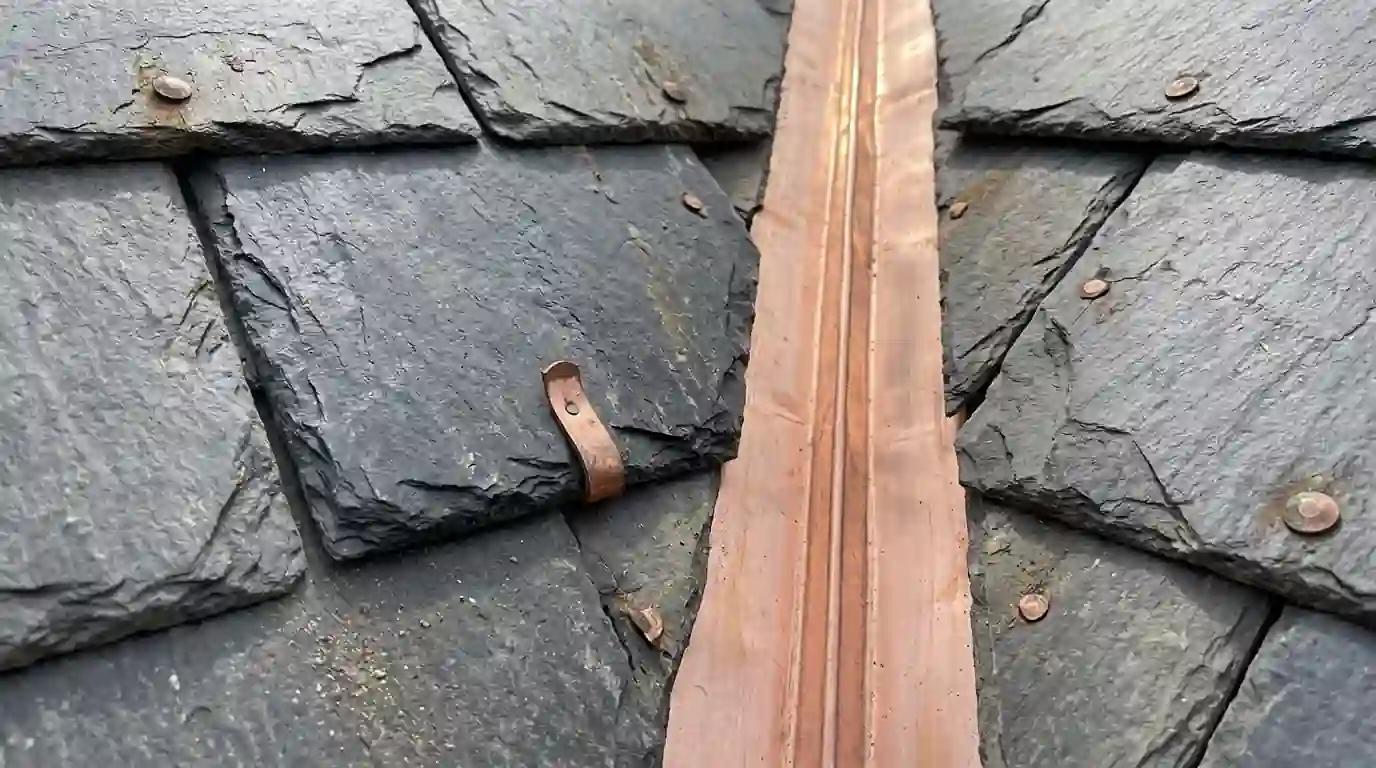
A good repair looks like nothing happened. We carry salvaged Buckingham and Pennsylvania slate in common sizes and thicknesses, and we source reclaimed Vermont gray, green and purple stock for roofs with patterned bands. Color, thickness and size all count: a thicker slate tilts the course above it and opens a gap.
Some Victorian roofs use fish-scale or diamond-cut shapes, especially on mansards and towers. We cut those shapes from rectangular stock when salvage pieces aren't on hand.
If the house is in a historic district, we stay with like-for-like stone. Swapping in a synthetic piece on a visible slope can bring the Historic Preservation Office into the picture.
On many older roofs the slate is fine and the metal is the problem. Valleys lined with terne or thin copper rust or wear through where water concentrates, and step flashing at a dormer cheek or chimney often failed decades ago and got painted with tar.
Rebuilding a valley means removing the slates along each side, pulling the old metal, laying underlayment and new 16 or 20 ounce copper, then setting the slates back with new fasteners. Chimneys get new step flashing and a cut-in counterflashing. If the masonry itself is loose, our chimney flashing repair work comes first.
Snow guards matter here too. Slate sheds snow in sheets, and on a rowhouse above a sidewalk that's dangerous. We add or replace copper snow guards where the old ones are missing.
There's a point where patching costs more than it saves. If more than about a fifth of the stone is soft, delaminating or flaking at the edges, or if nails are failing everywhere at once, we'll say so and price a slate roof replacement alongside the repair. Our article on repairing versus replacing slate lists the tests we use.
Even then, a new slate roof can often reuse sound stone from the old one on the most visible slopes, with new stone going on the rear.
Slate rewards small, regular attention. We suggest a look from the ground every spring and after any storm with strong gusts, plus a close check from roof ladders every few years. Catching one slipped piece early costs a fraction of what the rotted deck beneath it would.
Keep gutters and valleys clear, since standing water and wet leaves speed up the decay of nails and flashing. Ask cable, satellite and solar installers never to walk on the stone or screw mounts through it; we've repaired plenty of roofs cracked by a single service visit.
We also note every repair on a simple roof sketch with dates, so the next person on the roof knows which slates are new and where the copper work was done.
That's a missing piece leaving underlayment or bare deck exposed. Replace it before the next rain.
Rusted nails have let go. The slate is usually reusable if it didn't crack on the way down.
Delaminating stone is losing its surface layers. A few pieces are repairable; widespread flaking points toward replacement.
Someone patched a leak in a hurry. Tar hides the real failure and traps water under the stone.
Terne or steel valley metal is rusting through, and valleys carry more water than any other spot.
Dormer cheeks and step flashing often fail before the main field. Check the attic or the room beside the dormer.
We study the whole roof from the street and nearby yards first, marking broken, slipped and missing slates on photos.
Roof ladders, ridge hooks, scaffold on mansards or a lift where parking allows, so nobody walks on the stone.
A slate ripper cuts old nails so broken slates come out without disturbing the course above.
New or salvaged stone goes in with copper hooks or a nail-and-bib, chosen by how visible the spot is.
Where metal has failed, we lift the adjoining slates, replace the metal and reset the stone.
You get before and after photos of every repaired spot, marked on a roof sketch for future visits.
Slate pricing depends far more on access and stone sourcing than on the number of pieces. These 2026 ranges assume a typical two- or three-story house in the District.
| Job | Typical range |
|---|---|
| Small repair, up to about 8 slates, roof ladder access | $465-$1,280 |
| Mansard section repair with scaffold | $1,840-$4,370 |
| Copper valley rebuild, per valley | $2,160-$4,950 |
| Chimney step and counterflashing in copper | $1,390-$3,260 |
| Copper snow guards, per run | $385-$940 |
Height, steepness, scaffold or lift needs, special shapes such as fish-scale slate, and how hard the stone is to source all move the number. We price after seeing the roof.
Not safely, and not without cracking pieces. We work from roof ladders hooked over the ridge, scaffold or a lift, so our weight goes on the equipment instead of the stone.
It's a small copper or stainless steel hook nailed into the deck between slates that holds the replacement from below. You'll see a short tab at the bottom edge. On front slopes where that matters, we use a hidden nail-and-bib instead.
We keep salvaged Buckingham, Pennsylvania and Vermont stone in common sizes and look for a close color, thickness and size. For fish-scale or diamond patterns, we cut the shape from rectangular pieces.
Often, yes. Good slate lasts far longer than the nails and flashing that hold it. If the stone still rings when tapped and isn't flaking, repair is usually the better spend.
Replacing broken slates with real slate of the same color and shape doesn't change how the roof looks, which is what preservation staff care about. Changing a visible slope to a different material is another matter and goes through the Historic Preservation Office. We confirm the address's status before suggesting any material change.
These are the places we drive to most for this work. We cover all 45 areas on our service area list.
Natural slate replacement for Victorian mansards, turrets and steep roofs, with copper flashing, salvaged slate matching and historic district coordination.
Slate Roof Replacement detailsRepairs to the steep slate fronts of Victorian and Second Empire rowhouses: slipped and broken slates, rusted nails, dormer cheeks, built-in gutters and the flat-to-mansard joint.
Mansard Roof Repair detailsNew step, apron, counter and cricket flashing around brick chimneys on slate, shingle and flat roofs, cut into mortar joints instead of glued to the face.
Chimney Flashing Repair detailsComposite slate tiles that give colonials, Tudors and non-contributing homes a slate look at a fraction of the weight, with copper or steel flashing.
Synthetic Slate Roofing detailsCall and a roofer will answer, any hour of any day. We stop the leak first and fix it properly once the roof is dry.