Blisters in the membrane
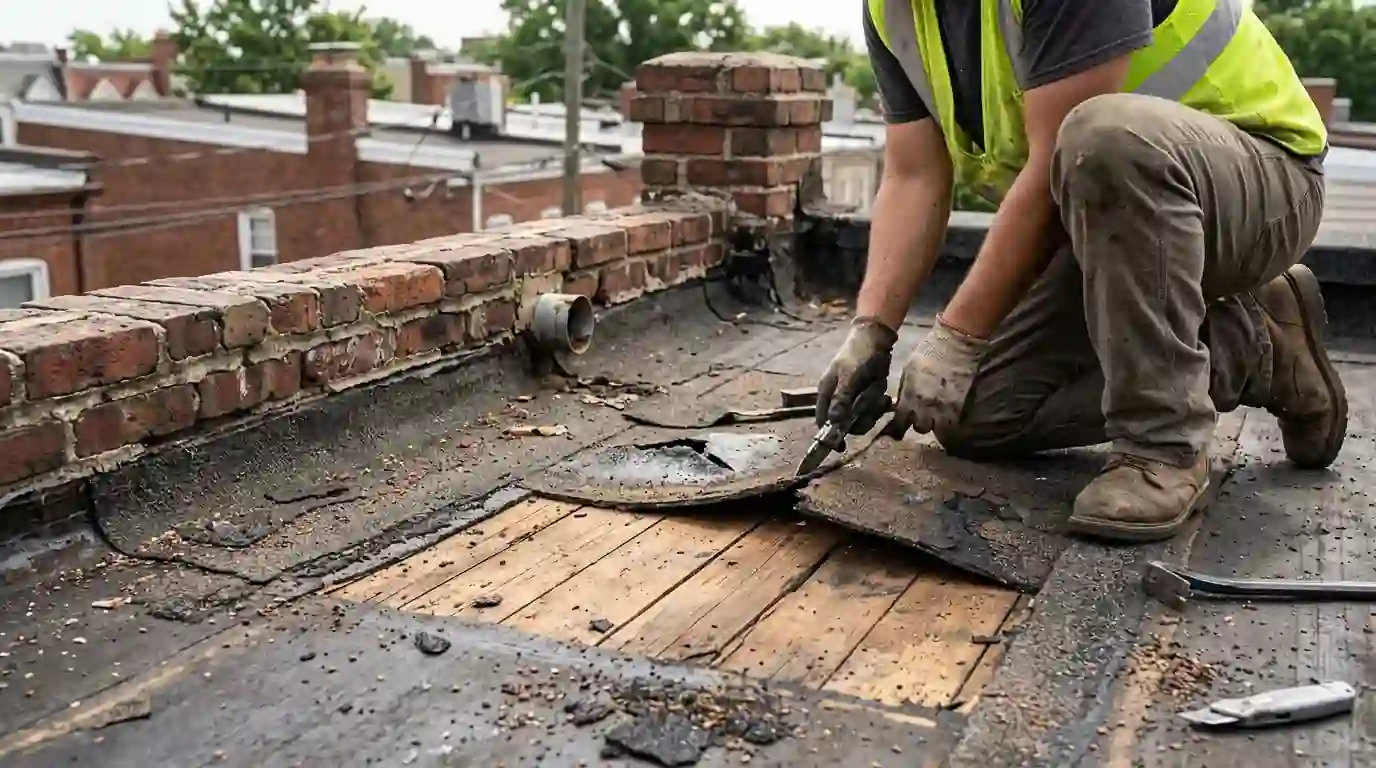
Soft raised bubbles mean trapped moisture or air under the sheet, and they crack open with foot traffic or heat.
Roof repair
Most rowhouse leaks in Washington start on a roof you never see: the low-slope surface behind the front parapet, where sun, standing water and foot traffic wear the membrane thin.
Materials we install
Flat roof repair fixes a section of a low-slope roof, such as blisters, split seams, punctures, failed base flashing or ponding spots, without stripping the whole surface. You need it when a leak appears or an inspection finds damage on a roof with years left. Most DC flat roof repairs cost about $435 to $1,960, depending on the membrane, the area and wet material underneath.
A flat roof repair only works if the new material bonds to the old one, so the first job is knowing what is up there. Many DC rowhouses carry granulated modified bitumen, a tar-like sheet torched or self-adhered in two plies. Others have black EPDM rubber, white or gray TPO, or older built-up roofing and roll roofing coated silver over the years.
We check by looking at seams, cutting a small core where needed, and noting how many layers sit on the deck. Some rowhouses we open have three roofs stacked on top of each other, each one installed over the last. That matters, because a wet lower layer can feed a leak no matter how good the top patch is.
Once the membrane is clear, we pick the matching repair: torch-down or cold-applied mod bit for mod bit, EPDM with the right primer and cover tape for rubber, heat-welded TPO for TPO. Our guide to the three main membranes explains how they differ.
Flat roofs are not truly flat; they should slope a little toward a scupper or drain at the rear of the house. Over decades, joists sag, decking deflects and new layers change the pitch, and water starts to sit in low spots for days after rain.
Standing water breaks down coatings, collects dirt and leaves, and freezes in winter, working seams open. When we see ponding, we look at why: a sagging joist bay, a drain set too high, or a scupper partly blocked by flashing buildup. Small low spots can be built up with tapered insulation or extra plies when we repair. Larger structural sags need framing work below.
Drain and scupper fixes often solve ponding without touching the field. On rowhouses in Eckington and nearby blocks, we regularly find rear scuppers that were half covered by successive roof layers, leaving water trapped an inch below the outlet.
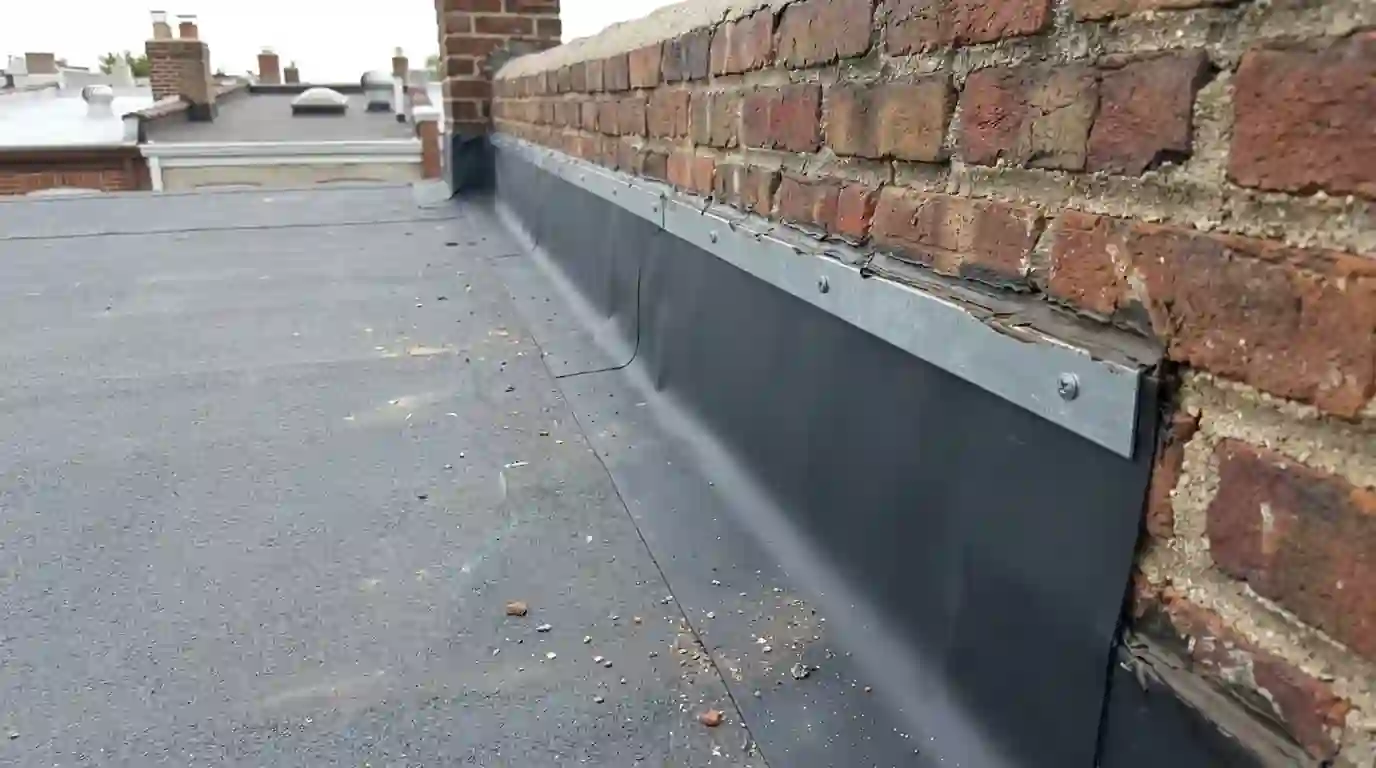
The weakest point on a rowhouse roof is where the horizontal membrane turns up the brick. Base flashing has to stretch up the wall at least eight inches, adhere fully, and be capped by metal counterflashing or the parapet coping. Heat cycles pull it away from the wall over time, and once a gap opens, water runs straight down behind the sheet.
We strip loose base flashing, clean and prime the brick, install new flashing ply fully adhered, and terminate it with a bar or a new counterflashing reglet cut into the mortar. If the parapet itself is cracked or the coping is loose, that work goes on our parapet repair list, because new flashing against a failing wall will not last.
Rowhouse roofs carry more than rain. Condensers on wood stands, satellite dish mounts, solar racking, old TV antenna bases and the roof hatch all sit on or pierce the membrane. Each stand leg that was bolted straight through the roof is a small leak waiting for its turn, and we often find rusted lag screws sitting in a smear of sealant.
When we repair around equipment, we set the legs on pitch pockets or prefabricated flashed supports, or on rubber blocks that sit on a protection pad without piercing the sheet. Roof hatches get new curb flashing up the sides and a fresh gasket so the lid seals when it closes.
Foot traffic wears paths too. The route from the hatch to the condenser, or across to a neighbor's roof, gets scuffed down to the reinforcing scrim on older membranes. Walkway pads laid along that route cost little and stop service techs from wearing a new leak into the roof every spring.
We repair when the membrane is still flexible, still stuck tight to the deck, and the damage is limited. If we find widespread blistering, brittle felts that crack when bent, soft decking in several bays or more than two existing layers, a repair is money that will not come back.
In that case we give you a repair price for the immediate leak and a separate price for a full low-slope replacement, so you can compare. DC energy rules push reflective membranes on low-slope roof replacements, which also cuts top-floor heat in July and August.
Roof decks and rooftop HVAC equipment change the math too. If a deck or condenser stand needs to come off for proper repair, the extra labor sometimes tips the decision toward replacing the section under it while access is open.
Soft raised bubbles mean trapped moisture or air under the sheet, and they crack open with foot traffic or heat.
Edges that curl up or show a dark line of dirt at the overlap are letting water underneath.
A silver or black coating broken into a crocodile-skin pattern means the surface is drying out and cracking.
Puddles that last more than 48 hours after rain point to sagging deck or a blocked outlet.
Flashing pulled away from the brick at the bottom of a wall is a direct path for water into the house.
Decking that flexes when you step means rot or wet insulation beneath the membrane.
We confirm the roofing type and how many roofs are stacked on the deck before choosing a repair.
Visual checks, probing and moisture readings show how far the damage extends.
Wet insulation, blistered plies and rotted decking come out until we reach dry, solid substrate.
New decking, insulation or cover board goes in, then compatible membrane is installed with proper laps.
Base flashing, curbs, pipes and scuppers in the repair area are redone, not just sealed.
We check seams with a probe, water-test if needed and send you photos of each stage.
Flat roof repair prices depend on the membrane, how much area is involved and what we find under the surface. These are common 2026 ranges for DC rowhouses and additions.
| Job | Typical range |
|---|---|
| Seam or puncture repair, single area | $435-$890 |
| Blister cut-out and patch, several spots | $615-$1,370 |
| Base flashing redo along one parapet | $960-$2,480 |
| Section repair with deck replacement, up to about 100 sq ft | $1,480-$3,860 |
| Ponding correction with tapered build-up | $1,170-$3,240 |
Membrane type, layer count, rooftop decks or equipment to move, access through a hatch or alley, and the amount of wet material all change the number. We price it after seeing the roof, and you see that price before work starts.
Sometimes, if the existing layers are dry, stuck firmly to each other, and there are no more than two. If lower layers are wet, a patch on top traps that water and the leak keeps feeding from below. We core the roof to check before deciding.
Coating can extend a sound roof by reflecting heat and sealing hairline cracks, but it will not fix open seams, wet insulation or failed flashing. We repair those first, then coat if the roof is a good candidate. Our page on roof coating covers when it makes sense.
Many deck frames sit on sleepers and can be lifted in sections to reach the membrane. If the deck is fastened through the roof, we remove the affected boards, repair the membrane and add proper flashed supports before reinstalling it.
Freeze and thaw cycles open small cracks, and melting snow on a cold roof can back up behind ice at the scupper. Water also travels farther in cold weather when it cannot evaporate. We check the outlets and seams near the rear wall first.
Small seam, puncture and boot repairs usually are, as long as the surface is dry and the temperature suits the adhesive or weld. Larger section repairs with wet insulation or rotted decking may need a temporary seal that day and a return visit once materials are cut to size.
These are the places we drive to most for this work. We cover all 45 areas on our service area list.
Tear-off and new low-slope roofs for rowhouses and flats, with tapered insulation for ponding, new parapet flashing and reflective cool roof membranes.
Flat Roof Replacement detailsSilver aluminum and white reflective coatings for DC low-slope roofs, applied over a cleaned, repaired surface to add years to a membrane that's still sound.
Roof Coating detailsLeaking scuppers through rowhouse parapets, rusted conductor heads and clogged internal roof drains rebuilt so flat roofs empty fast after a storm.
Roof Drain and Scupper Repair detailsRepairs to the brick walls that rise above rowhouse roofs: loose coping, cracked caps, open mortar, failed through-wall flashing and the membrane where it meets the parapet.
Parapet Wall and Coping Repair detailsCall and a roofer will answer, any hour of any day. We stop the leak first and fix it properly once the roof is dry.