Inner-Beltway bungalows
Low-pitched porch roofs and shed dormers on 1920s homes in Mount Rainier and Brentwood catch wind-driven rain at every tie-in.
Maryland
Prince George's County wraps around the east side of the District, and its roofs range from Mount Rainier bungalows to Bowie's Levitt homes to newer townhouses near Largo. Leaks, aging shingles and storm-snapped limbs keep us busy on both sides of the Beltway.
In Prince George's County we mostly replace and repair asphalt shingle roofs on homes from the 1920s through the 2000s, with some flat roofs on older rows and commercial strips. A leak repair often runs $415-$1,380, and a full shingle reroof on a typical house falls around $10,900-$24,700. Call (202) 771-7443 so we can look at it before pricing anything.
Mount Rainier, Brentwood, Cheverly and Riverdale Park are full of 1920s to 1940s bungalows, foursquares and small colonials, a few of them Sears kit homes ordered by catalog. Those roofs have been redone several times, and the leaks we find usually sit where old work meets new: chimney counterflashing set in crumbling mortar, a dormer cheek with no step flashing, or a porch roof tied into the main roof with tar.
We follow a ceiling stain's path from the attic side first, then from the roof. On a bungalow with a low shed dormer, water often enters several feet uphill of the stain and runs along a rafter before it drips. Our leak repair work starts with that trace, because patching only the wet spot rarely survives the next storm.
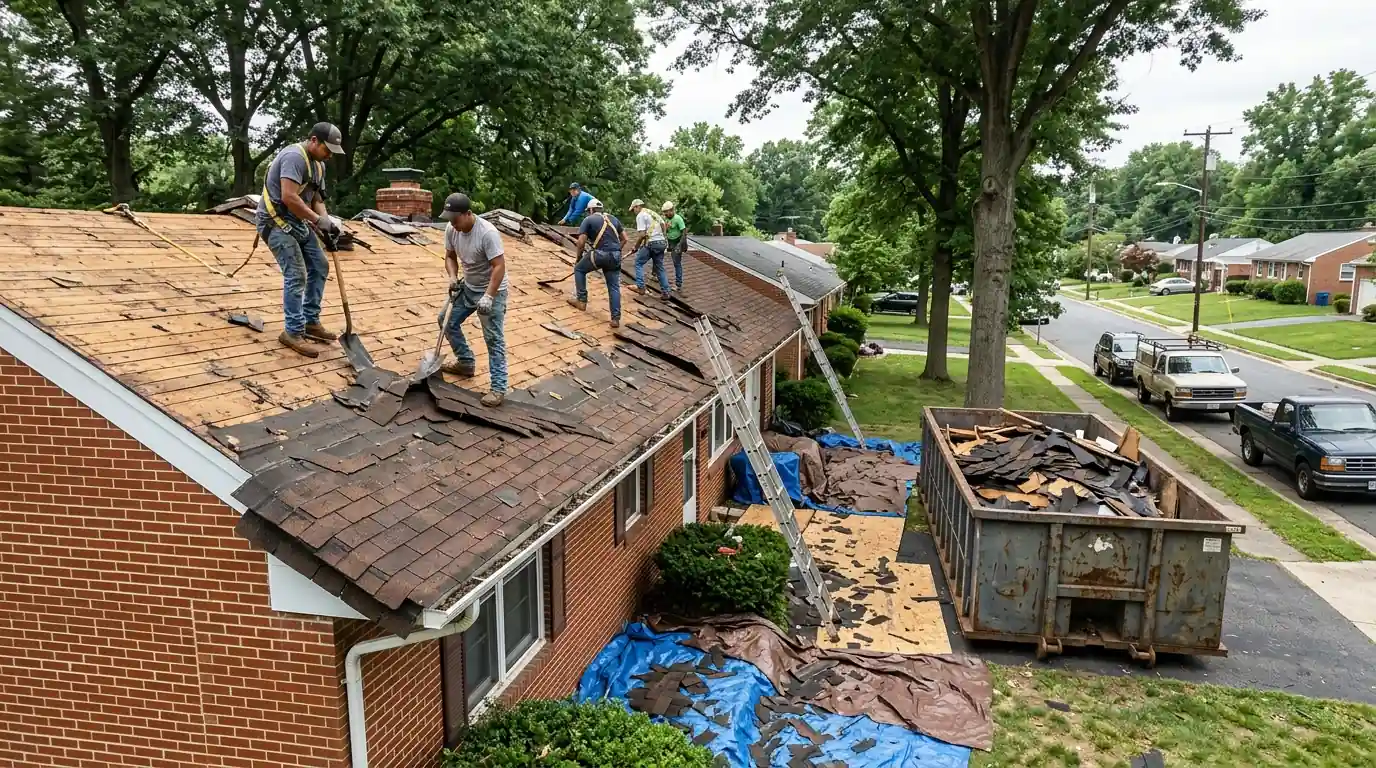
Outside the Beltway the county shifts to 1950s and 1960s subdivisions in places like Temple Hills, Oxon Hill, Clinton and Glenn Dale, with ramblers, split-levels and brick colonials under long, simple gables. Bowie's Belair sections add the Levitt models, covered in detail on the Bowie roofing page. These houses suit a straightforward tear-off with new ridge vents and fresh flashing.
Around Largo, Upper Marlboro and National Harbor, townhouse communities built from the 1980s to the 2000s are reaching their second roof. HOA approval of shingle color and style comes first there, and we coordinate with neighbors on attached units so the ridge line stays continuous from end to end.
Some of the original 1930s rows in old Greenbelt carry low flat roofs, and commercial strips along Route 1, Rhode Island Avenue and Branch Avenue are mostly built-up roofs, modified bitumen or rubber. Ponding water near clogged scuppers is the common thread. For these, we cut test patches, check the insulation for saturation, and price flat roof repair against a full membrane replacement.
A rooftop unit curb that was never properly flashed will keep leaking no matter how many times the field gets coated. We rebuild curbs and drains first, and only then talk about coatings or new membrane.
Some low commercial roofs along Route 1 still drain through interior drains with cast iron leaders. When those leaders crack inside a wall, the water looks like a roof leak, so we run a hose test on the drain before anyone tears into the membrane.
Reroofing permits in Prince George's County generally go through the county permit office, and some of the incorporated municipalities add steps of their own. We sort out which rules apply at your address before the dumpster arrives, so the crew isn't waiting on paperwork.
Thunderstorms rolling in from the west and tropical remnants moving up the Chesapeake both hit this side of the region. When wind lifts shingles or a limb punctures the deck, we photograph every slope, tarp what is open, and give you a written scope you can send to your insurer.
Low-pitched porch roofs and shed dormers on 1920s homes in Mount Rainier and Brentwood catch wind-driven rain at every tie-in.
Catalog houses in Cheverly and Riverdale Park usually keep their original spaced board sheathing, which changes how we deck and nail a new roof.
Ramblers and split-levels in Temple Hills and Clinton often have two shingle layers, so tear-off and deck repair figure into every quote.
Communities near Largo and Upper Marlboro need HOA-approved colors and careful tie-ins at shared ridges.
Route 1 and Branch Avenue storefronts lean on low-slope membranes with scuppers that clog with leaves every fall.
Full tear-off and new roof systems for DC rowhouses, Victorians and suburban colonials, from low-slope membranes to shingle, slate and metal.
Roof Replacement detailsArchitectural shingle roofs for colonials, Cape Cods and split-levels, with ice barrier at eaves, new valley metal and balanced ridge venting.
Asphalt Shingle Roofing detailsWe trace roof leaks from the ceiling stain back to the real entry point, then fix that cause: seams, flashing, vent boots, skylights, parapets and drains.
Roof Leak Repair detailsRepairs after thunderstorm gusts, nor'easters, hail and fallen limbs: lifted membrane, creased shingles, cracked slate, torn flashing and punctured decking around DC.
Storm Damage Roof Repair detailsLeaking seams, sagging runs, crushed downspouts and clogged alley tie-ins fixed on the spot, so you keep sound gutters instead of replacing them early.
Gutter Repair detailsLow-slope roof repair for DC rowhouses and additions: modified bitumen, EPDM, TPO and coated roll roofing, plus ponding areas, curbs and parapet base flashing.
Flat Roof Repair detailsWe do. Those jobs are a longer drive from our 7th St NW office, so we group material deliveries and plan the tear-off for one long day where the roof size allows.
We don't recommend it. A third layer adds weight, hides deck rot and shortens shingle life, and the county permit office may not allow it. A full tear-off lets us see the boards and fix what's soft.
Yes. We put together the color sample, product sheet and scope for the architectural committee and wait for written approval before scheduling the crew.
Call any hour. We answer 24/7 and tell you when a roofer can be at your house.