Victorian core
1890s to 1910s houses near the train station have steep gables, turrets and slate or wood shingle roofs.
Maryland
Kensington has two very different kinds of roofs within a few blocks of each other. Around the train station and Howard Avenue sit Victorian houses with porches, turrets and steep gables, and in the streets beyond them are 1950s ramblers and Cape Cods with plain, low roofs.
Kensington roofs split between late 1800s and early 1900s Victorians with slate, wood shingle or metal porch roofs, and mid-century ramblers and Cape Cods with asphalt shingles. Common jobs are porch and turret repairs, shingle reroofs, attic venting and gutter work under heavy trees. Repairs often run $470-$2,280, porch roof work $1,560-$5,370 and a rambler reroof $10,900-$17,600.
The oldest part of Kensington grew up around the railroad station in the 1890s, and many of those houses still have wraparound porches, corner towers and tall, steep roofs. Some wear slate, some painted wood shingles, and many have standing seam or flat-seam metal on the porches. Each of these materials needs a roofer who will repair it rather than reach for the nearest substitute.
Because this core is under local historic review, changes you can see from the street, like switching materials or altering a porch roof, may need approval before work starts. Repairs in kind usually move faster. We help you find out what applies to your address, prepare photos and material samples if a submission is needed, and pull the county permit for full replacements.
Turret caps and conical roofs are hard to reach and easy to neglect. When the cap flashing or the finial loosens, water runs straight down the center post into the room below. We rebuild these with copper or matching metal, cutting each piece to the curve.
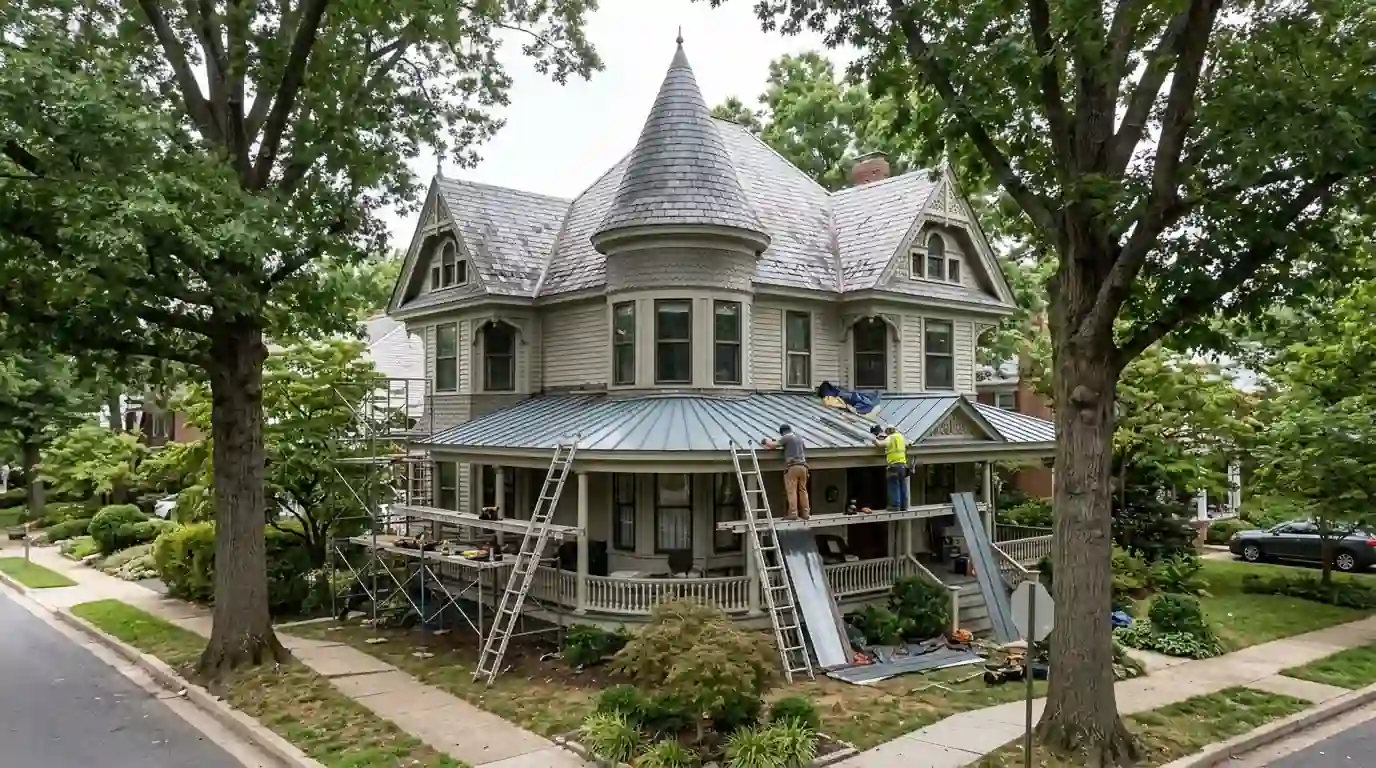
Most Victorian porch roofs here are low-slope metal, painted many times over. Small rust spots and open seams can be cleaned, soldered or sealed and repainted for a modest cost. When the metal is rusted through in several places, or the decking underneath has gone soft, we replace the panels with new standing seam or a membrane depending on the slope.
The wall where the porch roof meets the house is where most porch leaks start. We open the siding just enough to install proper step and counter flashing, then close it up so the paint lines match. Our porch roof repair work covers posts and beam ends that have taken water too.
Away from the station, Kensington looks quite different. Neighborhoods built after the war along and around Connecticut Avenue are lined with brick ramblers and one-and-a-half story Capes, many on their second or third roof. These roofs fail in predictable ways: curled tabs on the south slopes, cracked pipe boots and leaks around the chimney.
Cape Cods often have hot, poorly vented upper floors because the knee walls and short attics leave little room for air to move. During a reroof we can add soffit intake and a ridge vent, and our attic ventilation page explains how that keeps shingles from cooking. Most ramblers take a single day to reroof once the material is on site.
Two existing layers mean a full tear-off, not a third layer. We check the decking under every sheet we remove and replace any soft boards before the underlayment goes down.
Kensington sits close to Rock Creek Park, and old oaks, maples and poplars cover most of the town. Leaf loads in fall are heavy enough that open gutters fill in a single week, and the overflow soaks porch ceilings and basement walls. On the most shaded houses, gutter guards cut down on cleaning trips, and larger 6-inch gutters handle storm water better than the old 5-inch runs.
Heavy shade also keeps north slopes damp, which grows moss on shingles and wood. We clean it gently and talk through trimming branches before the next reroof.
1890s to 1910s houses near the train station have steep gables, turrets and slate or wood shingle roofs.
Visible changes in the old town core may need approval before work, while repairs in kind are simpler.
Low-slope tin and standing seam porch roofs rust at seams and leak where they meet the house wall.
Brick ramblers and Cape Cods from the 1950s carry asphalt shingle roofs that are often on their second or third layer.
Mature trees near Rock Creek Park fill gutters fast and keep north-facing slopes damp.
Leaking porch roofs on DC rowhouses fixed at the source: new low-slope membrane, rebuilt flashing at the brick facade, and rotted beadboard and fascia replaced.
Porch Roof Repair detailsSoldered repairs, repainting and partial replacement for tin, terne, standing seam and copper roofs on DC bay fronts, porches, turrets and mansards.
Metal Roof Repair detailsArchitectural shingle roofs for colonials, Cape Cods and split-levels, with ice barrier at eaves, new valley metal and balanced ridge venting.
Asphalt Shingle Roofing detailsAttic and roof cavity ventilation for DC rowhouses and suburban homes: ridge and soffit vents, baffles, bath fan ducting and fixes for winter condensation.
Roof and Attic Ventilation detailsStainless micro-mesh and solid-hood guards fitted for oak, tulip poplar and pine cover, so the gutters keep flowing between cleanings.
Gutter Guards detailsSlate repair for Victorian mansards, turrets and steep DC roofs: broken slates replaced with copper hooks or nail-and-bib, plus valley and flashing rebuilds.
Slate Roof Repair detailsIf your house is in the old town core, visible changes may go through local historic review first. Like-for-like repairs are usually simpler. We help you confirm what applies to your address before you commit to a material.
Often, yes. If rust is limited to spots and seams, we clean, solder or seal and repaint. If the metal has holes across several panels or the deck is soft, replacement costs less over time.
Cape Cods have short attics and knee walls with little airflow. Adding soffit intake and a ridge vent during a reroof moves hot air out and helps the shingles last longer.
We answer (202) 771-7443 every hour of every day and usually reach Kensington the same day for an active leak.
Call any hour. We answer 24/7 and tell you when a roofer can be at your house.