Low-pitch ramblers
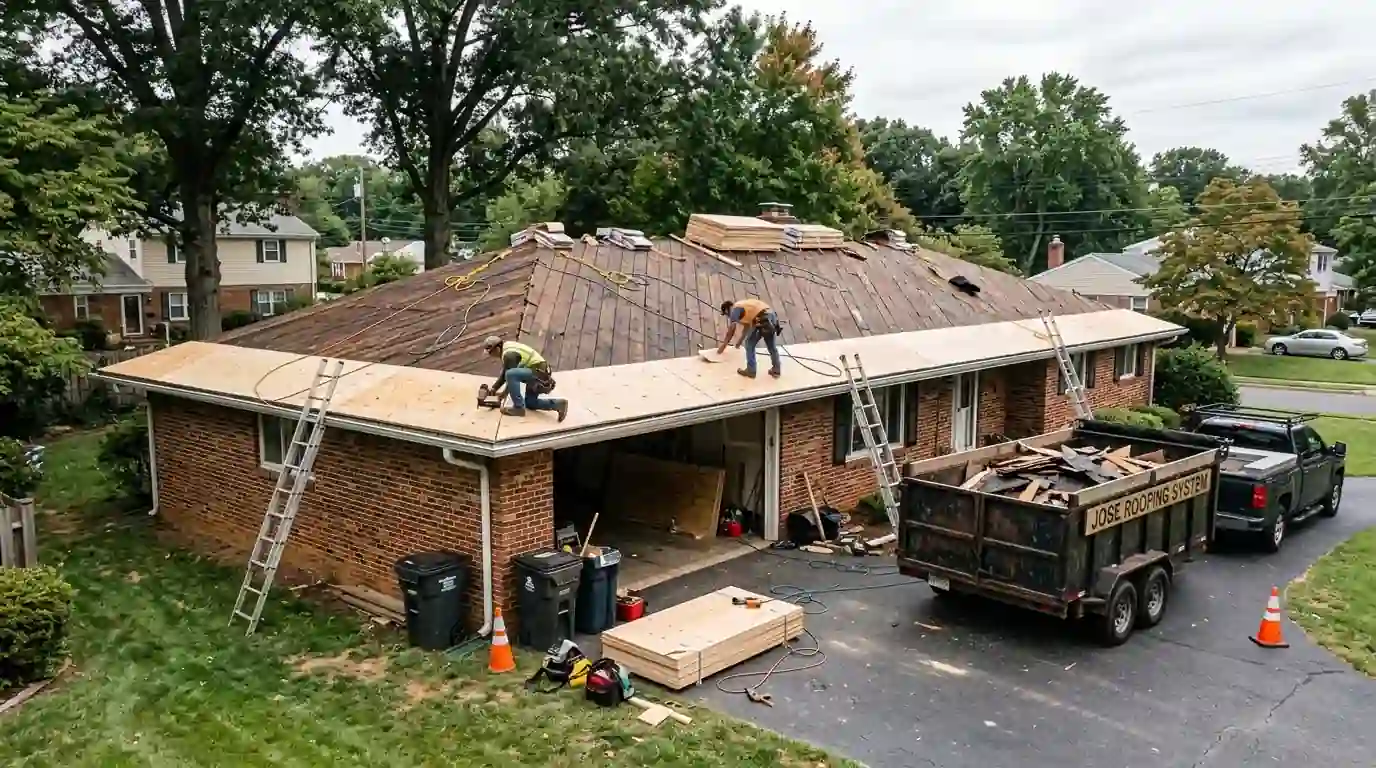
1950s brick homes with roofs around 4/12, often with two shingle layers that hide soft board decking.
Northern Virginia
Annandale's streets between Little River Turnpike and Braddock Road are lined with brick ramblers and split-levels from the 1950s through the 1970s. Their low, wide roofs are simple to look at and easy to underestimate, because what is underneath has usually been covered twice.
Most Annandale roofs are low-pitch asphalt shingle over plank or early plywood decking on 1950s to 1970s homes. A full tear-off and replacement usually runs $11,200-$20,400, with decking repair and attic venting the biggest swing factors. Leak repairs and small storm fixes commonly cost $375-$1,180. Call (202) 771-7443 to set up a roof check.
A 1950s rambler near Ravensworth or Wakefield Chapel was usually built with board sheathing, a low pitch around 4/12 and a single gable vent at each end. Over the decades, many got a second layer of shingles nailed straight over the first, which hides rotten boards and traps heat.
When we strip one of these roofs, we expect to replace boards at the eaves and along the bottom few feet, where water from ice and clogged gutters sat. We then add plywood over gappy boards where needed, so new nails have something solid to hold. That step matters on a low-slope roof where wind uplift is the main threat.
Split-levels in neighborhoods off Annandale Road and Columbia Pike usually have a higher roof meeting a lower roof at a sidewall. That junction is where step flashing, siding and a kickout all have to work together, and on many homes one of the three is missing.
We rebuild those sidewalls with new step flashing woven into each course and a proper kickout at the gutter. Inside the house, the leak usually shows up on the ceiling of the lower level, near the stairs, which confuses many owners because it appears far from the source.
Some Annandale split-levels also have a flat roof over a lower family room or a sunroom added in the 1970s. Those were often finished with roll roofing that has long since cracked. We replace them with a fully adhered membrane, run it up the wall under new counter flashing and slope it toward a proper scupper or gutter.
Many of these houses have little or no soffit venting, and their attics bake in July. That heat cooks shingles from below and shortens their life, and in winter, warm moist air condenses on the cold deck. We check for intake and exhaust on every replacement and add soffit vents and ridge vent where the framing allows it.
Owners are often surprised to learn that attic ventilation is part of the shingle maker's installation instructions. We also look at bathroom fans that dump moist air into the attic and run them outside through a roof or wall cap.
Most Annandale ranch roofs come off and go back on in one to two days. Driveways here are usually wide enough for a dump trailer, and we lay tarps over shrubs and cover window wells. The county permit office decides whether your scope needs a permit, and we check that before the job.
If your home also has gutters that have pulled loose from rotten fascia boards, it makes sense to fix them during the same visit. Our fascia and soffit repair keeps the new drip edge fastened to solid wood.
Annandale's commercial strip along Little River Turnpike also has low-slope buildings with membrane roofs, and we work on those too. For homes, though, the most common sequence is simple: tear-off, deck repair, ice and water membrane, new metal, shingles, ridge vent and a final cleanup with a walk-through of your yard.
1950s brick homes with roofs around 4/12, often with two shingle layers that hide soft board decking.
Upper and lower roofs meet at sidewalls, a frequent leak point when step flashing or kickouts are missing.
Many attics have only gable vents and no soffit intake, which bakes shingles and traps winter moisture.
Low-slope attached carports and porch roofs often need their own membrane rather than shingles.
Most ramblers have one exterior brick chimney whose flashing was reused through earlier reroofs and now needs replacing.
Full tear-off and new roof systems for DC rowhouses, Victorians and suburban colonials, from low-slope membranes to shingle, slate and metal.
Roof Replacement detailsArchitectural shingle roofs for colonials, Cape Cods and split-levels, with ice barrier at eaves, new valley metal and balanced ridge venting.
Asphalt Shingle Roofing detailsAttic and roof cavity ventilation for DC rowhouses and suburban homes: ridge and soffit vents, baffles, bath fan ducting and fixes for winter condensation.
Roof and Attic Ventilation detailsRotted fascia boards, sagging soffits and squirrel holes at the eaves rebuilt with solid wood or PVC, then wrapped and vented so the roof edge stays dry.
Fascia and Soffit Repair detailsWe trace roof leaks from the ceiling stain back to the real entry point, then fix that cause: seams, flashing, vent boots, skylights, parapets and drains.
Roof Leak Repair detailsLeaking seams, sagging runs, crushed downspouts and clogged alley tie-ins fixed on the spot, so you keep sound gutters instead of replacing them early.
Gutter Repair detailsIf the carport roof is below about 2/12 pitch, shingles will not shed water fast enough. We install a modified bitumen or EPDM membrane on that section and tie it into the main roof with proper flashing.
It varies, but on most 1950s homes we replace boards along the eaves and around chimneys. We walk you through what we found during tear-off and photograph each damaged area before swapping it.
Yes. Annandale is a short drive from both our Washington, DC office and the Woodbridge head office, and our phone is answered 24/7 at (202) 771-7443. Neighbors in Springfield and Burke are served by the same crews.
Call any hour. We answer 24/7 and tell you when a roofer can be at your house.