Stain at the top of the front wall
Water running down inside the cornice often shows first where the front wall meets the ceiling indoors.
Rowhouse and specialty roofing
If water stains the inside of your front wall just below the ceiling, the box gutter behind your cornice is the first suspect. These hidden troughs fail quietly for years before the damage shows indoors.
Materials we install
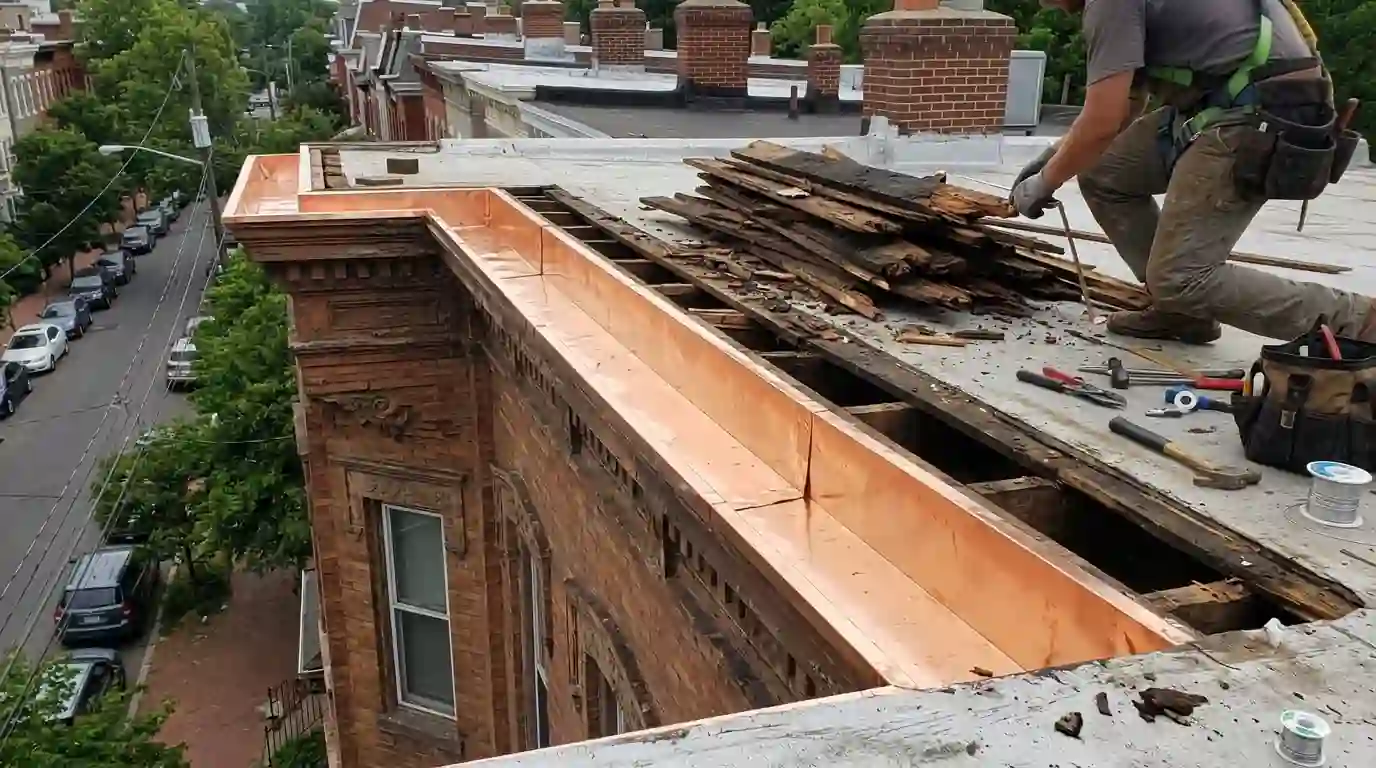
A box gutter is a trough built into the roof edge behind a cornice, lined with metal or membrane, that collects water and sends it to a downspout. Repair ranges from sealing seams to relining the whole trough and rebuilding rotted wood. Relining a typical rowhouse box gutter costs about $1,420-$3,580 in membrane and $3,970-$7,860 in copper.
Look at the front of a Victorian rowhouse on Capitol Hill or in Bloomingdale and you'll see a deep, ornate cornice of pressed metal or wood brackets. Behind it, set into the roof edge, is a wooden trough lined with sheet metal. The front strip of roof drains into that trough, and an outlet tube carries the water to a downspout at the front or side of the house.
Original linings were tin-plated or terne-coated steel, soldered at the seams and painted. Some houses got copper. As the paint wore off, the steel rusted; as seams cracked from heat and cold, water got into the wood box beneath. Since the gutter sits behind the cornice, nobody sees it from the sidewalk.
On many blocks the main roof drains to the rear, so the front box gutter only handles a short slope. That makes it easy to forget, and it's why leaves and silt sit in it for years.
The most common failure is a rusted-through lining at the low point near the outlet, where water sits longest. Next come split soldered seams along a long run. Both let water into the wood trough, which rots, sags and creates a new low spot that holds even more water.
The outlet itself is another weak spot. Old outlet tubes rust off at the joint with the lining, so water drops inside the cornice or down the face of the brick instead of into the downspout. Ice in a clogged outlet can push water back under the roofing at the gutter's back edge.
Past fixes cause trouble too. Layers of roofing cement and fabric over a rusty liner hold water against the steel and hide the holes. By the time we open them, the wood underneath is often soft.
Copper is the traditional upgrade. We form 16 or 20 ounce sheets to the trough shape, solder the seams, and add expansion joints on long runs so the metal can move. Copper lasts for generations and is the usual choice for front cornices in historic districts, where the gutter edge may be visible.
A membrane relining uses EPDM, TPO or modified bitumen laid into the trough and run up under the roofing at the back edge. It costs less, handles movement well, and suits gutters nobody can see from the street. It does need to wrap over the front lip under a metal edge so sun and ice don't chew at it.
Terne-coated stainless steel sits between the two. It holds paint well, solders like terne and resists rust, which makes it a good fit where the original painted look matters.
A new lining is only as good as the trough under it. Once the old metal is out, we probe every board. Rotted bottom boards, sagging side walls and soft rafter tails get cut out and replaced with treated lumber or new framing sistered to sound wood.
We also reset the pitch. A box gutter should fall gently toward its outlet, and decades of sagging often leave it level or sloping the wrong way. Shims and tapered blocking restore the fall before the lining goes back.
If the cornice itself is damaged, we stabilize it from behind and coordinate any face repairs with our fascia and soffit repair work. Our article on box gutters on DC rowhouses covers seasonal care between repairs.
Every new lining gets a new outlet tube, soldered or welded to the lining and sized for the gutter's flow. A basket strainer keeps leaves out of the tube. Where the downspout below is crushed or rusted, we replace it during the same visit.
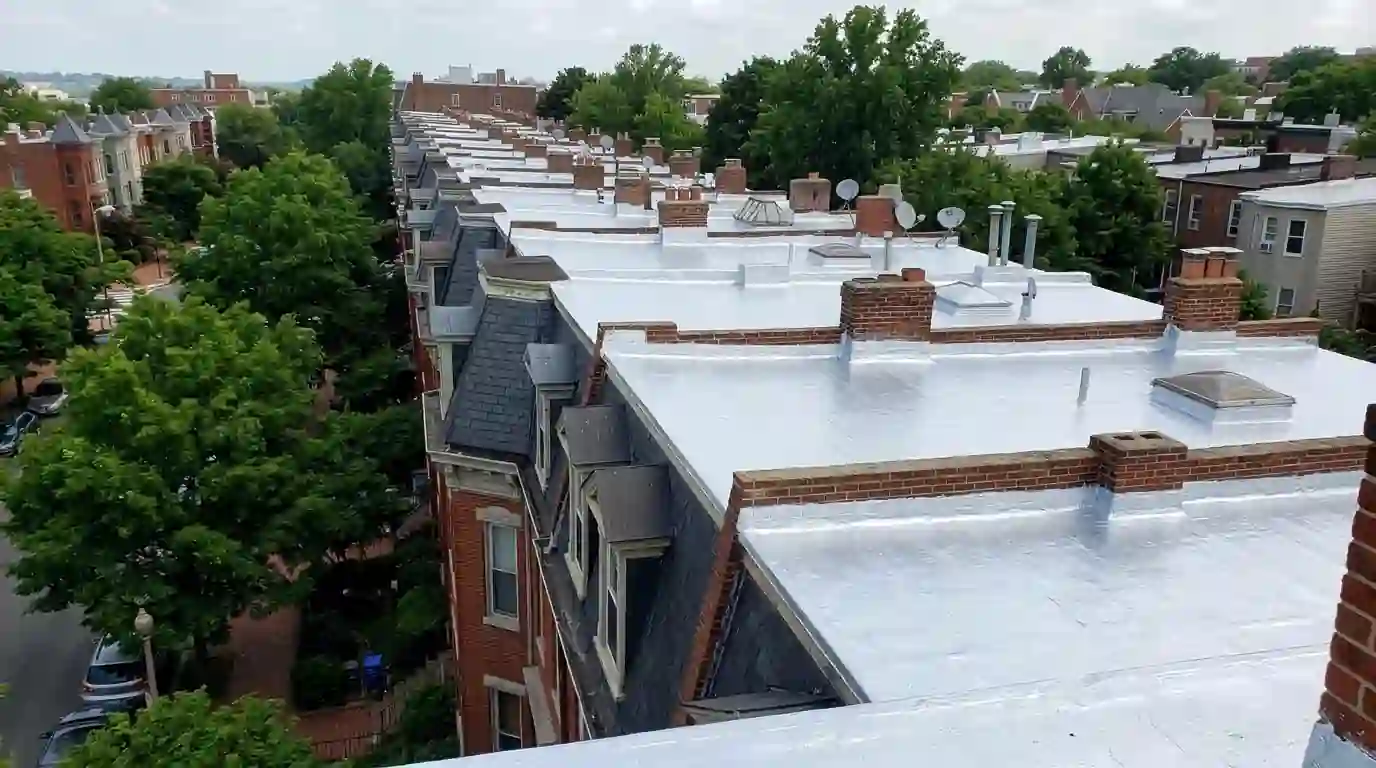
The back edge of the gutter has to tie into the roof above. On rowhouses with a front mansard, the slate or metal laps into the gutter; on flat-front houses, the low-slope membrane runs into it. We join that edge to your rowhouse roof so water never finds a gap between the two.
Built-in gutters aren't limited to rowhouses. Many older detached homes in Takoma Park, Cleveland Park and parts of Montgomery County have Yankee gutters or pole gutters built into the lower edge of the roof. They fail in the same ways: rusted linings, split seams, rot in the wood behind them.
On those houses the gutter often runs around corners and over porches, which adds miters and expansion joints to the lining. We form and solder those corners on site, and we check where each downspout lands so water doesn't end up back against the foundation.
Water running down inside the cornice often shows first where the front wall meets the ceiling indoors.
Blistered paint or swollen wood on the cornice face means water is soaking in from behind.
An overflowing box gutter usually has a clogged outlet or a sagging section holding water.
If the downspout stays quiet while water drips elsewhere, the outlet tube has probably rusted off.
Seedlings growing from the cornice mean soil and leaves have filled the trough.
Orange stains on the facade trace back to a rusted lining or outlet.
We clear debris, run a hose into the gutter and watch where the water goes.
Rusted metal and old patches come out so we can see the wood box.
Bad boards are replaced and the trough is shimmed to fall toward the outlet.
Copper, terne-coated stainless or membrane is formed, seamed and turned up under the roof edge.
A new outlet tube is joined to the lining and connected to a sound downspout.
We fill the gutter and watch the outlet and cornice for drips before closing out.
Most DC rowhouse fronts run 16 to 22 feet wide, and these 2026 ranges assume that length. The final price depends on what we find once the old lining is out.
| Job | Typical range |
|---|---|
| Clean, seal seams and spot repair | $385-$960 |
| Membrane relining with metal edge | $1,420-$3,580 |
| Copper relining with soldered seams | $3,970-$7,860 |
| Rotted trough and rafter tail carpentry | $670-$2,390 |
| New outlet tube, strainer and downspout | $345-$880 |
Wood rot, lining material, cornice condition, scaffold or lift needs and whether the gutter connects to a mansard all move the price.
The gutter sits inside the wall line, behind the cornice. When the lining fails, water drops into the wood box and the wall cavity instead of off the eave, so it shows up indoors first.
Sometimes, by closing the trough and hanging a gutter at the roof edge. On rowhouses with decorative cornices, that changes the front and may need historic approval, so relining is usually the better path.
At least once a year, ideally in late fall after the street trees drop their leaves. Blocks with big oaks or maples may need a spring cleaning too.
Only as a short stopgap on a liner with small pinholes. Once metal has rusted through or the wood has softened, coating just hides the damage.
Often we can reach the gutter from the roof. Gutters on three-story fronts, or cornices needing carpentry from outside, may need scaffold or a lift, which we include in the quote.
These are the places we drive to most for this work. We cover all 45 areas on our service area list.
Leaking seams, sagging runs, crushed downspouts and clogged alley tie-ins fixed on the spot, so you keep sound gutters instead of replacing them early.
Gutter Repair detailsRotted fascia boards, sagging soffits and squirrel holes at the eaves rebuilt with solid wood or PVC, then wrapped and vented so the roof edge stays dry.
Fascia and Soffit Repair detailsSoldered and standing seam copper for bay roofs, turrets, dormers, cupolas and entry roofs, plus copper valleys, caps and built-in gutter liners.
Copper Roofing detailsTear-off and new low-slope roofs for DC rowhouses, with party-wall parapets, rear ells, neighbor tie-ins and the rear scupper that carries all the water handled properly.
Rowhouse Roofing detailsCall and a roofer will answer, any hour of any day. We stop the leak first and fix it properly once the roof is dry.