1940s Cape Cods
Steep roofs with paired front dormers and center chimneys, where most leaks start at dormer sidewalls.
Northern Virginia
Falls Church packs Victorian farmhouses, 1940s Cape Cods and postwar ramblers into a small city cut through by Broad Street and the W&OD Trail. Leaks here most often start at dormers, old chimneys and the seams where a later addition meets the original roof.
Most Falls Church roof calls are leaks on older pitched roofs: dormer sidewalls, chimneys and addition tie-ins. Those repairs usually cost $395-$1,260. A full shingle replacement on a Cape Cod or rambler typically runs $10,900-$19,800, while larger Victorians with steep pitches and turrets cost more. We look before we price. Call (202) 771-7443.
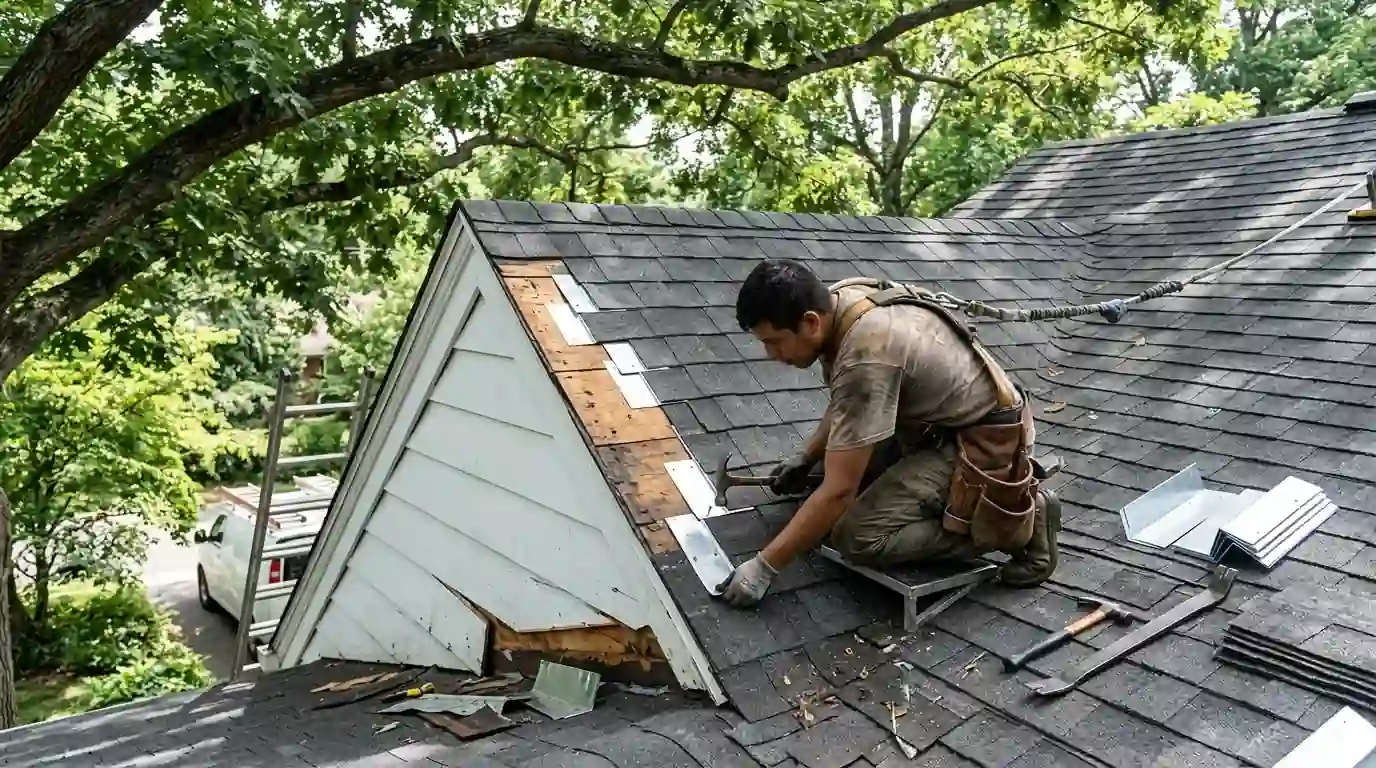
The 1940s Cape Cods on the streets off Washington Street and around Cherry Hill Park usually have two front dormers, a steep main roof and a center chimney. That layout puts a lot of flashing in a small space, and each dormer has two sidewalls where step flashing tucks behind siding.
On a typical leak call, we pull a few courses of shingles beside the dormer, check whether the step flashing was ever woven in, and look at the siding above it. A lot of the time, someone in the 1980s reroofed over the old flashing and simply caulked the joint. That caulk gave up years ago.
We replace the step flashing piece by piece, add a kickout at the bottom of each sidewall and, where it is needed, lay ice and water membrane up the dormer cheek. Our leak repair approach is to find the source, not just the stain.
Closer to the historic church and the old town center, some late nineteenth and early twentieth century houses still have steep gables, wraparound porch roofs and the odd slate or metal section. Porch roofs on these houses are often low-slope, and they fail long before the main roof does.
We treat those porch roofs as their own small project: strip, repair rafters, install a membrane and flash it properly under the house siding. On the main roof, we try to match the original look, whether that means dimensional shingles in a slate-like color or a metal roof on a farmhouse.
Falls Church also has 1950s ramblers south of Broad Street and newer infill homes going up where older houses came down. The infill houses tend to have complex rooflines with several valleys and low-slope sections over rear decks, and their builder-grade flashing is often the first thing to fail.
They can, but they mostly change how we set up. Many Falls Church lots have mature oaks over the driveway and narrow side yards, so we skip the big dumpster and bring a trailer instead. Tarps go over flower beds and decks, and a magnet sweep runs at the end of every day.
Heavy shade also keeps north slopes damp. That is where we see moss, algae streaks and shingles that wear out early. If your gutters fill with leaves every fall, our gutter guard installs pair well with a new roof here.
We start in the attic with a flashlight, looking for water stains on rafters, daylight around chimneys and damp insulation. Then we go up on the roof and check every penetration, valley and wall junction, taking photos you can see on your phone afterward.
You get a written scope that separates must-fix items from things that can wait a season. On older homes, we often suggest a small set of repairs now and a replacement in a few years, so you can plan for it instead of reacting to a ceiling stain. A roof inspection before buying a house here is also worth it, since the city's older stock hides a lot.
Steep roofs with paired front dormers and center chimneys, where most leaks start at dormer sidewalls.
Older homes near the city center with steep gables, porch roofs and occasional slate or metal sections.
1950s brick homes with low-pitch roofs that have often been overlaid and need a full tear-off.
Second-story additions create new valleys and wall tie-ins that are common leak points.
Falls Church is an independent city, so we check with the city's permit office rather than the county.
We trace roof leaks from the ceiling stain back to the real entry point, then fix that cause: seams, flashing, vent boots, skylights, parapets and drains.
Roof Leak Repair detailsArchitectural shingle roofs for colonials, Cape Cods and split-levels, with ice barrier at eaves, new valley metal and balanced ridge venting.
Asphalt Shingle Roofing detailsNew step, apron, counter and cricket flashing around brick chimneys on slate, shingle and flat roofs, cut into mortar joints instead of glued to the face.
Chimney Flashing Repair detailsLow-slope roof repair for DC rowhouses and additions: modified bitumen, EPDM, TPO and coated roll roofing, plus ponding areas, curbs and parapet base flashing.
Flat Roof Repair detailsStainless micro-mesh and solid-hood guards fitted for oak, tulip poplar and pine cover, so the gutters keep flowing between cleanings.
Gutter Guards detailsRotted fascia boards, sagging soffits and squirrel holes at the eaves rebuilt with solid wood or PVC, then wrapped and vented so the roof edge stays dry.
Fascia and Soffit Repair detailsThat depends on your scope, and since Falls Church is its own city, the answer comes from the city's permit office. We check before we start and handle the filing when one is needed.
Tie-ins between an addition and the original roof are a frequent problem because the two roofs were built decades apart. We open the joint, rebuild the valley or wall flashing and lap new underlayment across both roofs.
Yes, along with nearby Arlington and the rest of Fairfax County. Reach us at (202) 771-7443, day or night.
Call any hour. We answer 24/7 and tell you when a roofer can be at your house.