Water spills over the front
Overflow during normal rain, with clean gutters, means the trough is too small, the pitch is wrong or the outlets can't keep up.
Gutters, trim and commercial
Gutters that spill over in every summer downpour are dumping roof water against your foundation, your basement walls and the brick of your rear wall. A new run that is sized, pitched and hung right stops that water where it lands.
Materials we install
Gutter installation means replacing worn, undersized or sagging gutters with new runs and downspouts sized for your roof area and our rainfall. You need it when joints leak, sections pull away from the fascia or water overflows at the front lip. Around Washington, DC most homes pay roughly $1,385-$3,960 for aluminum seamless gutters, more for copper or half-round, and the real number comes from measuring your roof.
Most of the gutters we pull down around Washington are 5-inch K-style runs sized for gentler rain than the region now gets. A summer thunderstorm can deliver water faster than a narrow trough and a 2x3 downspout can carry it, so the front lip spills even with nothing in the gutter.
Pitch is the other common fault. Gutters hung dead level, or bowed between hangers that have pulled out of soft wood, hold standing water that breeds mosquitoes, rots the board behind them and adds weight every time it rains. We set a fall of about a quarter inch per ten feet toward each outlet and check it with a level before the last hanger goes in.
Downspout count matters as much as gutter width. A long run on a center-hall colonial with one downspout at the far corner forces all the water to travel the full length, and it backs up halfway. Adding a second outlet near the middle often does more good than going to a bigger trough.
On a Petworth rowhouse, the front of the roof usually drains back to a rear gutter or through an opening in the back parapet. That rear gutter hangs over a narrow yard, and its downspout often ties into a cast iron or clay line running under the patio toward the alley or the sewer. When we replace the gutter, we test that tie-in first, because a new gutter feeding a clogged boot just moves the overflow to the ground.
If the underground line is broken or packed with roots, we tell you plainly and show you where it stops taking water. Sometimes the fix is a new boot and a cleanout. Sometimes it means running the downspout to a splash block or a short extension until a plumber clears the line.
Where the rear roof drains through a parapet, the gutter starts at a conductor head under the opening rather than along an eave. Those heads rust through and fill with leaves, so we size the replacement to hold a heavy burst without spilling down the brick. Problems at the opening itself are handled under scupper and roof drain repair.
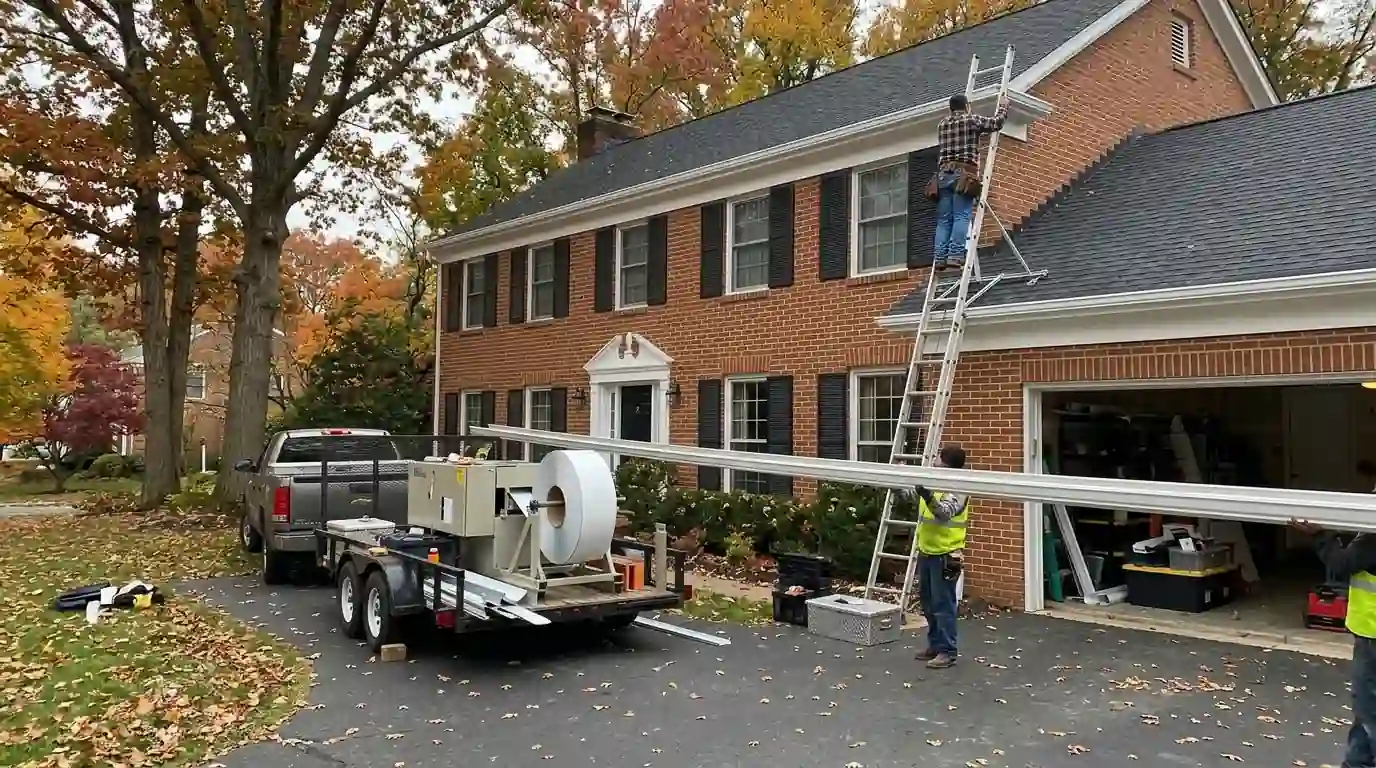
Seamless gutters in .032 aluminum, K-style profile, cover most houses we work on. We roll them from coil on a machine on our trailer, cut each run to the exact length of the eave and join only at the inside and outside corners. That removes the mid-run joints where older sectional gutters drip.
Six-inch troughs with 3x4 downspouts make sense on steep slate roofs, big hip roofs in Bethesda and McLean, and anywhere a lot of roof funnels into one valley. On a small porch roof a 5-inch run is still fine. We pick the size from the square footage and pitch draining to each run, not from a single default.
Copper half-round gutters belong on many Georgetown and Cleveland Park houses where the original detail was copper and historic review expects it. They cost more and take more labor at the joints, which we solder rather than caulk. Galvanized steel is still available for buildings that need it, but it rusts much sooner than aluminum unless it's kept painted.
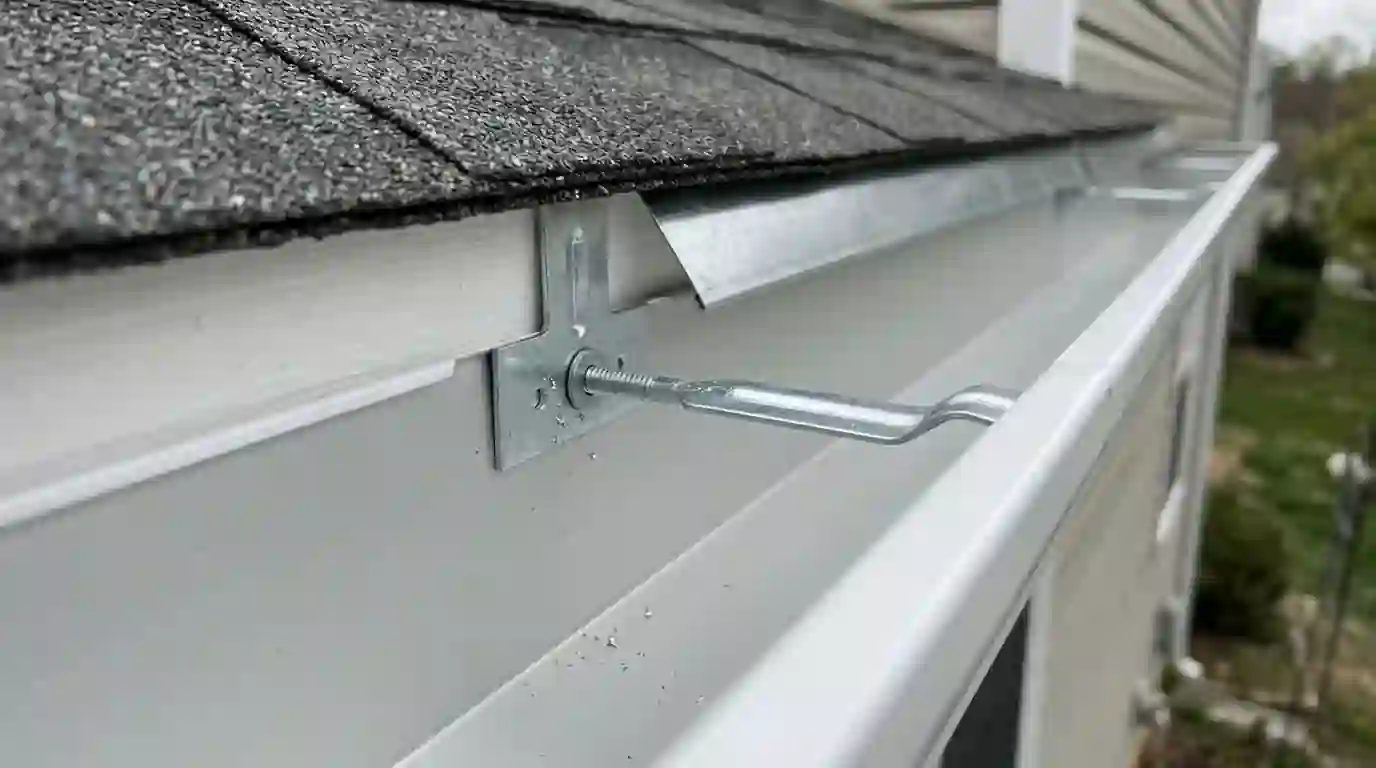
Hangers are where most installs fail. We use hidden screw-in hangers every 24 inches, closer at valleys and under slate where snow slides, driving the screws through the fascia into the rafter tails wherever we can find them. Spikes and ferrules, the old method, work loose as the wood shrinks and swells through the seasons.
Before a new run goes up we push a screwdriver into the board behind it. If it sinks in, we take care of replacing the rotted fascia first, because a new gutter screwed into rot will be on the ground after the first ice load. That work is priced separately so you can see exactly what it adds.
We also slide drip edge or a gutter apron under the first course of shingles so water can't run behind the trough. On houses where the shingles stop short of the gutter, that small strip of bent metal is the difference between a dry fascia and a stained soffit. Call (202) 771-7443 and we'll measure the eaves and walk the fascia with you before quoting.
Guards make the most sense on houses under oaks, tulip poplars and pines, which describes much of upper Northwest, Takoma Park and the older Fairfax subdivisions. If your gutters fill twice a year, a good screen pays for itself in avoided ladder work. If they barely see a leaf, skip it and keep the money.
Adding guards during installation costs less than coming back later, because the setup is already done and the trough is open. Our page on gutter guards explains which screens hold up under pine needles and which ones overshoot in heavy rain.
Overflow during normal rain, with clean gutters, means the trough is too small, the pitch is wrong or the outlets can't keep up.
Sectional gutters leak at every seam once the sealant ages, and patching them buys a season at most.
A gap between the gutter and the fascia means failed hangers or rotted wood, and both get worse with every load of wet leaves.
Old steel gutters rust from the inside, showing orange streaks long before the bottom gives out.
Trenches in the mulch under the eave or a wet basement corner usually trace back to a downspout dumping water too close.
On rowhouses, flaking paint or white efflorescence under the back gutter points to water running behind the trough.
We measure each eave, note the roof area draining to it and probe the fascia for soft spots before we quote.
Old runs come down and get hauled away, then we look at the fascia, drip edge and first course of shingles.
Rotted board is cut out and replaced, and a gutter apron goes under the shingles where the edge needs it.
Each gutter is rolled to length on site, then hung on hidden hangers with a measured fall toward the outlets.
We cut outlets, fit the downspouts and connect them to the underground line, a splash block or an extension.
A hose at the high end shows the water running to each outlet and leaving the house where it should.
These are typical 2026 ranges for homes in DC, suburban Maryland and Northern Virginia, installed with old gutters removed.
| Job | Typical range |
|---|---|
| Rowhouse rear gutter and one downspout | $585-$1,240 |
| Single-family home, 5-inch aluminum | $1,385-$2,790 |
| Larger home, 6-inch aluminum with 3x4 downspouts | $2,460-$3,960 |
| Copper half-round, per linear foot installed | $34-$58 |
| Fascia board replacement behind gutters, per foot | $17-$31 |
Height, the number of corners, access from a narrow alley and how much rotted wood we find move the price most. We give you a firm number only after measuring the eaves and looking at the fascia.
With proper pitch and solid hangers, aluminum gutters commonly run 20 to 30 years here. The paint finish fades before the metal fails. Most early failures come from rotted fascia or a downspout nobody cleared, not the gutter itself.
Yes, as long as the line still takes water. We run a hose into it before connecting anything. If it backs up, we route the downspout to the surface for now and show you where the blockage sits so a plumber can clear or reline it.
It depends on how much roof drains to each run and how steep it is. A small, low-pitched roof is fine with 5-inch. Steep roofs, valleys that empty into one corner and large hip roofs usually need 6-inch with larger downspouts.
Like-for-like gutter replacement usually doesn't need a building permit in the District. In a historic district, a visible change in gutter style or material can need sign-off from the Historic Preservation Office, so we check before swapping copper half-round for aluminum.
We hang gutters year-round as long as the fascia is dry enough to fasten into and the corner sealant can cure. Sealants want temperatures above about 40 degrees, so on cold days we work midday and seal the corners last.
These are the places we drive to most for this work. We cover all 45 areas on our service area list.
Leaking seams, sagging runs, crushed downspouts and clogged alley tie-ins fixed on the spot, so you keep sound gutters instead of replacing them early.
Gutter Repair detailsStainless micro-mesh and solid-hood guards fitted for oak, tulip poplar and pine cover, so the gutters keep flowing between cleanings.
Gutter Guards detailsRotted fascia boards, sagging soffits and squirrel holes at the eaves rebuilt with solid wood or PVC, then wrapped and vented so the roof edge stays dry.
Fascia and Soffit Repair detailsRelining and rebuilding the built-in box gutters hidden behind DC rowhouse cornices, plus the rotted wood, outlet tubes and downspouts around them.
Box Gutter Repair detailsCall and a roofer will answer, any hour of any day. We stop the leak first and fix it properly once the roof is dry.