Colonial Revival and Tudor
Steep slopes, multiple gables and dormers are common, with slate or architectural shingles.
Washington, DC neighborhoods
Many detached houses west of Connecticut Avenue are reaching the age when their first slate or shingle roof needs a real decision. Owners in Chevy Chase DC usually ask the same thing: how much life is left, and is it worth repairing?
Chevy Chase DC homes are mostly 1910s to 1940s Colonial Revival, Tudor and Dutch Colonial houses, many with slate roofs. Slate often outlives its nails and flashing, so targeted repair can buy decades. When a full roof is due, natural slate commonly runs $38,600-$71,400 and synthetic slate $24,900-$43,200 on a typical house, depending on size, steepness and dormers.
A house built on Morrison Street in 1925 may still have its first slate, a second asphalt roof from the 1990s or a third roof installed last decade. The age of the house does not tell you much. What we look at is the material, the condition of the fasteners and the state of the flashing, because each wears on its own clock.
Pennsylvania and Vermont slate can last a century or more. Soft slate from other quarries delaminates sooner, flaking in layers you can see from a ladder. Asphalt laid in the 1990s is often near its end now, with curled tabs and bald spots on the south slopes. A roof inspection from a ladder and the attic tells you which group your house is in.
Flashing is usually the first thing to go regardless of roof material. Original copper on the oldest houses holds up well, but galvanized steel valleys and lead-coated chimney aprons from mid-century repairs rust or split. On Tudor houses with steep intersecting gables, a single failed valley can rot a section of decking while the slopes on either side look perfect. We check every valley from above and look for dark staining on the rafters below it in the attic.
We write down what we find slope by slope, with photos, so you can plan the work over a few seasons instead of all at once.
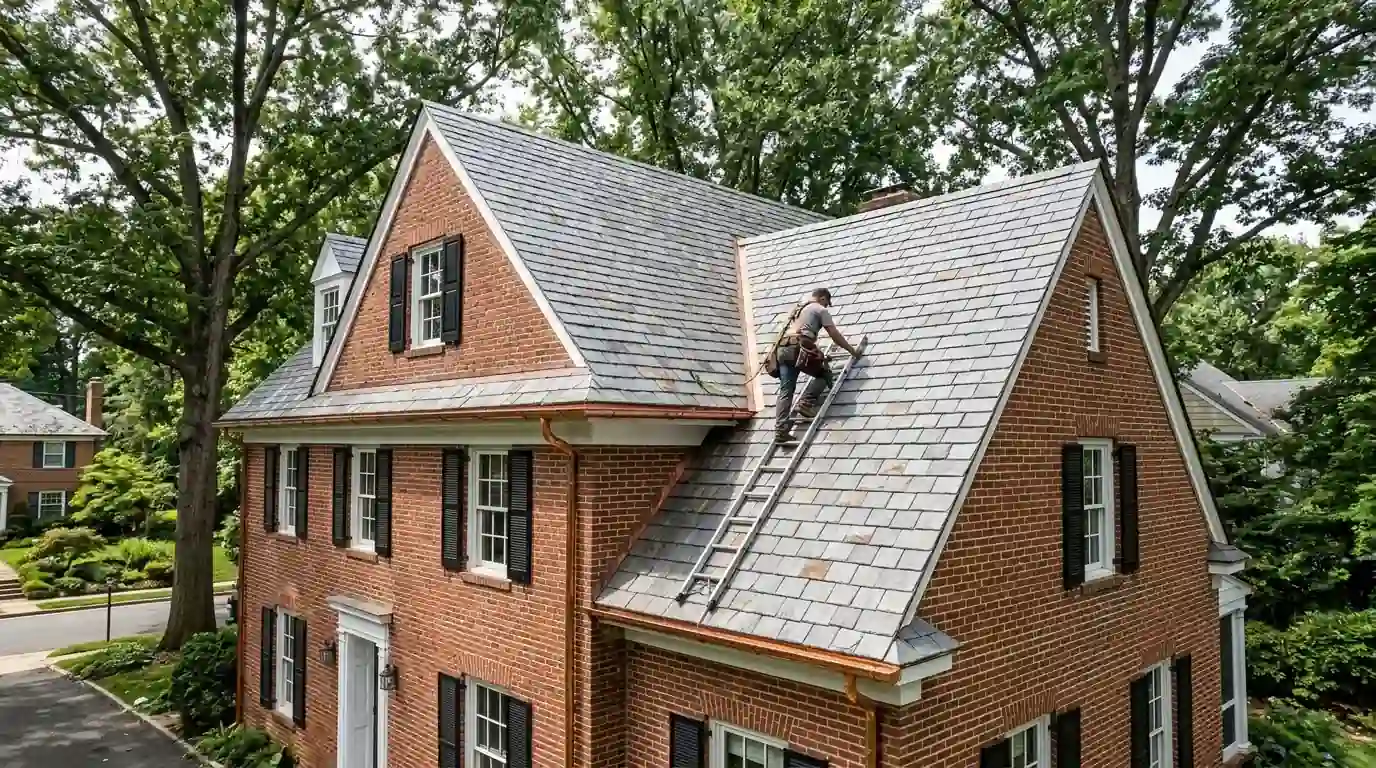
If the slate itself is sound and only a scattering of pieces have slipped, repair wins. We replace broken slates with matching salvaged stock, hang them on copper hooks and rebuild failing valleys and chimney flashing in copper. That work often costs a fraction of a new roof and leaves the original look intact.
When a large share of the slate is soft or crumbling, replacing it with new natural slate keeps the house authentic, but the cost is high. Synthetic slate made from polymer or rubber composite looks close from the street, weighs much less and costs less to install. It does not last as long as good stone, and that tradeoff is worth weighing before you choose.
Chevy Chase DC is not a designated historic district, so the choice is yours, with a standard DOB permit for a full replacement.
Large oaks and tulip poplars shade most lots between Western Avenue and Rock Creek Park. Shade keeps north slopes wet, and moss grows in the gaps between slates. The heavier problem is leaf load: half-round copper and aluminum gutters fill quickly, and overflowing water rots fascia and soaks foundation plantings.
We clean and reslope gutters during repair visits and recommend leaf guards where the tree cover is heaviest. Copper half-rounds on slate houses get soldered joints and new hangers rather than caulk.
Most houses have a driveway or side yard, so a dumpster can sit off the street. We protect the driveway with plywood under the container and cover plantings below the eaves. Slate tear-offs are heavy, so we sort reusable pieces from debris on the roof and lower them in buckets instead of chuting them.
Steep slopes, multiple gables and dormers are common, with slate or architectural shingles.
Many first-generation slate roofs survive, with nail and flashing failure the main issue.
Mature street trees and yard trees near Rock Creek Park bring moss, leaf load and gutter overflow.
Copper and aluminum half-rounds with ornamental hangers need soldered seams and periodic resloping.
Slate repair for Victorian mansards, turrets and steep DC roofs: broken slates replaced with copper hooks or nail-and-bib, plus valley and flashing rebuilds.
Slate Roof Repair detailsNatural slate replacement for Victorian mansards, turrets and steep roofs, with copper flashing, salvaged slate matching and historic district coordination.
Slate Roof Replacement detailsComposite slate tiles that give colonials, Tudors and non-contributing homes a slate look at a fraction of the weight, with copper or steel flashing.
Synthetic Slate Roofing detailsA walk of the whole roof with photos and a written condition report: membrane, slate, shingles, flashing, drains, parapets and attic, for owners, buyers and sellers in DC.
Roof Inspection detailsStainless micro-mesh and solid-hood guards fitted for oak, tulip poplar and pine cover, so the gutters keep flowing between cleanings.
Gutter Guards detailsNew step, apron, counter and cricket flashing around brick chimneys on slate, shingle and flat roofs, cut into mortar joints instead of glued to the face.
Chimney Flashing Repair detailsTap test and look: sound slate rings, soft slate thuds and flakes. If most pieces are sound and only some have slipped, repair makes sense. We check from the roof and the attic and give you a plain answer.
From the sidewalk most people cannot tell, especially in the darker gray blends. Up close it reads as composite. We bring samples so you can hold them next to your existing roof.
It is not a designated historic district, so a standard DOB permit covers a full replacement. We file it as part of the job.
Yes. We stage away from the root zone, avoid dropping debris into the canopy and tie back branches that hang over the work area. Ring (202) 771-7443 and we will find a morning that suits you.
Call any hour. We answer 24/7 and tell you when a roofer can be at your house.