Slate colonials
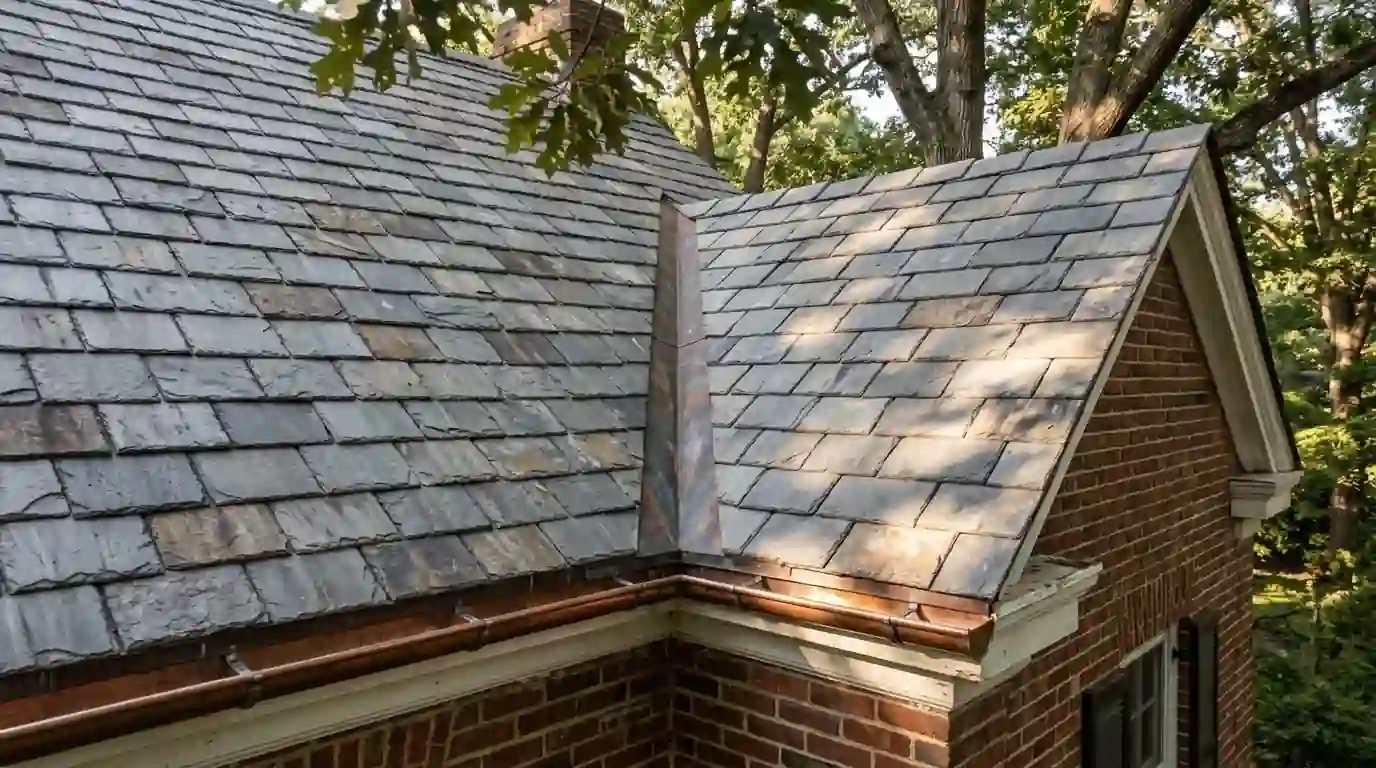
Many 1920s and 1930s houses in Edgemoor still carry original slate, where the nails and flashing fail long before the stone does.
Maryland
Between Wisconsin Avenue and Old Georgetown Road, Bethesda mixes 1920s colonials with slate and copper trim, 1940s Cape Cods, and big new houses built where older homes came down. Each of those roofs fails in its own way, and we price and repair them accordingly.
Bethesda roofs lean toward heavier materials: slate on older Edgemoor and Battery Park colonials, cedar shakes on some 1930s to 1950s homes, and copper on bays, dormers and gutters. A slate repair visit often runs $485-$1,620. Cedar or synthetic slate replacements are priced only after we measure and inspect the deck. Call (202) 771-7443 to set up a visit.
Edgemoor, Battery Park and East Bethesda grew up from the 1910s through the 1940s, and many original houses still stand: brick and stucco colonials, Tudor revivals and Cape Cods with steep front gables. A good number still wear Pennsylvania or Buckingham slate, often with copper valleys that have outlasted two or three owners. Huntington Terrace adds smaller bungalows and a few Sears kit homes.
Slate on these houses usually outlives its fasteners. Iron nails rust through, slates slide out, and the gap lets water reach the felt beneath. We replace individual pieces with salvaged slate of the same color and size, hold them with copper nails or slate hooks, and check the valleys while we're up there. Our slate repair page covers the methods in more depth.
We also look hard at the snow guards. Older slate roofs over front walks often had rows of copper or bronze guards that have since bent or pulled loose, and a slab of sliding snow off a steep slate roof can tear a gutter clean off the fascia.
Bethesda sees steady infill construction, and a neighbor's excavation, crane picks or scaffolding can send debris onto your roof. We photograph the condition of your slate, gutters and flashing before the project next door starts, so if pieces crack you have dated evidence to show the builder.
New houses here usually go up with architectural shingles, synthetic slate or standing seam metal over porches. Where an owner wants the look of the older street without the weight, synthetic slate is a common choice, though we only install it after checking the manufacturer's slope and underlayment rules against that particular roof.
Wood shakes turn up on some 1940s and 1950s colonials and Cape Cods in neighborhoods like Wood Acres and Bannockburn. Under heavy oak and tulip poplar shade, the shakes stay damp, grow moss and split along the grain. We replace damaged shakes with straight-grain western red cedar, keep the keyway spacing correct, and clear the valleys so leaves don't dam water.
Copper gutters, bay roofs and dormer cheeks are common on the better-built older homes. Copper rarely wears out from weather; it fails at soldered seams and where expansion has split a long run. We resolder seams, add expansion joints, and replace sections in 16 or 20 ounce copper to suit what's already on the house. Tall brick stacks get their own attention through our chimney flashing repair work.
Bethesda is unincorporated, so roof replacements generally go through the county permit office. A few small municipalities just east of Wisconsin Avenue, toward Chevy Chase, add their own rules, and we check the boundary for addresses near that line.
Parking near the Bethesda Metro, Woodmont Triangle and the side streets off Old Georgetown Road is tight. We schedule dumpster drops early, use a small trailer where a roll-off won't fit, and keep slate and copper stacked on the property instead of the sidewalk.
Many 1920s and 1930s houses in Edgemoor still carry original slate, where the nails and flashing fail long before the stone does.
Steep front gables and shed dormers on 1940s homes need careful step flashing where dormer walls meet the main roof.
Large new houses carry complex hip roofs with many valleys, so even a small leak takes careful tracing.
North slopes under mature oaks stay wet and grow moss on shingles and shakes alike.
Bay windows, dormers and half-round gutters in copper need soldered repairs, not caulk.
Slate repair for Victorian mansards, turrets and steep DC roofs: broken slates replaced with copper hooks or nail-and-bib, plus valley and flashing rebuilds.
Slate Roof Repair detailsFull tear-off and new roof systems for DC rowhouses, Victorians and suburban colonials, from low-slope membranes to shingle, slate and metal.
Roof Replacement detailsWestern red cedar shake and shingle roofs for Capes, cottages and colonials, laid over breathable underlayment with stainless fasteners and copper flashing.
Cedar Shake Roofing detailsSoldered and standing seam copper for bay roofs, turrets, dormers, cupolas and entry roofs, plus copper valleys, caps and built-in gutter liners.
Copper Roofing detailsNew step, apron, counter and cricket flashing around brick chimneys on slate, shingle and flat roofs, cut into mortar joints instead of glued to the face.
Chimney Flashing Repair detailsStainless micro-mesh and solid-hood guards fitted for oak, tulip poplar and pine cover, so the gutters keep flowing between cleanings.
Gutter Guards detailsUsually, yes. We slide out the broken pieces with a slate ripper, install salvaged slate of similar color and thickness, and secure each one with a copper hook or nail. If the whole field is delaminating, we'll show you photos and explain why spot repairs no longer make sense.
It can be, especially where the framing can't carry real slate. We look at the slope, the existing trim details and how close the product's color comes to the neighbors' roofs before recommending it.
In most cases a full replacement needs a permit from the county permit office. We confirm the requirement for your address and handle the application before tear-off.
Call any hour. We answer 24/7 and tell you when a roofer can be at your house.