Framing built for shingles
If your rafters were sized for asphalt, composite slate gives the look without reinforcing the roof.
Roof replacement and new roofs
You like the look of slate on your house, but the quote for natural stone was more than the car in the driveway and the framing was never built to carry it.
Materials we install
Synthetic slate is a molded tile made from recycled rubber and plastic polymers, shaped and colored to look like natural slate. It weighs a fraction of real stone, cuts with a utility knife and resists impact. It fits detached homes and non-historic slopes that want a slate appearance. Installed costs around Washington usually run $1,270-$1,890 per square, or about $26,700-$61,400 for a typical colonial.
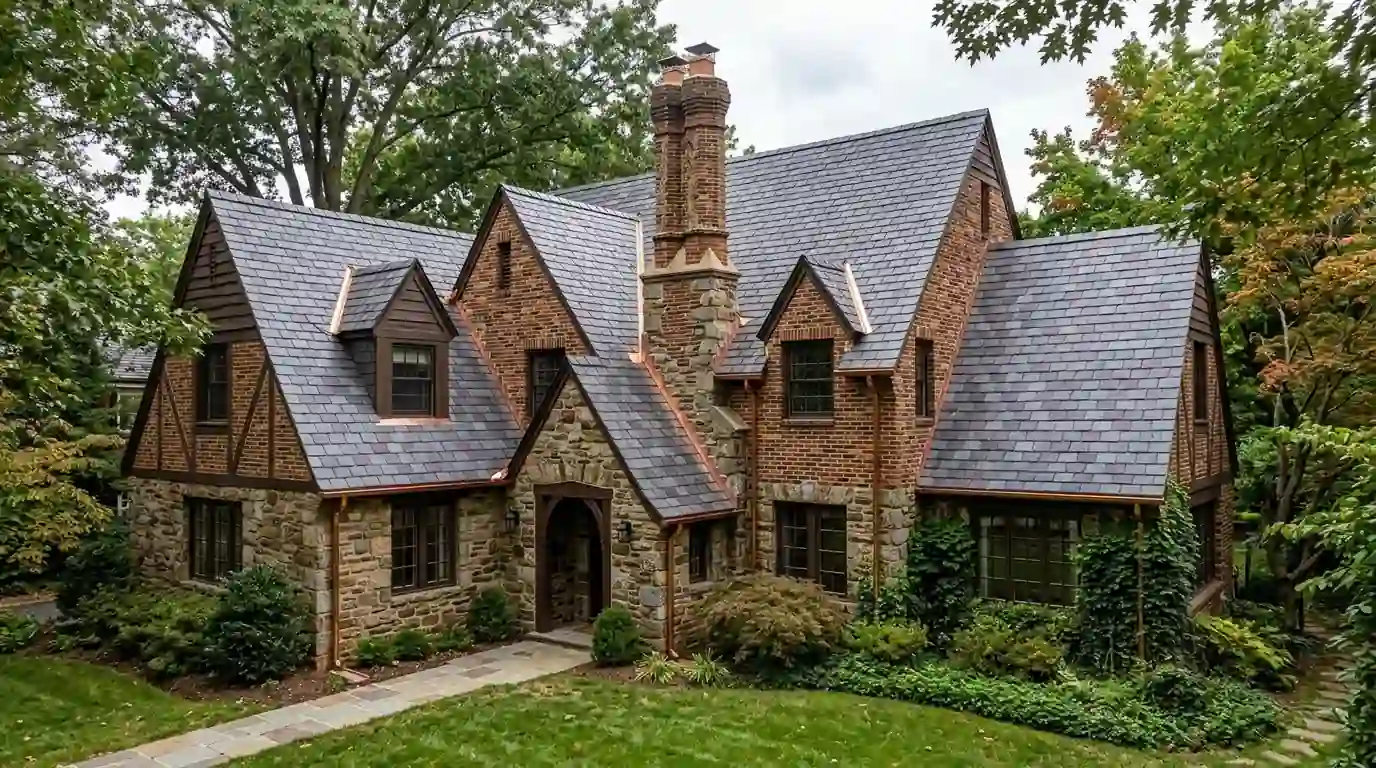
The best candidates are detached homes in upper Northwest, Bethesda, McLean and Falls Church where the owner wants a slate character but the house was framed for shingles. A two-story colonial with a 2x6 rafter system can't carry 1,200 pounds per square, but it handles composite slate at roughly a quarter of that without any structural work.
It also suits owners who are replacing a shingle roof on a Tudor or Cape and want the roof to finally match the house. Steep gables, eyebrow dormers and stone chimneys look right under slate-textured tiles in the gray, black or purple blends that composite makers offer.
It is not a magic fix for every slate roof. On historic rowhouses and contributing buildings, natural slate is still the expected choice, and we cover that in our natural slate replacement work.
Inside a DC historic district, any visible change of roof material goes through the Historic Preservation Office. Some composite products have been accepted on secondary slopes or on non-contributing buildings, but approvals vary case by case. On a front mansard in Mount Pleasant or on Capitol Hill, the starting answer is usually natural slate.
We don't promise approval. What we do is prepare the file: product samples, photos of the house and neighboring roofs, and installation details that show how the new tiles meet copper flashing and existing trim. In Georgetown, the Old Georgetown Board reviews visible changes, and we treat that as a longer timeline.
Outside historic districts, you need only a standard permit, from the DC Department of Buildings or from the county permit office in Maryland and Virginia.
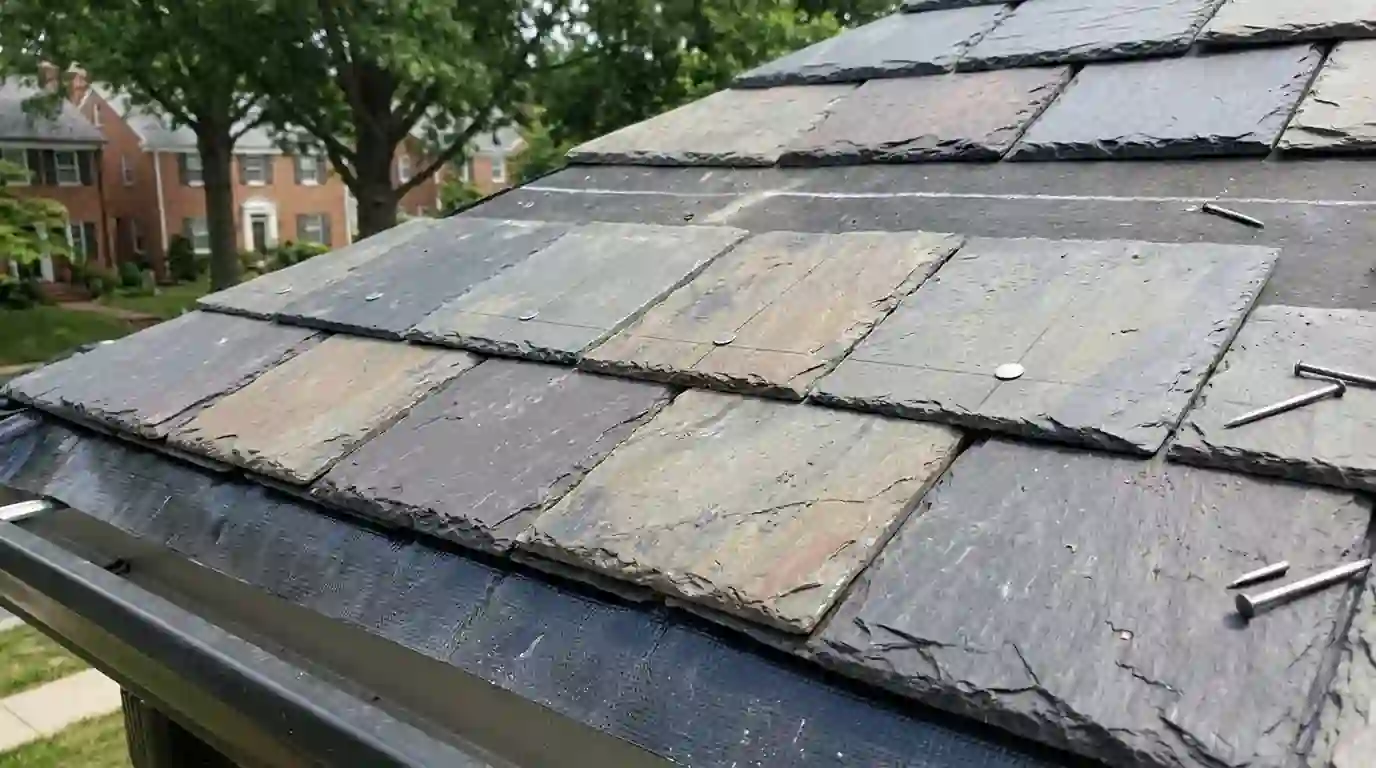
Composite slate varies a lot. Cheap tiles look flat and plastic in low-angle light, while better products have hand-split edges, varied thickness and mottled color that read as stone from the sidewalk. We install lines such as DaVinci Slate, Brava and EcoStar Majestic, and we bring full-size tiles so you can see them on your roof in your light.
Blending matters more than the base color. Real slate roofs vary from tile to tile, and so should a synthetic one. We mix tiles from several bundles and follow the maker's blend ratio so the finished roof doesn't show repeating stripes or patches.
Width variation helps too. Many products come in several widths that we shuffle across each course, mimicking the uneven random-width look of a traditional slate roof.
Synthetic slate sheds water like natural slate, through headlap and overlap, so the details underneath matter just as much. We lay ice and water membrane along every eave, in valleys and around chimneys, then a high-temperature synthetic underlayment across the rest of the deck. Dark composite tiles get hot in July sun, and cheap felt can soften beneath them.
Each tile gets stainless or hot-dipped galvanized ring-shank nails through the pre-marked nailing zone. Composite tiles expand with heat, so we leave the side gap the maker specifies. Butting them tight leads to buckling by the second summer.
Valleys and flashings go in copper for a premium look or in pre-finished steel for budget. Chimneys get new step flashing woven into each course and counterflashing let into the mortar joint. Snow guards are a good idea over porches and walks on steep slopes, since composite tiles shed snow quickly once it starts to melt.
Many of the homes that suit composite slate sit under big trees. Streets off Connecticut Avenue, the older sections of Bethesda and much of McLean have oaks and tulip poplars that drop limbs every summer storm. Natural slate cracks when a heavy branch lands on it, and asphalt shingles tear. Composite tiles flex and spring back, and the better lines carry a Class 4 impact rating.
Shade brings moss and debris. Composite tiles don't absorb water the way some stone does, so moss has a harder time rooting, but leaves still pile up behind chimneys and in valleys. We set crickets behind wide chimneys and leave open copper valleys wide enough to flush debris instead of trapping it.
Wind matters as well. Each tile is nailed independently, so a gust that lifts one piece doesn't zipper across the course. We add extra fasteners at rakes and eaves on exposed hilltop lots, where summer squall lines hit hardest.
Composite slate costs two to three times as much as architectural shingles. In return, it lasts much longer, often 40 to 50 years, resists hail and wind well, and gives a period house its proper character. For owners who plan to stay put, the per-year cost narrows quickly.
For a starter colonial you may sell in five years, architectural shingles with a slate-style profile might be a better use of the money. We price both and lay them side by side so you can decide with real numbers.
If your rafters were sized for asphalt, composite slate gives the look without reinforcing the roof.
When real slate is out of reach, composite tiles can cost far less installed.
Impact-resistant composite tiles hold up better than shingles under falling limbs on wooded lots.
A Tudor or colonial wearing basic shingles often looks better and sells better with a slate-style roof.
On non-visible rear slopes, composite tiles can sometimes replace failing natural slate where rules allow.
We bring full-size tiles, measure every slope and check framing and deck condition.
Where historic review applies, we prepare the submission; otherwise we file the standard permit.
The old roof comes off, the deck is repaired and refastened, and edges are prepped.
Ice barrier, high-temperature underlayment, valleys, drip edge and chimney flashing go on.
Tiles are blended, shuffled by width and nailed with correct gaps and headlap.
Hip and ridge pieces and snow guards are installed, and you get the photo record.
Composite slate is priced per square installed, plus metal work and any deck repair. These 2026 ranges are typical for DC area homes.
| Job | Typical range |
|---|---|
| Composite slate installed, per square | $1,270-$1,890 |
| Cape Cod or small colonial, full roof | $26,700-$38,900 |
| Large colonial or Tudor, full roof | $41,300-$61,400 |
| Copper valleys and flashings upgrade | $3,460-$9,180 |
| Snow guards over entries, per run | $415-$1,060 |
Roof complexity, dormers, pitch, copper versus steel flashing and the product line chosen drive most of the difference. Simple gables on sound decks land near the low end.
Most composite slate carries a rated life of around 40 to 50 years. Natural slate can last a century or more. For houses not designed for stone weight, composite still lasts well beyond asphalt shingles.
Better products hold color well, with some gentle weathering in the first few years, similar to natural slate. Lower grade tiles can fade or chalk, which is one reason we steer owners to proven lines.
Yes, more easily than natural slate. Composite tiles flex rather than crack underfoot, so chimney sweeps and gutter cleaners can work on them with normal care.
Usually no. Most products weigh roughly 250 to 350 pounds per square, close to a heavy architectural shingle. We still check rafters and deck during the walk to rule out older damage.
We don't recommend mixing them on the same slope, because color and texture differ up close and the products age differently. Using composite on a hidden rear slope while keeping natural slate on the front is sometimes a workable compromise.
These are the places we drive to most for this work. We cover all 45 areas on our service area list.
Natural slate replacement for Victorian mansards, turrets and steep roofs, with copper flashing, salvaged slate matching and historic district coordination.
Slate Roof Replacement detailsArchitectural shingle roofs for colonials, Cape Cods and split-levels, with ice barrier at eaves, new valley metal and balanced ridge venting.
Asphalt Shingle Roofing detailsFull tear-off and new roof systems for DC rowhouses, Victorians and suburban colonials, from low-slope membranes to shingle, slate and metal.
Roof Replacement detailsSlate repair for Victorian mansards, turrets and steep DC roofs: broken slates replaced with copper hooks or nail-and-bib, plus valley and flashing rebuilds.
Slate Roof Repair detailsCall and a roofer will answer, any hour of any day. We stop the leak first and fix it properly once the roof is dry.