Porch roofs
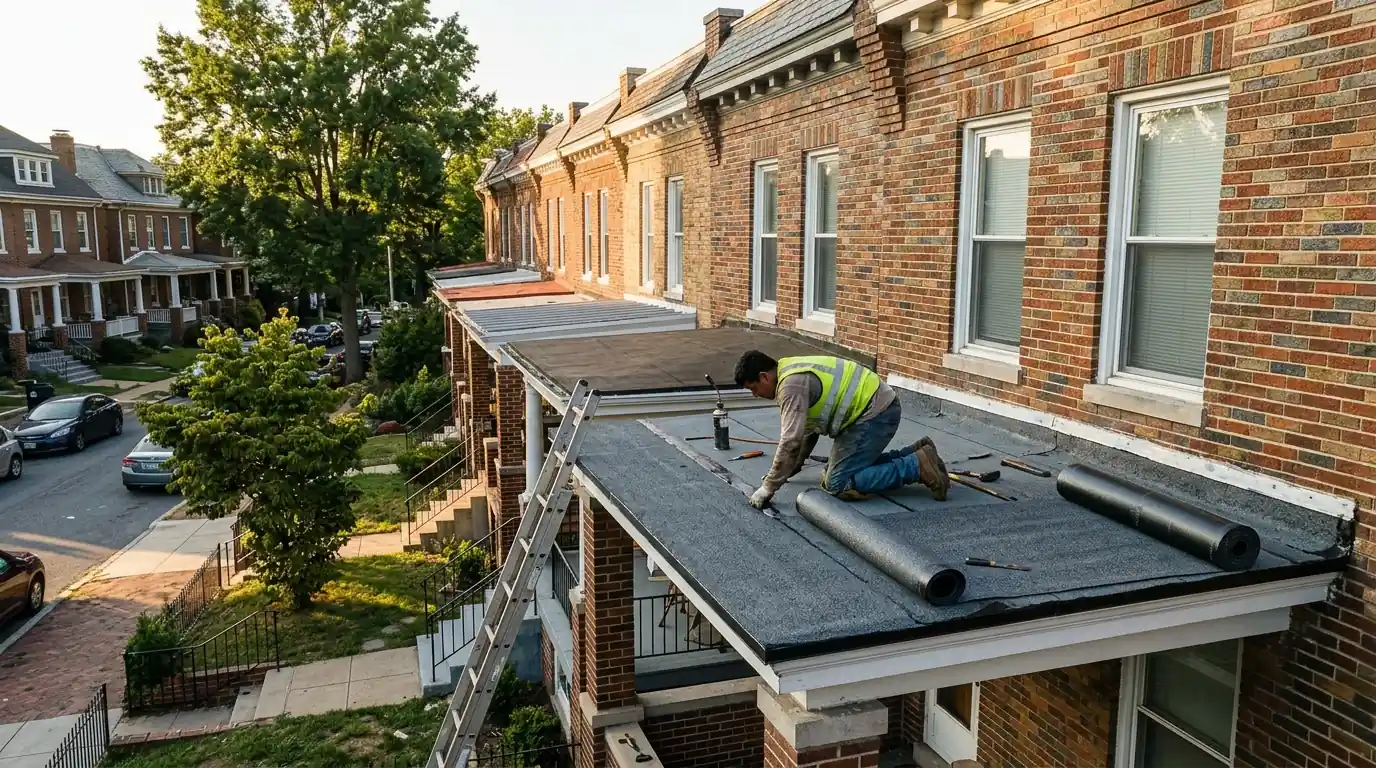
Separate low-slope roofs over front porches carry heavy runoff and often hide several old layers of roll roofing.
Washington, DC neighborhoods
Petworth's porch-front rowhouses went up in long matching blocks in the 1910s and 1920s, which means many of their roofs are now on the same aging cycle. If one porch roof on your row is leaking, the house next door is probably close behind.
The typical Petworth house has two low-slope roofs: the main roof over the second floor and a separate porch roof out front. Many also have a narrow strip of clay tile or slate along the front cornice. Replacing the main roof with a reflective membrane usually runs $7,940-$13,600; a porch roof alone is often $2,180-$4,350, depending on decking rot and flashing at the brick.
Porch roofs catch everything that drains off the front of the house, and their pitch is barely there. On blocks around Upshur, Taylor and Shepherd Streets, we often find porch roofs with four or five layers of roll roofing and a gutter that sags at one corner. Water ponds in the low spot, the top layer cracks, and the leak shows up as a stain on the porch ceiling beadboard.
The fix depends on what is underneath. When the decking is sound, we strip the old layers, set a new base sheet and finish with a granulated modified bitumen cap that matches the look of the street. When the boards are soft, we replace them and sometimes add tapered strips so water actually reaches the gutter.
The joint where the porch roof meets the brick front wall is the other weak spot. Old tar patches there trap water instead of shedding it. We cut a reglet into the mortar joint and set a new metal counterflashing so the membrane tucks underneath it.
Petworth rowhouses share party walls and, on many blocks, one continuous roof line from end to end. When we replace your section, we cut a clean edge at each party wall, tie into the neighbor's roof with a lapped membrane and seal the seam so the two systems act as one. We talk to the neighbor on each side before we start, because our tear-off reaches their side of the wall by a few inches.
Most houses here drain to the rear, toward the alley, through a single scupper and downspout. That scupper is often undersized or rusted shut. As part of a full flat roof replacement we rebuild the scupper box, check the slope across the deck and add a second drain point where water has been standing.
DC energy rules push a reflective membrane on low-slope replacements, so we usually install white TPO or a light granulated cap. Our page on TPO roofing covers how we weld the seams and detail the edges.
Many Petworth rows have a short decorative mansard across the front, often red clay tile or slate set over a steep wood frame. Those strips look solid from the sidewalk, but broken tiles and failed nails at the top course let water into the front wall cavity. We reset slipped pieces, swap cracked ones with salvaged tile and reflash the transition where the strip meets the flat roof behind it.
Grant Circle and Sherman Circle frame some of the most intact blocks, and owners there tend to want the original front kept. We price repairs and full replacement side by side so you can decide with real numbers in hand.
Most Petworth blocks have paved rear alleys wide enough for a pickup and a trailer, which keeps roll goods and debris off Georgia Avenue and away from the front porches. We load the roof from the alley side with a hoist and lower tear-off into a covered trailer, then sweep the alley and check gutters for nails before we leave.
Separate low-slope roofs over front porches carry heavy runoff and often hide several old layers of roll roofing.
Most main roofs slope gently toward the alley and rely on one scupper, so clogs show up fast as ponding.
Short clay tile or slate mansards across the facade need reset tiles and new flashing at the back edge.
Long rows share one roof plane, so every replacement involves tying into the neighbors on both party walls.
Pop-up third floors and roof decks have appeared on many blocks, adding new walls that need step and base flashing.
Tear-off and new low-slope roofs for rowhouses and flats, with tapered insulation for ponding, new parapet flashing and reflective cool roof membranes.
Flat Roof Replacement detailsTear-off and new low-slope roofs for DC rowhouses, with party-wall parapets, rear ells, neighbor tie-ins and the rear scupper that carries all the water handled properly.
Rowhouse Roofing detailsLow-slope roof repair for DC rowhouses and additions: modified bitumen, EPDM, TPO and coated roll roofing, plus ponding areas, curbs and parapet base flashing.
Flat Roof Repair detailsLeaking scuppers through rowhouse parapets, rusted conductor heads and clogged internal roof drains rebuilt so flat roofs empty fast after a storm.
Roof Drain and Scupper Repair detailsRepairs to the brick walls that rise above rowhouse roofs: loose coping, cracked caps, open mortar, failed through-wall flashing and the membrane where it meets the parapet.
Parapet Wall and Coping Repair detailsHeat-welded white TPO membranes for rowhouse and low-slope roofs, built to meet DC cool roof expectations and shrug off ponded water.
TPO Roofing detailsYes. The porch roof is a separate surface with its own gutter, so it can be done on its own in a day or two. We still look at the main roof while we are up there and tell you how much life it has left.
Usually the leak comes from the seam between two roofs of different ages. We open the joint, find which side failed and repair it so both roofs tie together again. We explain what we found to both owners.
Petworth is not one of DC's designated historic districts, so roof work goes through a standard DOB permit. That makes permitting simpler than on Capitol Hill or in Mount Pleasant, though permit timing still matters for planning.
Most rowhouse main roofs take two to three working days once the permit is in hand, weather allowing. Rotted decking or a rebuilt scupper can add a day. Call (202) 771-7443 to set a time for us to look.
Call any hour. We answer 24/7 and tell you when a roofer can be at your house.