Slates out of line
A slate sitting lower than its neighbors or sticking out at an angle has lost its nails and will drop soon.
Roof repair
The steep slate front on a Victorian rowhouse is the face of the whole block, and when slates start sliding into the gutter or the top-floor front room shows a stain, it needs careful hands rather than a tube of caulk.
Materials we install
Mansard roof repair fixes the steep, nearly vertical lower slope found on many late 1800s DC rowhouses, usually covered in slate with dormer windows. You need it when slates slip or crack, the front bedroom ceiling stains, or dormer trim rots. Most mansard repairs here run about $585 to $2,340, with scaffolding, copper work and dormer carpentry pushing larger jobs higher.
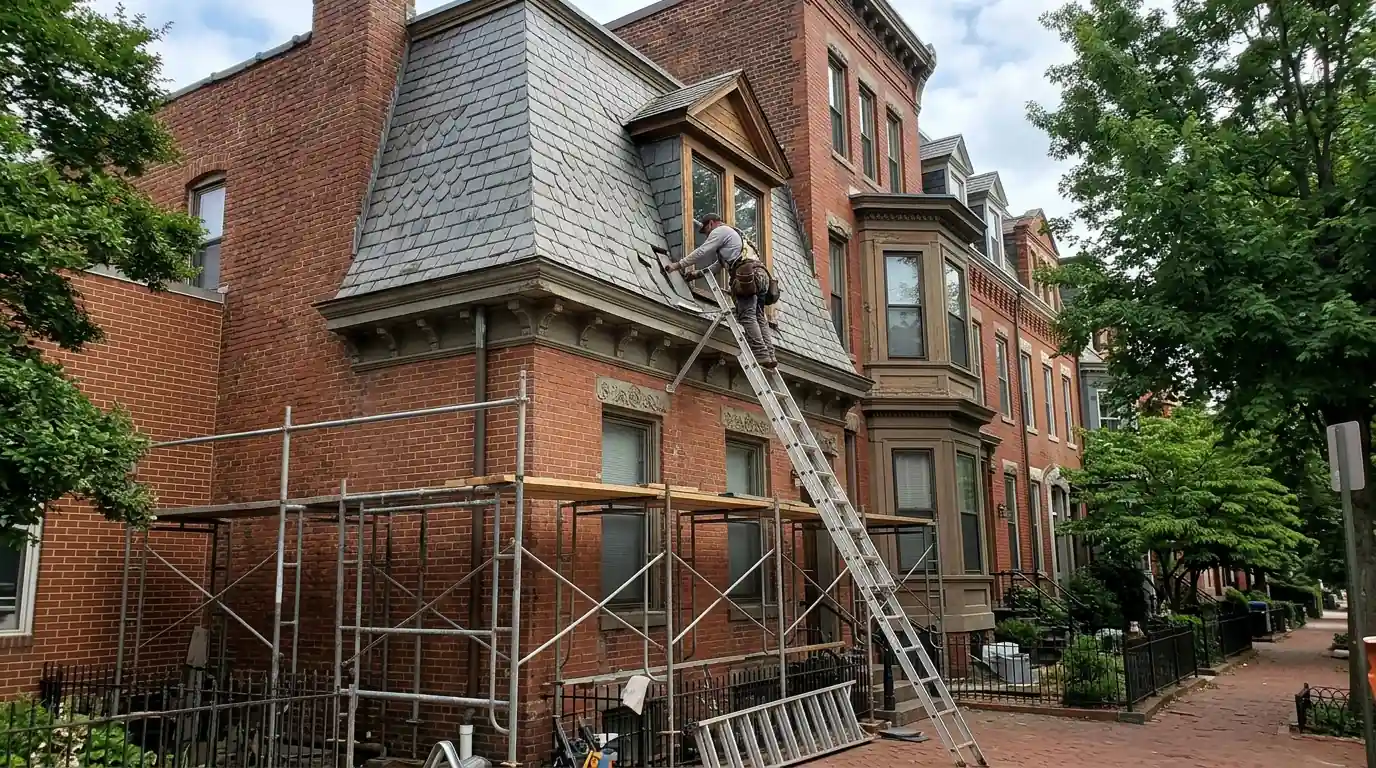
A mansard is really two roofs. The front face rises from the cornice at a steep pitch, often with one or two dormers, and is usually covered in slate laid in rows of rectangles, fish scales or hexagons. Behind and above it sits a low-slope roof covering most of the house, hidden from the street. You see this form across Capitol Hill, Shaw, LeDroit Park and the Logan Circle blocks.
Where those two roofs meet is the weakest point. A metal or membrane transition lies at the top of the mansard, and if that joint opens, water runs straight down behind the slate onto the front wall. Many leaks blamed on the slate actually start there, at the flat roof edge.
At the bottom, most mansards drain into a built-in or box gutter set into the cornice. When that gutter lining cracks, water soaks into the cornice and the wall below. We look at the gutter with every mansard repair and handle failures through our box gutter work.
Slate rarely wears out before the nails holding it. Old iron nails rust through at the head, and the slate slides down until it rests on the course below or falls into the gutter. On a mansard, the pitch is so steep that a loose slate drops quickly and can hit the sidewalk.
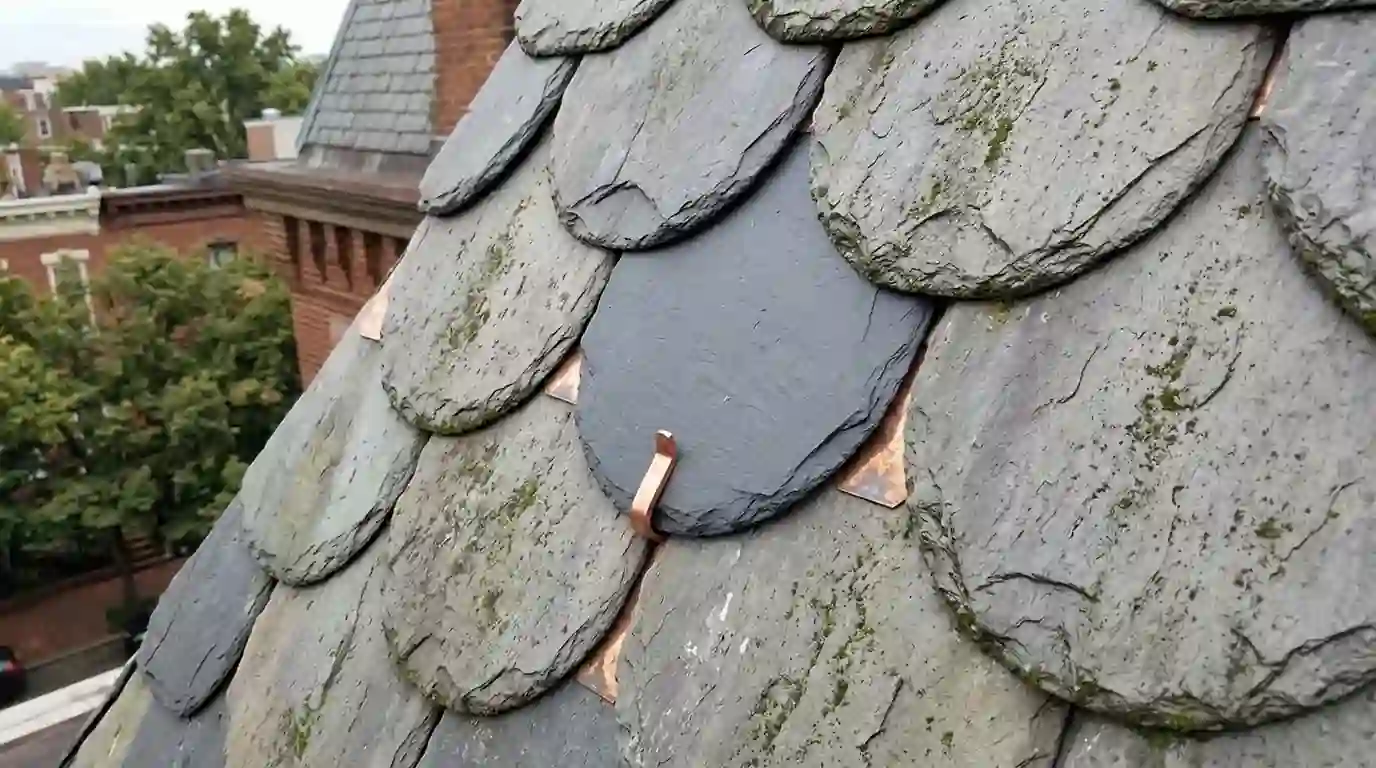
To replace a slate, we use a slate ripper to reach under the course above and cut the old nails. A new slate of matching size, thickness and color goes in, held with a copper slate hook or a copper nail through the joint, covered by a copper bib. We do not face-nail slates with a dab of sealant, which is the shortcut that fails within a few winters.
Matching matters on a visible front. We keep salvaged slate in common DC sizes and colors, including the soft gray Pennsylvania and purple and green Vermont slates used on many local blocks. On patterned mansards we match the shape of the piece, not just the color. Our slate roof repair page covers the same methods on pitched main roofs.
Dormers make a mansard work as living space, but each one adds side walls, a small roof and a window with its own flashing. The side walls, called cheeks, are often covered in slate or metal and flashed into the main slope with step pieces. When that flashing rusts or the cheek wood rots, water shows up around the inside window frame.
We open the area around the dormer, replace rotted sheathing or trim, install new copper step and apron flashing, and reset the slate. The small dormer roof on top is often a tiny flat or low-slope surface, and it gets the same attention as any other flat roof, with membrane turned up properly at the wall.
Window trim on dormers is wood, painted, and exposed to every storm. Peeling paint and soft sills are the first sign of trouble. Catching that early keeps the repair to a few boards of trim rather than a full dormer rebuild.
Mansard repairs usually happen above a public sidewalk on a busy street. Depending on the scope, we use ladders with stand-offs, roof brackets set from the top, or a pipe scaffold on the front, and we protect pedestrians below. Larger jobs that need scaffolding or a sidewalk closure may need a public space permit from the District, which we plan around.
Many mansard streets sit in historic districts, including Capitol Hill, Shaw, Mount Pleasant and LeDroit Park. Like-for-like slate repair generally keeps you clear of extra steps, while switching materials or colors on a visible front can need approval from the Historic Preservation Office. We stick with slate, copper and matching details on the street face.
If more than about a fifth of the slates are slipping, the nails are failing across the whole face, or the underlayment and sheathing are rotted in several places, a piece-by-piece approach becomes expensive and never ends. At that point, stripping the face, replacing damaged boards and relaying the good slate with new copper nails gives the front another long run.
We count the slipped and broken slates, check the sheathing from inside where we can, and show you photos before recommending anything bigger than a repair. A full relay is covered under slate roof replacement, and good original slate is often reused on the front to keep the historic look.
A slate sitting lower than its neighbors or sticking out at an angle has lost its nails and will drop soon.
Broken slate below the house means gaps have opened in the face and water can reach the underlayment.
Water marks on the ceiling or upper wall of a front room often trace to the mansard or the joint above it.
Blistering paint and soft wood at dormer sills and cheeks mean water is getting behind the trim.
Orange stains running down from nail holes show iron nails corroding throughout the face.
Water spilling over the front cornice in rain points to a blocked or failed built-in gutter at the base.
We look at the face from the sidewalk, then from above, counting loose slates and checking the top joint.
We decide on ladders, brackets or scaffolding and arrange any public space needs before work starts.
Barriers and debris netting keep falling material away from passersby.
Broken or slipped slates are swapped with matched pieces on copper hooks or nails, and failed flashing is replaced.
Rotted cheek boards, sills and trim are replaced and flashed before the slate is relaid around them.
We clear and inspect the built-in gutter and the flat roof transition so the repair is not undone from above or below.
Mansard costs depend on how many slates are involved, the access setup and any dormer or gutter work. These are typical DC ranges for 2026.
| Job | Typical range |
|---|---|
| Replace 5 to 10 slates from ladders or brackets | $585-$1,290 |
| Replace 10 to 25 slates with matched salvage | $1,140-$2,340 |
| Reflash one dormer cheek and apron in copper | $1,370-$3,180 |
| Repair the flat-to-mansard transition | $790-$1,860 |
| Pipe scaffold setup for a mansard front | $1,260-$2,890 |
Height, street access, sidewalk protection, slate availability, copper versus other metals and rotted wood found behind the slate all change the price. We confirm it after looking at your mansard and before the work is scheduled.
Mixing synthetic pieces into real slate usually looks wrong on a visible front, because they weather differently. On historic district fronts it may also need approval. We use salvaged or new natural slate matched to your face whenever possible.
The original iron nails have rusted through. Each time one lets go, its slate slides. Replacing pieces as they fall is fine for a while, but when many are moving, relaying the face with copper nails is the longer fix.
It can be either, and the joint between them is a frequent cause. We check the flat roof edge, the metal or membrane transition and the mansard face before deciding, often with a water test.
Small slate replacements can often be done from ladders with stand-offs or from roof brackets set at the top. Dormer rebuilds, larger slate areas and high three-story fronts usually need a scaffold, which adds cost and may need a public space permit.
Trim and window work can sometimes be done from the outside without touching the slate. Flashing the cheeks and apron properly means removing and relaying the slates next to the dormer, which we set aside and reuse.
These are the places we drive to most for this work. We cover all 45 areas on our service area list.
Slate repair for Victorian mansards, turrets and steep DC roofs: broken slates replaced with copper hooks or nail-and-bib, plus valley and flashing rebuilds.
Slate Roof Repair detailsRelining and rebuilding the built-in box gutters hidden behind DC rowhouse cornices, plus the rotted wood, outlet tubes and downspouts around them.
Box Gutter Repair detailsNatural slate replacement for Victorian mansards, turrets and steep roofs, with copper flashing, salvaged slate matching and historic district coordination.
Slate Roof Replacement detailsTear-off and new low-slope roofs for DC rowhouses, with party-wall parapets, rear ells, neighbor tie-ins and the rear scupper that carries all the water handled properly.
Rowhouse Roofing detailsCall and a roofer will answer, any hour of any day. We stop the leak first and fix it properly once the roof is dry.