Slate mansards
Victorian fronts often carry hexagonal or fishscale slate on a steep mansard. Most can be repaired slate by slate with copper hooks rather than replaced.
Washington, DC neighborhoods
A Capitol Hill rowhouse usually carries two roofs at once: a slate mansard or bay facing the street and a low-slope roof hidden behind the parapet. Both age differently, and both sit inside one of the largest historic districts in the country.
Most Capitol Hill roof work falls into three jobs: slate repairs on the street-facing mansard, membrane replacement on the flat main roof, and box gutter or parapet coping fixes where the two meet. Visible changes go through the DC Historic Preservation Office, and a full replacement also needs a DOB permit. Flat roof replacements here commonly run $8,350-$14,900 depending on size, layers and parapet condition.
The Capitol Hill Historic District covers blocks from Lincoln Park to the Navy Yard edge, so almost every rowhouse east of the Capitol falls under it. When a roof change can be seen from the street, the Historic Preservation Office wants to know about it before work starts. That mostly means the front mansard, the bay tower caps and any dormer, not the flat roof tucked behind a brick parapet.
In practice, swapping a worn modified bitumen roof for a reflective membrane on a hidden low-slope section tends to move through at the staff level with the DOB permit. Replacing slate on a front mansard with asphalt or a different color of tile is where questions start. We photograph the street view, note slate size and color, and write the scope so the preservation staff can see we are putting back what was there.
If you want the background before you call, our guide on how DC roof permits and preservation filings work walks through the steps and the usual timing. Rules change, so we always check current requirements for the specific address.
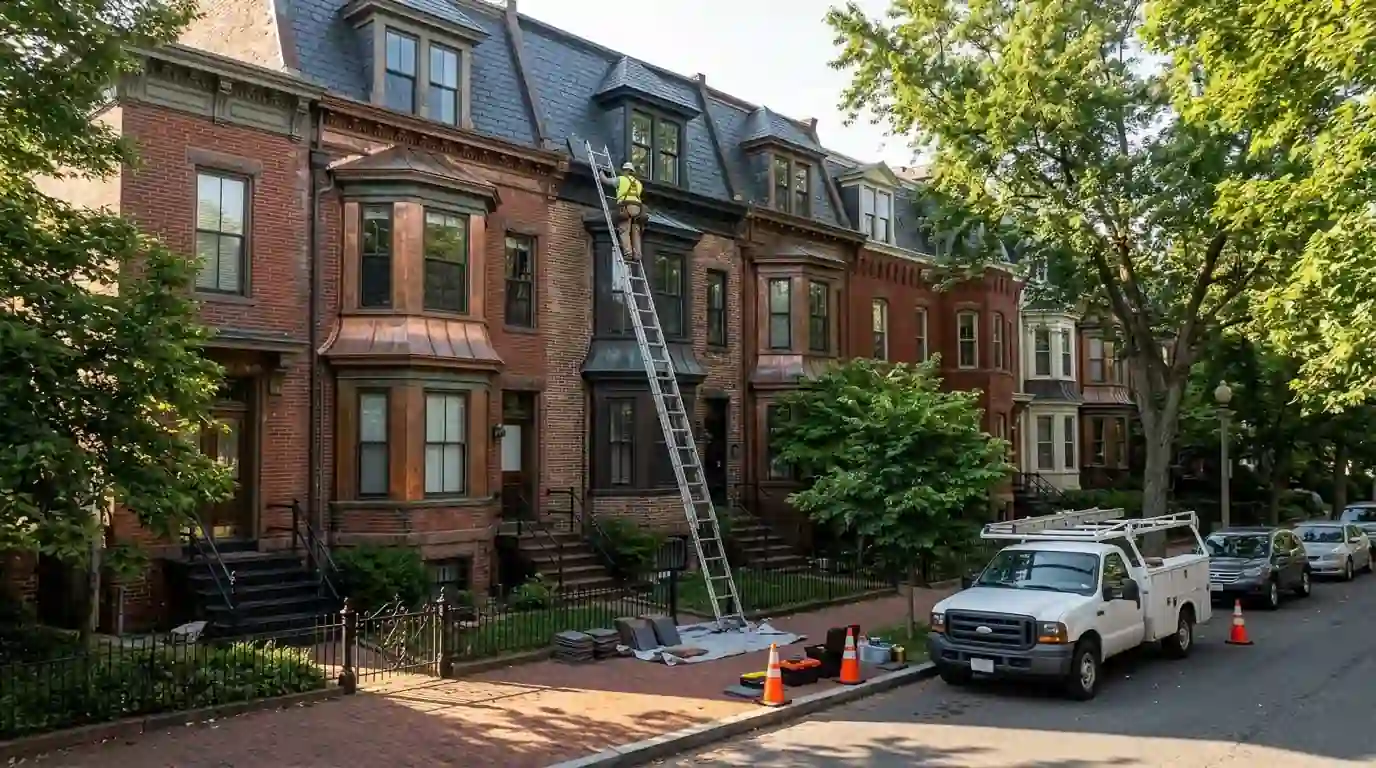
Federal-era houses near Eastern Market and Italianate rows along East Capitol Street share a weak point: the joint where the front slope meets the flat roof. That seam often holds a built-in box gutter lined with old tin, patched with tar many times over. When the lining splits, water runs into the front bedroom ceiling or down inside the brick facade.
Party walls are the second problem. Neighboring houses were reroofed in different decades, so one side may have a fresh membrane lapped over the parapet while the other side has cracked roll roofing. We cut back to sound material on both sides, set new base flashing up the wall and cap it with a counterflashing or coping that sheds water away from the joint.
Behind the parapets, many roofs still carry two or three layers of old material. Extra layers trap moisture against the deck boards and hide soft spots. On a flat roof replacement we tear down to the wood, replace rotted planks and check the slope toward the rear scupper before any new membrane goes down.
Many blocks between Pennsylvania Avenue SE and Constitution Avenue NE have rear alleys, and that is where we stage ladders and debris chutes when we can. Where the alley is too tight for a dumpster, we bring a smaller trailer and haul out in several trips rather than blocking a neighbor's garage.
Front-of-house staging needs a public space permit from DDOT for anything placed in the street. We handle that paperwork and plan around market weekends, school pickup near the Capitol Hill elementary schools and the residential permit parking signs.
Victorian fronts often carry hexagonal or fishscale slate on a steep mansard. Most can be repaired slate by slate with copper hooks rather than replaced.
The main roof behind the parapet usually drains toward the rear. DC energy rules push a reflective membrane when it is replaced.
Rounded or polygonal bays end in small metal or slate caps that crack at the seams and let water into the front wall.
Built-in gutters at the cornice line are common and often relined with copper or a membrane when the old tin gives out.
Party wall parapets need flashing tied into both roofs, which means coordinating with the neighbor when the work crosses the line.
Slate repair for Victorian mansards, turrets and steep DC roofs: broken slates replaced with copper hooks or nail-and-bib, plus valley and flashing rebuilds.
Slate Roof Repair detailsRepairs to the steep slate fronts of Victorian and Second Empire rowhouses: slipped and broken slates, rusted nails, dormer cheeks, built-in gutters and the flat-to-mansard joint.
Mansard Roof Repair detailsTear-off and new low-slope roofs for rowhouses and flats, with tapered insulation for ponding, new parapet flashing and reflective cool roof membranes.
Flat Roof Replacement detailsRepairs to the brick walls that rise above rowhouse roofs: loose coping, cracked caps, open mortar, failed through-wall flashing and the membrane where it meets the parapet.
Parapet Wall and Coping Repair detailsRelining and rebuilding the built-in box gutters hidden behind DC rowhouse cornices, plus the rotted wood, outlet tubes and downspouts around them.
Box Gutter Repair detailsTear-off and new low-slope roofs for DC rowhouses, with party-wall parapets, rear ells, neighbor tie-ins and the rear scupper that carries all the water handled properly.
Rowhouse Roofing detailsA low-slope roof hidden behind the parapet usually goes through with a DOB permit and a quick look from preservation staff. Changes visible from the street, like new slate on a mansard, get closer attention. We check the address and prepare photos before filing.
We carry salvaged and new slate in the common Hill colors and sizes, and we compare thickness and texture on site. For a few missing pieces, salvaged slate blends best. For a larger section we may show you new stock next to the old before ordering.
It can, because two different systems meet at one joint. We tie our new base flashing up and over the shared parapet so water cannot slip between the two roofs, and we tell your neighbor what we are doing before we touch the wall.
Our Washington office is on 7th Street NW, a short drive away, and we answer 24/7. For an active leak we can usually tarp or patch the same day and come back for the permanent repair once the roof is dry. Call (202) 771-7443.
Call any hour. We answer 24/7 and tell you when a roofer can be at your house.