Garden apartments
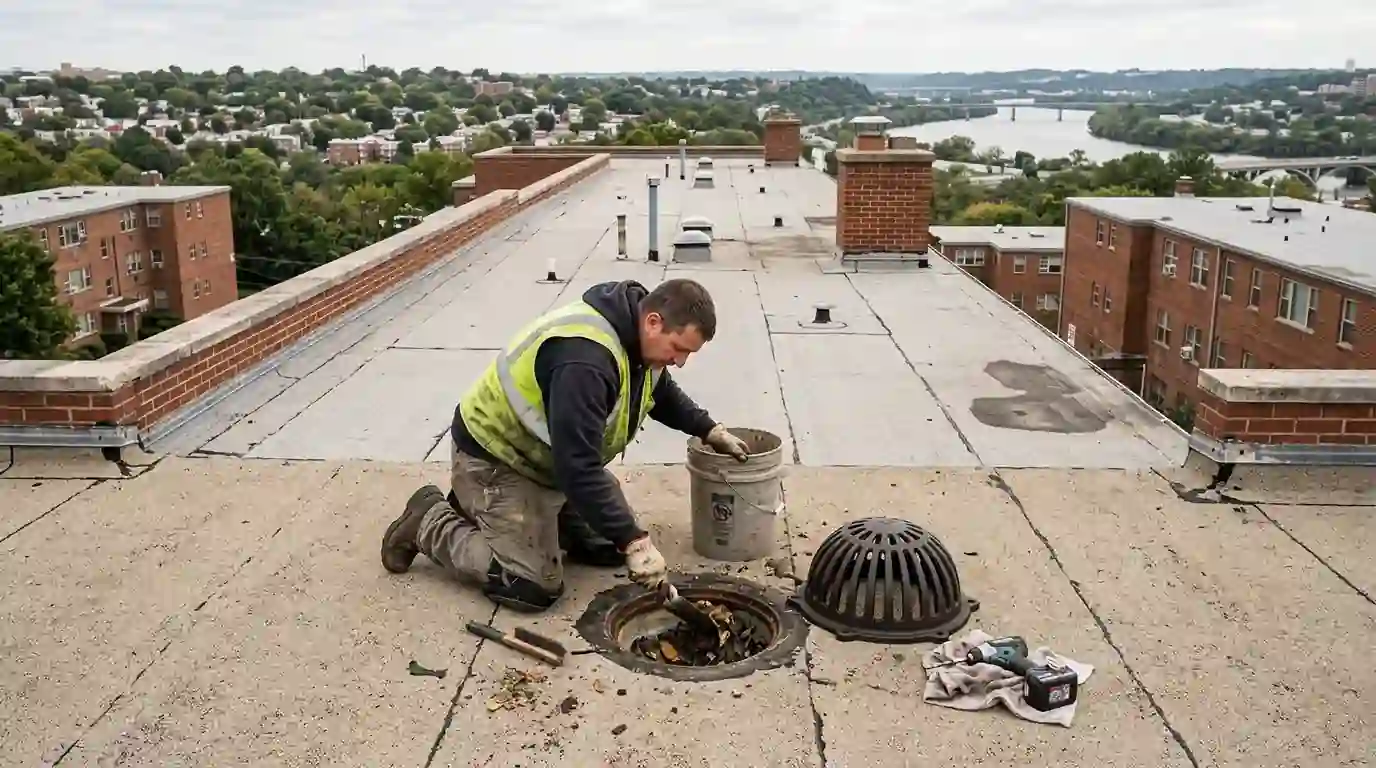
Mid-century brick apartment buildings have long flat roofs with drains, hatches and mechanical curbs.
Washington, DC neighborhoods
Congress Heights sits on the high ground east of the Anacostia River, around the historic St. Elizabeths campus and along Martin Luther King Jr. Avenue SE. Its housing ranges from mid-century garden apartment buildings to brick duplexes and older frame houses, and the roofs vary just as much.
In Congress Heights, roof work splits between flat roofs on garden apartment buildings and small multifamily properties, and gable or hip roofs on duplexes and detached homes. Common fixes are membrane repair, drain clearing, shingle replacement and fascia work. Flat roof repairs often run $720-$2,940; a duplex half reroof with shingles is typically $6,880-$11,240, depending on layers and decking.
The two- and three-story brick garden apartments that line many blocks off Alabama Avenue and Wheeler Road were built mostly in the 1940s to 1960s. They have long low-slope roofs with interior drains or perimeter scuppers, plus hatches, vent stacks and mechanical curbs. Owners and property managers call us when top-floor units report stains.
The usual cause is a clogged drain or a failed seam near a penetration. We clear the drain, replace the strainer and check the drain clamp ring, then patch or rebuild flashing around curbs and stacks. When the membrane itself is past saving, we plan a phased replacement so tenants are not disrupted for long. Our multifamily roofing work covers those larger jobs, and drain and scupper repair explains the outlet work.
Brick semi-detached houses and frame single-family homes on streets near Congress Heights Recreation Center usually carry asphalt shingles on gable or hip roofs. Many are on their second or third roof. The most common calls are for missing shingles after wind, leaks around plumbing vents and chimneys, and fascia boards rotting behind sagging gutters.
Not every leak means a new roof. When shingles are still flexible and the deck is sound, a targeted roof repair at the failed flashing or damaged area can buy several more years. When shingles are brittle, curled and losing granules across every slope, repairs stop holding and replacement is the better spend. We show you photos from the roof so you can see what we see.
Parts of Congress Heights look out over the Anacostia and Potomac rivers toward Joint Base Anacostia-Bolling. That open exposure means storms arrive with little to block them. Flat roof edges peel, metal coping lifts and shingles along the rakes break loose.
We secure membrane edges with continuous cleats and fastened edge metal, and on shingle roofs we use sealed starter courses and extra nails at the rakes and eaves. Once a storm passes, our first job is a tarp over any opening, followed by photos your insurer can use.
Apartment roofs on the bluff have their own wind weak spots: rooftop exhaust fans and HVAC units that rattle loose from their curbs, and roof hatches whose lids slam and crack the surrounding flashing. We check curb fasteners and hatch hold-open arms on every apartment visit, because a fan that tips over in a gust tears a hole in the membrane right beside it.
Older detached homes along the slope toward Oxon Run also sit under mature trees that drop limbs in summer storms. We check for punctures in the deck under any branch that landed, not just the obvious broken shingles.
Garden apartment buildings usually have parking lots, which makes staging easy. Duplexes and detached homes often have driveways or rear yards with alley access. Construction around the St. Elizabeths East redevelopment and the Entertainment and Sports Arena can affect traffic, so we schedule deliveries early. Congress Heights is not a designated historic district, though the nearby Anacostia district has its own rules.
Mid-century brick apartment buildings have long flat roofs with drains, hatches and mechanical curbs.
Semi-detached houses share gable roofs, often replaced on separate schedules by each owner.
Older detached houses carry asphalt shingles, wood fascia and aluminum gutters.
High ground above the rivers sees stronger wind on roof edges and copings.
Congress Heights itself is not a designated historic district, so standard DOB permits apply.
Shared roofs on condo buildings, co-ops and small apartment buildings repaired or replaced with clear reports for boards and simple notices for residents.
Condo and Multifamily Roofing detailsLow-slope roof repair for DC rowhouses and additions: modified bitumen, EPDM, TPO and coated roll roofing, plus ponding areas, curbs and parapet base flashing.
Flat Roof Repair detailsTargeted fixes for open seams, slipped slate, lifted shingles and failed flashing on DC rowhouses, porch roofs and detached homes, sized to the actual damage.
Roof Repair detailsLeaking scuppers through rowhouse parapets, rusted conductor heads and clogged internal roof drains rebuilt so flat roofs empty fast after a storm.
Roof Drain and Scupper Repair detailsArchitectural shingle roofs for colonials, Cape Cods and split-levels, with ice barrier at eaves, new valley metal and balanced ridge venting.
Asphalt Shingle Roofing detailsRepairs after thunderstorm gusts, nor'easters, hail and fallen limbs: lifted membrane, creased shingles, cracked slate, torn flashing and punctured decking around DC.
Storm Damage Roof Repair detailsYes. We give managers photos, a written scope and a price range, and we schedule work around tenants. For leaks we can usually respond the same day.
Yes. We separate the two halves at the ridge and party wall and tie the new roof into the old one so both stay watertight.
Congress Heights is separate from the Anacostia historic district. We check the exact address before filing so you know which rules apply.
We answer 24/7 and can usually get there the same day. Call (202) 771-7443.
Call any hour. We answer 24/7 and tell you when a roofer can be at your house.