Split-levels
Low upper roofs meeting tall walls at the garage level, where missing kickouts cause rot and interior stains.
Northern Virginia
Springfield sits where I-95, I-395 and the Beltway meet, and its neighborhoods of 1950s and 1960s split-levels and colonials catch the same thunderstorms that tie up the Mixing Bowl every summer. Wind and falling limbs are behind a large share of our calls from here.
Springfield homes are mostly asphalt shingle on split-levels, ramblers and two-story colonials built from the 1950s to the 1970s. Storm repairs commonly run $445-$1,690, and a complete replacement usually falls between $11,900 and $22,300 depending on size, layers and decking. If a storm opened your roof, ring (202) 771-7443 for a same-day tarp.
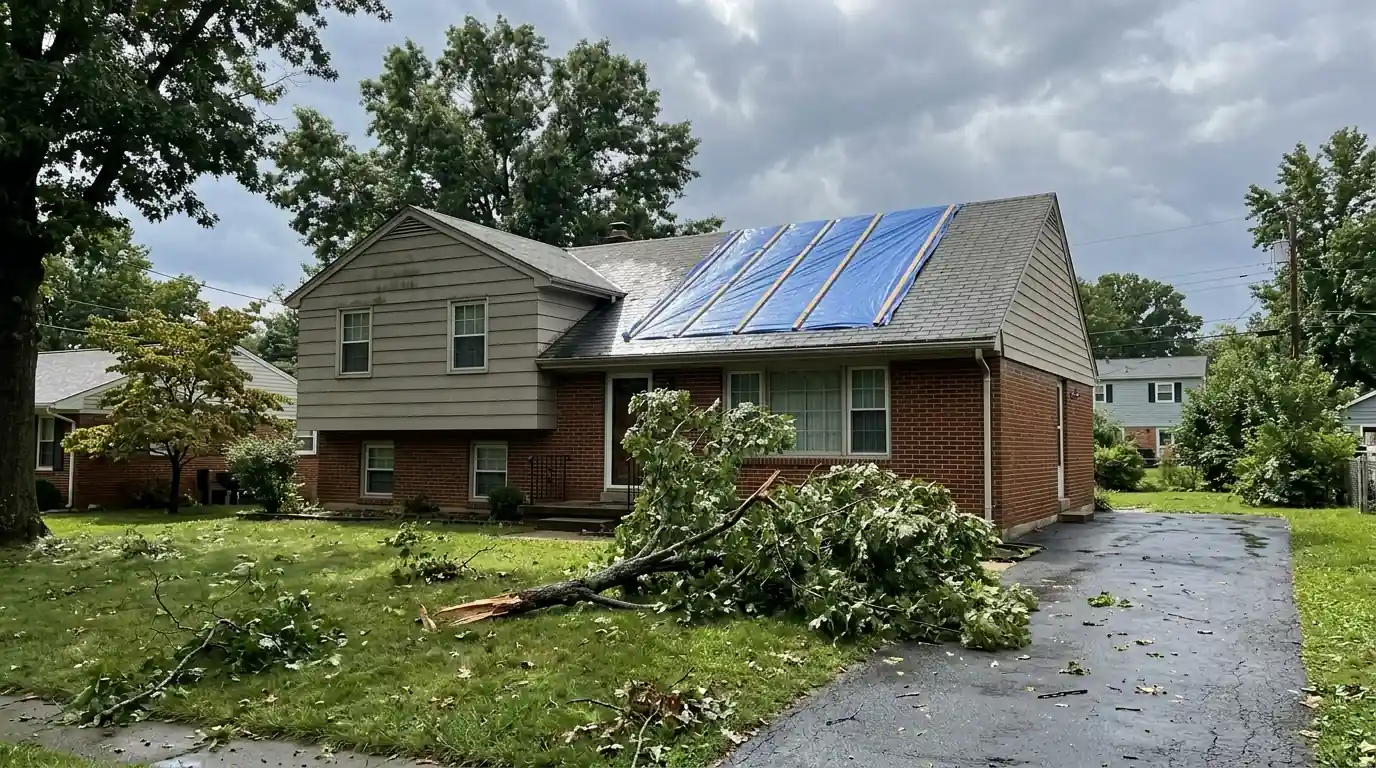
When a line of storms rolls in from the west, we often get calls from North Springfield, West Springfield and the streets around Lake Accotink within an hour of each other. Our first goal on every call is to stop water. We cover the opening with a heavy tarp fastened to wood battens, not loose sandbags that blow off overnight.
Once the house is dry, we come back to measure, photograph and plan the permanent fix. If limbs broke rafters, we sister or replace them before new decking goes on. Our storm damage repair work includes a written photo report you can hand to your adjuster.
A shingle that has folded back in the wind and laid down again often looks fine from the yard. Up close, there is a horizontal crease across the tab, and the sealant strip underneath has broken. That shingle will lift again in the next storm and can tear off completely.
On older three-tab roofs, creasing tends to show up across whole slopes, especially on the side facing the prevailing wind. When that happens, spot repairs rarely hold up, and replacing that slope or the whole roof is usually the better use of money. Our page on insurance claim roof help explains how we document it.
Builders put up thousands of homes here in the 1950s and 1960s, and many of the split-levels off Old Keene Mill Road and Backlick Road follow similar plans. Their low upper roofs meet tall walls over the garage level, so step flashing and kickouts are crucial.
The two-story colonials in West Springfield and Orange Hunt usually came later, with steeper roofs and more valleys. Those valleys load up with oak and maple leaves, and if gutters are not cleaned, water backs up under the shingles at the eaves.
Townhouse communities around Springfield Town Center and Kingstowne add another layer. Those roofs are shared, color-controlled by an HOA and often have firewalls between units that rise through the roof. We cap those firewalls with new metal coping or shingle over them according to the original design, and we keep each unit's work separate so neighbors' roofs stay sealed.
When we replace a roof here, wind is what we plan around. Starter strip goes along every eave and rake, shingles get six nails each in the manufacturer's nail zone, and we use a shingle rated for high winds where the budget allows. Hip and ridge caps are nailed with longer fasteners into solid wood.
We also look up. Limbs that hang over the roof are the biggest storm risk on most Springfield lots, and we will tell you which ones worry us so you can call an arborist. Clean gutters and clear valleys are the other half of the job, since wind-driven rain backs up fast when they are full.
Low upper roofs meeting tall walls at the garage level, where missing kickouts cause rot and interior stains.
Steeper roofs with several valleys that fill with leaves under the neighborhood's mature trees.
Older three-tab shingles on west-facing slopes crease and lift during summer thunderstorms.
Many homes have two shingle layers, which hides soft decking and complicates storm repairs.
Garage roofs often tie into the house at awkward angles that trap water.
Repairs after thunderstorm gusts, nor'easters, hail and fallen limbs: lifted membrane, creased shingles, cracked slate, torn flashing and punctured decking around DC.
Storm Damage Roof Repair detailsAfter wind or a falling tree, we tarp the roof, document the damage with photos and measurements and meet your adjuster on the roof.
Insurance Claim Roof Help detailsArchitectural shingle roofs for colonials, Cape Cods and split-levels, with ice barrier at eaves, new valley metal and balanced ridge venting.
Asphalt Shingle Roofing detailsFull tear-off and new roof systems for DC rowhouses, Victorians and suburban colonials, from low-slope membranes to shingle, slate and metal.
Roof Replacement detailsDay or night roof emergencies in DC: tarping, temporary membrane patches, tree limb dry-ins and active leak control, with a crew answering (202) 771-7443 around the clock.
Emergency Roof Repair detailsSeamless gutters formed on site and sized for DC rowhouse rear roofs and tree-heavy lots, with downspouts routed where the water can actually go.
Gutter Installation detailsThat depends on your policy and on the damage the adjuster agrees to. We document creased, torn and missing shingles with photos and measurements, and we can meet the adjuster on the roof if you want.
Our Woodbridge head office is a short drive down I-95, and the phone is answered 24/7 at (202) 771-7443. Same-day tarping is the norm after most storms.
If your gutters are sagging, leaking at seams or too small for the roof, yes. Pairing a new roof with new gutters lines up the drip edge and hangers so water lands where it should.
We serve Burke, Annandale, Kingstowne, Franconia, Lorton and Alexandria, along with the rest of Fairfax County.
Call any hour. We answer 24/7 and tell you when a roofer can be at your house.