Victorian summer houses
Queen Anne and Shingle Style houses with towers, porches and multiple gables are common.
Washington, DC neighborhoods
Cleveland Park began as a summer retreat, and its big Queen Anne and Shingle Style houses still have the wraparound porches, towers and complicated roof lines of that era. Add Wardman porch-front rows along Ordway and Macomb Streets, and the neighborhood holds a wide range of roof types inside one historic district.
Cleveland Park is a designated historic district, so visible roof changes are filed with the Historic Preservation Office. The large houses often have slate or cedar shake with copper details; the rowhouses have flat main roofs and porch roofs. Cedar shake replacement commonly runs $27,800-$49,600 on a detached house; a porch roof is often $2,960-$7,180 depending on size and decking.
Several of the older detached houses along Newark and Highland Place were built with wood shingles or shakes on the roof and walls. Cedar weathers to a soft gray, but under the tree canopy here it stays damp, grows moss and splits sooner than it would in open sun. Once shakes cup and crack, water reaches the underlayment and the skip sheathing below.
We replace individual shakes where the roof is mostly sound. For full replacement, we install new cedar shake over an interlayment, with stainless steel ring-shank nails and copper valleys. Leaving room for air under the shakes helps them dry between storms.
Because these houses sit in a historic district, switching from cedar to asphalt on a visible slope draws scrutiny. Some owners consider fire-rated or synthetic shake products. We bring samples and discuss what preservation staff tends to accept before you commit.
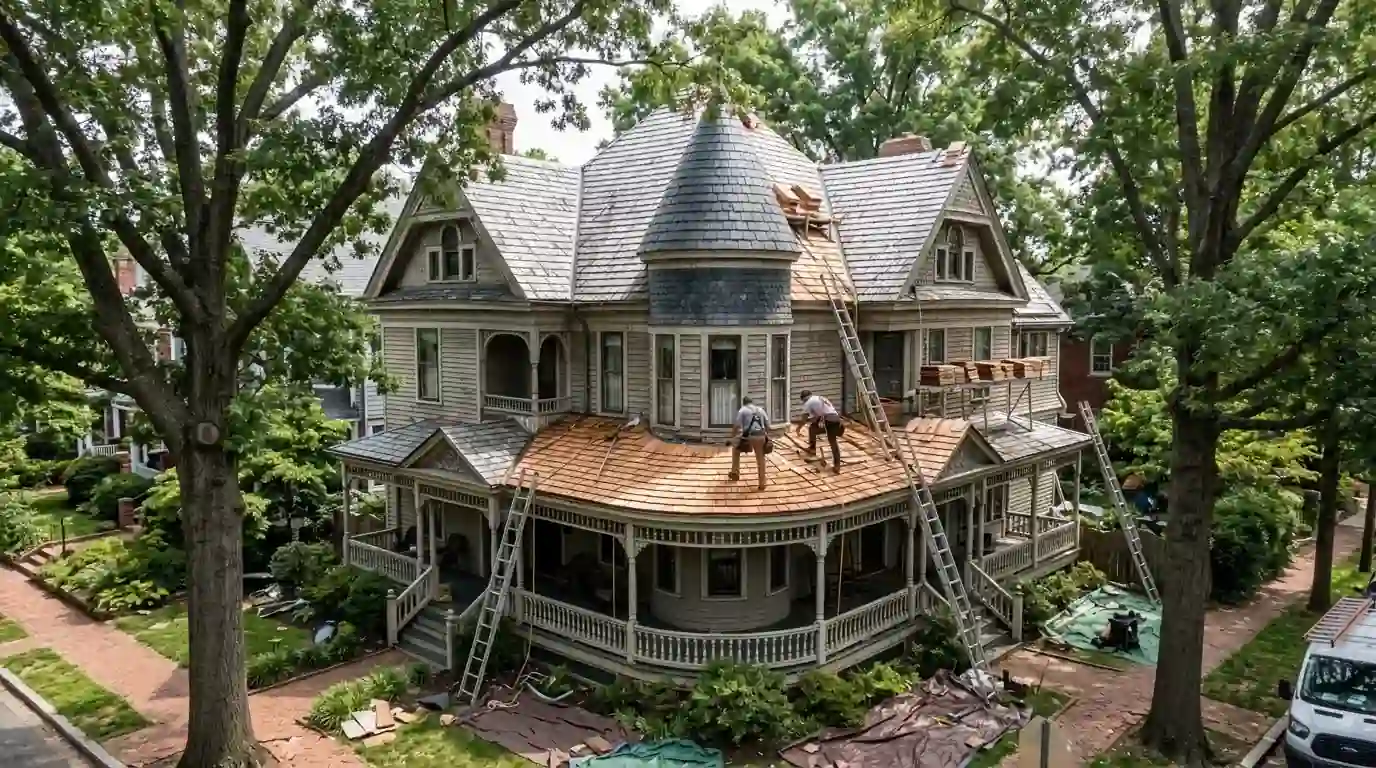
Queen Anne houses here carry towers, eyebrow dormers, multiple gables and porch roofs that wrap two or three sides. Each change in plane is a valley or a wall flashing, and those are where the leaks start. A tower cap with failed copper flashing can drip into a second-floor bedroom long before the slate around it shows wear.
We work these roofs with roof brackets and toe boards, replacing slates piece by piece and rebuilding valleys in copper. Our slate repair approach keeps sound stone in place and only removes what has failed.
Wraparound porch roofs are often low-slope and covered with old roll roofing or soldered tin. Tin can be patched, soldered and painted if the pans are sound; otherwise, a new standing seam or a membrane with a metal edge is the replacement.
The porch-front rowhouses near the Uptown Theater and the Cleveland Park Metro have flat main roofs that drain to rear alleys. These roofs see the same issues as other Wardman rows across the city: worn modified bitumen, rusted scuppers and party wall seams. Hidden flat roofs usually clear historic filing simply, while front porch roofs and cornices draw more attention.
We schedule rowhouse work around rear alley access and keep the Connecticut Avenue side clear of trucks.
Tall oaks and tulip poplars cover most streets, especially near Rosedale and the Tregaron conservancy. Branches over the roof drop leaves, sticks and acorns that clog valleys and gutters. We clean valleys during every visit, trim small branch tips touching the roof and suggest an arborist when larger limbs overhang the house.
Shade has a second cost on cedar and slate: north slopes stay wet for days after rain, and moss roots lift shake butts and hold water against slate nails. We remove moss by hand rather than pressure washing, which can strip the wood surface and drive water under the courses. A strip of zinc or copper below the ridge slows regrowth as rain carries traces of metal down the slope.
Narrow streets like Newark and Ordway leave little room for a dumpster, so on detached houses we often use the driveway, and on rows we stage in the alley and haul out daily.
Queen Anne and Shingle Style houses with towers, porches and multiple gables are common.
Visible slopes often carry cedar shake or slate with copper valleys and flashings.
Long porch roofs in tin or roll roofing need their own repairs and edge details.
Cleveland Park is designated, so visible roof material changes go through preservation staff.
Porch-front rowhouses near Connecticut Avenue have flat main roofs draining to rear alleys.
Western red cedar shake and shingle roofs for Capes, cottages and colonials, laid over breathable underlayment with stainless fasteners and copper flashing.
Cedar Shake Roofing detailsSlate repair for Victorian mansards, turrets and steep DC roofs: broken slates replaced with copper hooks or nail-and-bib, plus valley and flashing rebuilds.
Slate Roof Repair detailsSoldered and standing seam copper for bay roofs, turrets, dormers, cupolas and entry roofs, plus copper valleys, caps and built-in gutter liners.
Copper Roofing detailsSoldered repairs, repainting and partial replacement for tin, terne, standing seam and copper roofs on DC bay fronts, porches, turrets and mansards.
Metal Roof Repair detailsTear-off and new low-slope roofs for rowhouses and flats, with tapered insulation for ponding, new parapet flashing and reflective cool roof membranes.
Flat Roof Replacement detailsLeaking seams, sagging runs, crushed downspouts and clogged alley tie-ins fixed on the spot, so you keep sound gutters instead of replacing them early.
Gutter Repair detailsOn a visible slope in a historic district, that change may not be approved. Preservation staff generally look for the original material or a close match. We help you weigh cedar, synthetic shake and other options before filing.
Shade and damp shorten its life. Good ventilation under the shakes and regular cleaning help. We look at how your roof is drying and tell you what to expect.
If the pans are not rusted through, cleaning, soldering and painting keep it working for years. Thin or perforated pans need replacement, often with standing seam metal.
Yes, including flat roofs, porch roofs and scuppers. Call (202) 771-7443 and ask for a rowhouse roof check near Connecticut Avenue.
Call any hour. We answer 24/7 and tell you when a roofer can be at your house.