Stain that appears only after rain
If the spot darkens during or right after storms and dries in between, the roof or its flashing is the likely source.
Roof repair
The stain on your ceiling is almost never directly under the hole in your roof, and that is why so many leak repairs fail on the second try.
Materials we install
Roof leak repair is finding where water enters the roof system and fixing that point, whether it is a seam, flashing, a vent boot, a skylight curb or a clogged drain. You need it the first time you see a stain, drip or damp spot after rain. Tracing and fixing a typical DC leak runs about $395 to $1,420, depending on the cause and access.
We measure the stain location against walls and windows and ask when it appears.
We check every seam, flashing, penetration and drain above and behind the wet area.
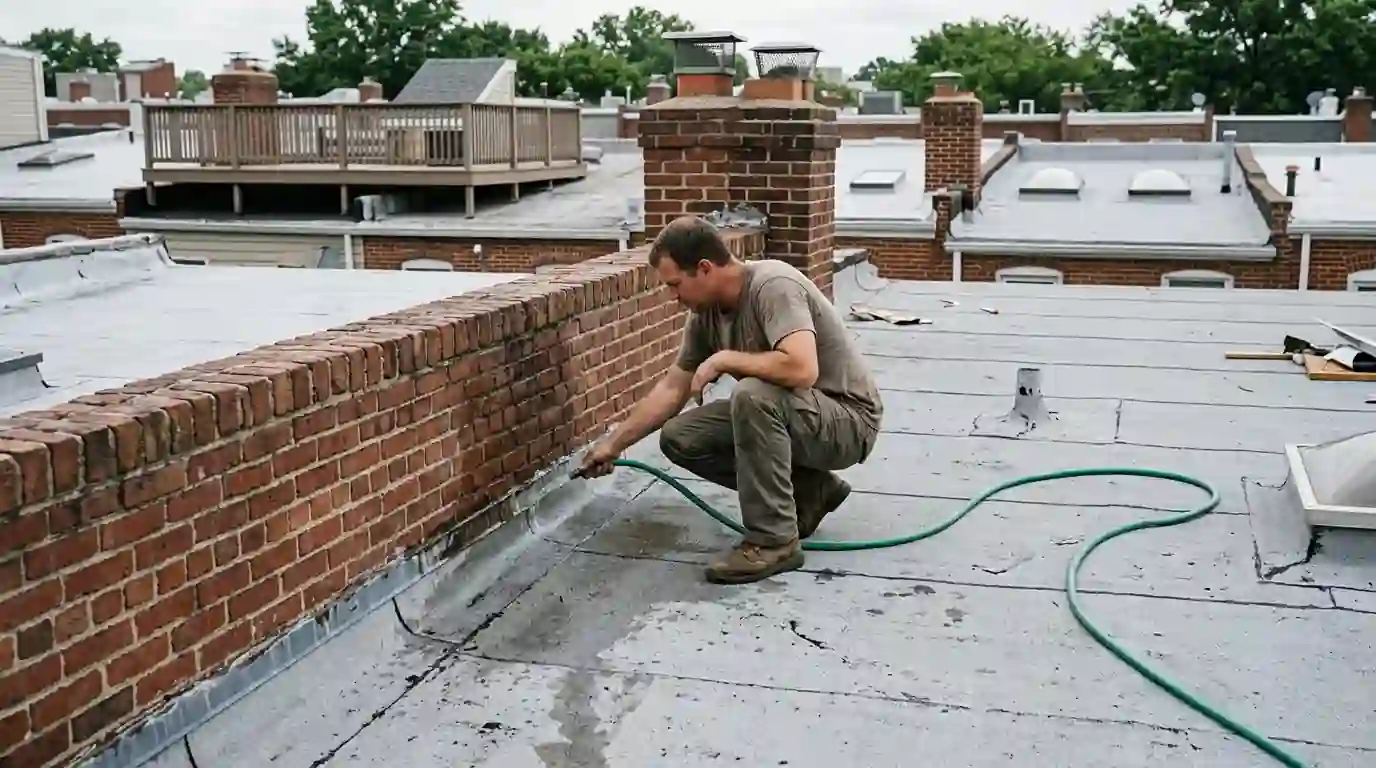
Moisture readings and a controlled hose test pin down the exact failing detail when it is not obvious.
We remove wet insulation and any soft decking so the repair sits on a sound, dry base.
Seams, boots, flashings or drains are repaired with materials compatible with your roof.
A follow-up water test and photos show the leak path is closed.
If the spot darkens during or right after storms and dries in between, the roof or its flashing is the likely source.
Moisture with no rain points to plumbing, HVAC condensate or condensation rather than the roof.
Bubbling paint near the top of an exterior or party wall often means water behind the flashing at the parapet.
A persistent odor can mean a slow leak soaking insulation in the joist bays long before a stain shows.
Water follows wiring and collects at fixture boxes, so a wet light often marks the low point of a leak path.
Brown streaks on the skylight well usually trace back to curb flashing or a cracked frame.
Most DC rowhouses have no attic. The roof deck sits on joists that run from party wall to party wall, and the ceiling of the top floor hangs right below. Water that gets through the roof drops into a joist bay, runs along it with the slope, and comes out wherever the ceiling has a seam, a light box or a low point.
That means a stain near the front bedroom window may start at the rear of the roof, and a drip in the hall may begin at the parapet on the neighbor's side. Pitched roofs on detached houses do the same thing in a different way: water lands on top of the attic insulation, follows a rafter downhill and appears on a wall ten feet from the entry.
So we do not start by sealing the spot above the stain. We measure where the stain sits relative to exterior walls, then go up and look at everything upslope of it. That habit is the difference between fixing the leak and adding another layer of roof cement to a roof that already has too much.
The party wall is the most frequent culprit. Where the membrane turns up the brick between houses, flashing pulls loose, mortar joints open and water slips behind the sheet. Our article on why party walls leak goes deeper into how that joint ages.
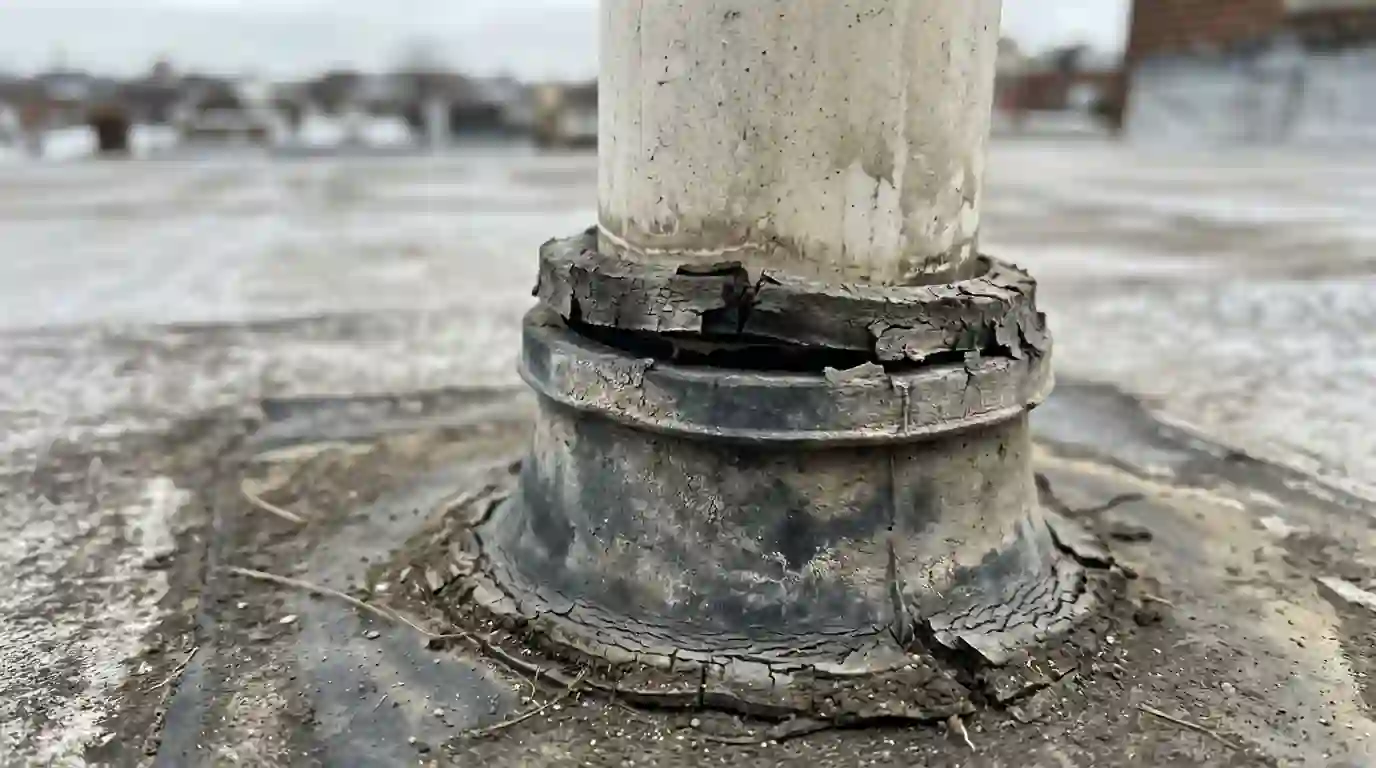
After that come the penetrations: plumbing vent stacks with dried-out rubber boots, abandoned chimneys with cracked caps, bathroom exhaust fans and old roof hatches with worn curbs. Each one is a hole in the membrane that depends on a flashing detail holding up through summer heat and winter freeze.
Drains and scuppers come next. When leaves or a tennis ball block the outlet at the rear wall, water backs up over the flashing height and finds every weak seam at once. We see this often on blocks in Bloomingdale, where mature street trees drop leaves straight onto the roofs.
On the roof, we probe seams with a blunt tool, press around flashings to feel for soft spots, and look for wrinkles, voids and staining on the membrane. On shingle roofs we lift tabs near the suspect area to check nails and underlayment. Moisture meters help us map wet insulation under a low-slope roof without cutting it open everywhere.
When the source is still unclear, we water-test. One person runs a hose on a small section, starting low and working upslope, while another watches the ceiling inside. It takes patience, but it isolates the exact detail that is failing, and it proves the repair afterward.
We also rule out things that are not roof leaks. Condensation in a cold bathroom ceiling, a failed window head flashing, a rooftop HVAC condensate line or a cracked supply pipe in the ceiling can all look like a roof leak. Telling you that it is a plumbing issue is better than charging you for a roof repair that will not help.
The fix suits the failure. A lifted seam gets cleaned, primed and rewelded or retorched. A cracked vent boot gets replaced with a new flashing collar set under the upslope membrane. Loose counterflashing gets cut into a fresh mortar joint, not just glued to the brick face.
Skylight leaks often come from the curb flashing, not the glass, and we cover them on our page about skylight curbs. Drain problems may need a new drain body, a larger scupper or a cleared downspout, which falls under our scupper and drain work.
If wet insulation or soft decking sits under the leak, we cut it out and replace it. Leaving wet material under a new patch traps moisture, rots the deck and brings back the stain within a season or two.
Repeat leaks make up a big part of our calls. The usual story is a smear of black mastic over the area above the stain, applied in dry weather, that never touched the real entry point. The next storm finds the same path, and the ceiling gets repainted again.
On these jobs we strip the old patches so we can see the original membrane, then trace from scratch. It costs a little more up front than another tube of sealant, but it ends the cycle of ceiling repairs and repainting.
The work splits into tracing the leak and repairing it. Simple leaks are found in minutes, while stubborn ones need water testing and opening the roof.
| Job | Typical range |
|---|---|
| Leak tracing with moisture meter | $245-$485 |
| Water test with two-person crew | $385-$715 |
| Seam or vent boot repair | $395-$920 |
| Flashing repair at parapet or party wall | $740-$1,980 |
| Wet insulation and deck replacement, small area | $860-$2,340 |
Access, how many old patches cover the area, the roof type and how much wet material sits underneath change the price. We quote the repair after tracing, before any cutting starts.
Wind pushes water sideways and uphill, under counterflashing, through laps in old metal and into gaps that stay dry in a gentle rain. These leaks often start at parapet caps, chimney flashing or the edge of a skylight. A water test with the hose aimed sideways can reproduce them.
We measure the stain, work out which joist bay it sits in, then inspect everything upslope of that bay on the roof. Moisture meters and a controlled water test confirm the source. Occasionally we open a small section of ceiling to see where water is running along the joists.
Roof cement is useful for small details and temporary holds, but it cracks as it ages and does not bond well to many modern membranes like TPO. Used over a wet or dirty surface, it can trap water and hide the real entry point.
Wait until the roof leak is fixed and the ceiling has dried, usually one to three weeks with fans and good air flow. Painting too early lets the stain bleed through, and closing up a wet ceiling can cause mold.
Not usually. Rubber vent boots dry out and crack long before the roof around them wears out, especially on sunny south and west exposures. Replacing the boot or the flashing collar is a small job compared with the roof.
These are the places we drive to most for this work. We cover all 45 areas on our service area list.
Targeted fixes for open seams, slipped slate, lifted shingles and failed flashing on DC rowhouses, porch roofs and detached homes, sized to the actual damage.
Roof Repair detailsDay or night roof emergencies in DC: tarping, temporary membrane patches, tree limb dry-ins and active leak control, with a crew answering (202) 771-7443 around the clock.
Emergency Roof Repair detailsLow-slope roof repair for DC rowhouses and additions: modified bitumen, EPDM, TPO and coated roll roofing, plus ponding areas, curbs and parapet base flashing.
Flat Roof Repair detailsLeaking scuppers through rowhouse parapets, rusted conductor heads and clogged internal roof drains rebuilt so flat roofs empty fast after a storm.
Roof Drain and Scupper Repair detailsCall and a roofer will answer, any hour of any day. We stop the leak first and fix it properly once the roof is dry.