Stain beside the chimney breast
Brown marks on the ceiling or wall right next to the fireplace column point to water entering at the roof line.
Roof repair
A damp patch on the wall beside a fireplace, or a stain on the ceiling near the chimney breast, usually means the flashing where the roof meets the brick has given up.
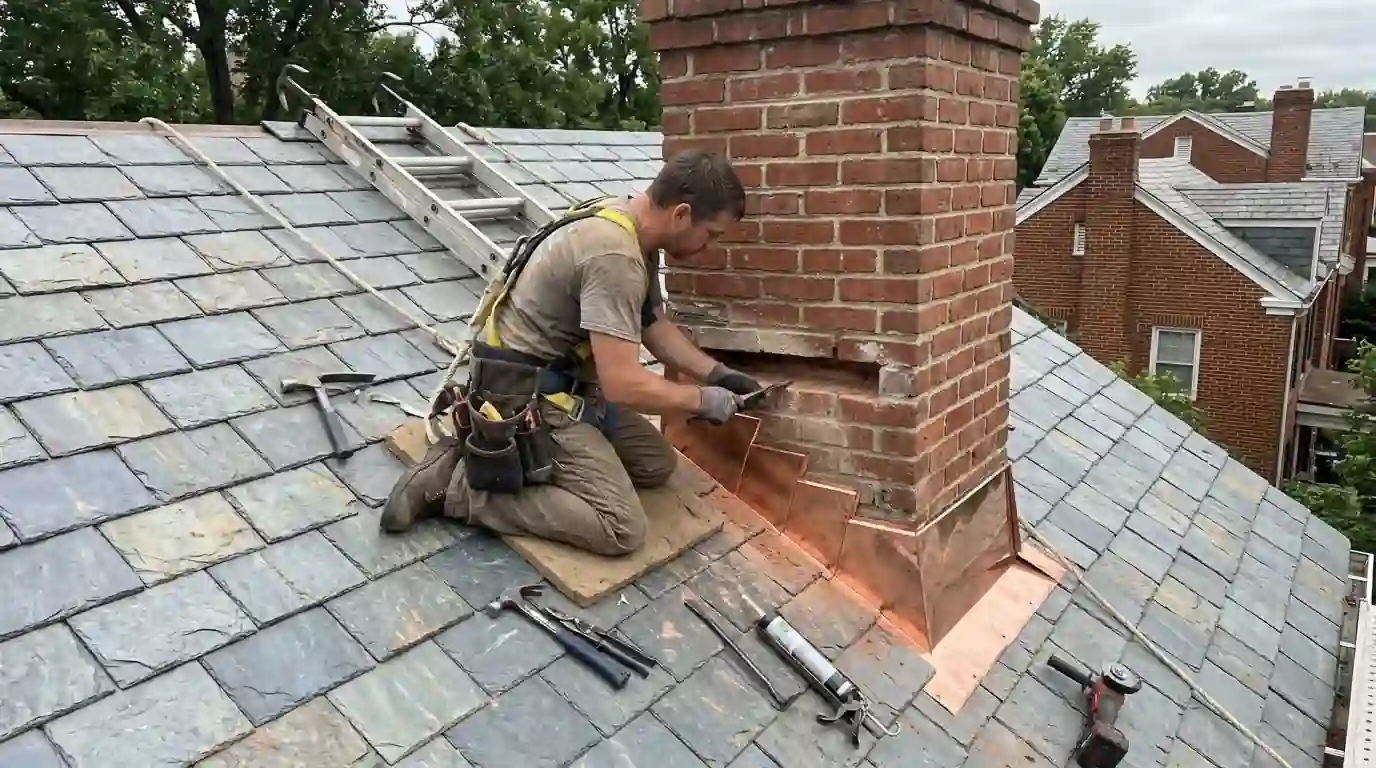
Materials we install
Chimney flashing repair replaces or rebuilds the metal that seals the joint between a chimney and the roof, including step flashing, counterflashing, the front apron and a back cricket. You need it when water stains appear near the chimney, caulk is cracked or metal has pulled from the brick. In DC, most chimney flashing jobs cost roughly $645 to $2,180.
A chimney is a big masonry box punched through the roof, and the roof and the brick move differently. Flashing bridges that gap in two layers. Base or step flashing tucks under the roofing and turns up the side of the chimney. Counterflashing is set into the mortar joints and folds down over the step pieces, so water running down the brick lands on the roof, not behind it.
At the downslope face, an apron piece wraps the front of the chimney and laps onto the roofing below. On the upslope side, a chimney wider than about 30 inches needs a cricket, a small peaked roof that splits water around the chimney instead of letting it pond against the brick and leaves pile up there.
When any of those parts is missing or done with shortcuts, leaks follow. The most common shortcut we see is a single bent strip of aluminum glued to the brick face with roof cement, with no counterflashing at all. It looks fine for a few years, then the cement cracks and water runs behind it.
Rowhouse chimneys usually rise from the party walls, so the flashing has to tie into the low-slope membrane on both sides and often into the neighbor's roof too. Many are no longer used, with a cracked cap or a tin cover over the flue. We look at the cap and the top courses of brick as part of the repair, because water entering at the top runs down the inside of the chimney and shows up in exactly the same places.
On detached colonials and Tudors in neighborhoods like Chevy Chase, Spring Valley and Tenleytown, the chimney usually sits on a steep shingle or slate slope. These need proper step flashing woven into each course, a soldered or folded apron, and on wide chimneys a cricket framed and covered with the same roofing or with metal.
Slate roofs call for copper or tin-coated copper flashing that will last as long as the slate. Putting aluminum against slate means you will be back up there replacing flashing long before the slate wears out. Our slate repair crews handle the slate that comes off and goes back on around the chimney.
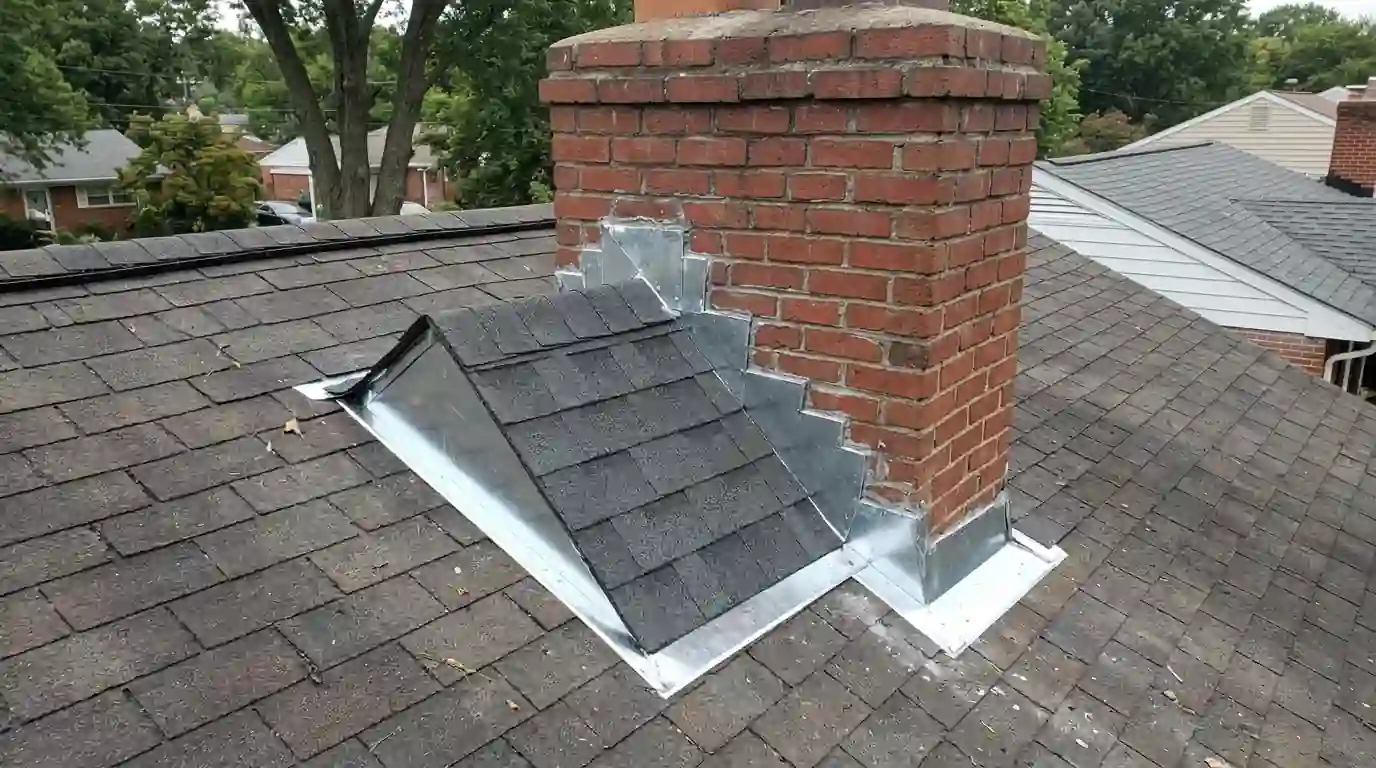
The proper way to attach counterflashing is to grind a reglet, a slot about an inch deep, into a horizontal mortar joint. The top edge of the metal is bent into that slot, wedged, and sealed with a sealant made for masonry. On a sloped roof the counterflashing is stepped to follow the courses of brick.
Face-mounted counterflashing, screwed or glued onto the brick, is the main reason we see repeat chimney leaks. Water running down the brick face gets behind the top edge, and no amount of caulk keeps up with it. We remove it and cut proper reglets, even when it takes longer.
If the mortar joints are soft or crumbling, the reglet will not hold. In that case we repoint the joints around the flashing line first, or recommend a mason for heavier chimney work, before installing new metal.
Brick is porous. A chimney with failed mortar, a cracked crown or no cap can soak up rain and pass it down into the house, and the stain looks exactly like a flashing leak. We check the crown, the cap and the condition of the brick above the roof before we sell anyone new flashing.
Condensation inside an unlined flue serving a gas furnace or water heater can also stain the chimney breast. That is a venting and lining issue rather than a roofing one, and we tell you so when we see it. Separating these causes is part of any leak tracing job near a chimney.
The cheapest time to replace chimney flashing is when the roof around it is being replaced, because the roofing is already off and the new step pieces weave straight into new courses. If your roof has a few years left but the flashing is failing now, we fix the flashing and leave the roofing ready to accept the next roof without tearing it out again.
Masonry work should come before flashing. If a mason is rebuilding the crown, repointing the stack or taking the chimney down a few courses, we schedule our flashing after that work so new metal is not disturbed or splattered with mortar. We coordinate the order with you so the chimney is not left half flashed through a week of thunderstorms.
Brown marks on the ceiling or wall right next to the fireplace column point to water entering at the roof line.
Dried, split sealant along the chimney base means the seal has opened and water is getting behind it.
Counterflashing that has popped out of its joint or bent away from the face no longer sheds water.
A pile of wet leaves on the upslope side means there is no cricket and water is pooling against the brick.
Steel flashing that is rusting through at the bends will soon leave gaps at the corners.
White salt deposits on the chimney inside the attic or top floor show water has been moving through the masonry.
We check the crown, cap, brick and mortar along with the existing flashing to find every water path.
Shingles, slates or membrane around the chimney come up so new step and base flashing can be woven in.
On wide chimneys we frame and sheath a cricket on the upslope side and cover it with matching roofing or metal.
New metal goes in course by course on sloped roofs, or as fully adhered base flashing on flat roofs.
We grind slots in the mortar joints, insert bent counterflashing and seal it for masonry.
Roofing is reinstalled around the chimney, and we water-test the joint before we pack up.
Chimney size, roof type and the metal used drive the cost. These 2026 ranges reflect typical DC and close-in suburban homes.
| Job | Typical range |
|---|---|
| Reseal and refasten existing counterflashing | $365-$740 |
| New aluminum step and counterflashing, shingle roof | $845-$1,720 |
| New copper flashing on a slate roof chimney | $1,460-$3,280 |
| Rowhouse party-wall chimney flashing on a flat roof | $645-$1,590 |
| Framed and flashed cricket for a wide chimney | $795-$1,940 |
Copper versus aluminum, slate versus shingle, chimney width and height, mortar repair needs and access all change the number. We confirm the price after seeing the chimney and before any material comes off.
Small fixes, like resetting loose counterflashing into a fresh reglet, can be done without disturbing the roofing. Replacing step flashing requires lifting the roofing next to the chimney, because each step piece sits under a course of shingles or slate.
Copper or tin-coated copper. Both last for decades and match the life of good slate. Aluminum or galvanized steel against slate will need replacing long before the slate does, which means disturbing the slate again.
Yes, as long as it stands above the roof. An unused chimney still has a joint with the roof membrane and still takes rain at the top. Some owners choose to have an abandoned chimney taken down below the roof line and roofed over, which removes the flashing joint entirely.
Properly installed copper flashing with counterflashing set in reglets can last for many decades. Sealant at the reglet usually needs renewing every eight to twelve years, and we check it during roof inspections.
Often the old counterflashing was reused or the new step flashing was skipped and the roofing was simply sealed against the brick. We open the area, check what was installed and rebuild it properly.
These are the places we drive to most for this work. We cover all 45 areas on our service area list.
We trace roof leaks from the ceiling stain back to the real entry point, then fix that cause: seams, flashing, vent boots, skylights, parapets and drains.
Roof Leak Repair detailsSlate repair for Victorian mansards, turrets and steep DC roofs: broken slates replaced with copper hooks or nail-and-bib, plus valley and flashing rebuilds.
Slate Roof Repair detailsTargeted fixes for open seams, slipped slate, lifted shingles and failed flashing on DC rowhouses, porch roofs and detached homes, sized to the actual damage.
Roof Repair detailsA walk of the whole roof with photos and a written condition report: membrane, slate, shingles, flashing, drains, parapets and attic, for owners, buyers and sellers in DC.
Roof Inspection detailsCall and a roofer will answer, any hour of any day. We stop the leak first and fix it properly once the roof is dry.