Slates sliding every winter
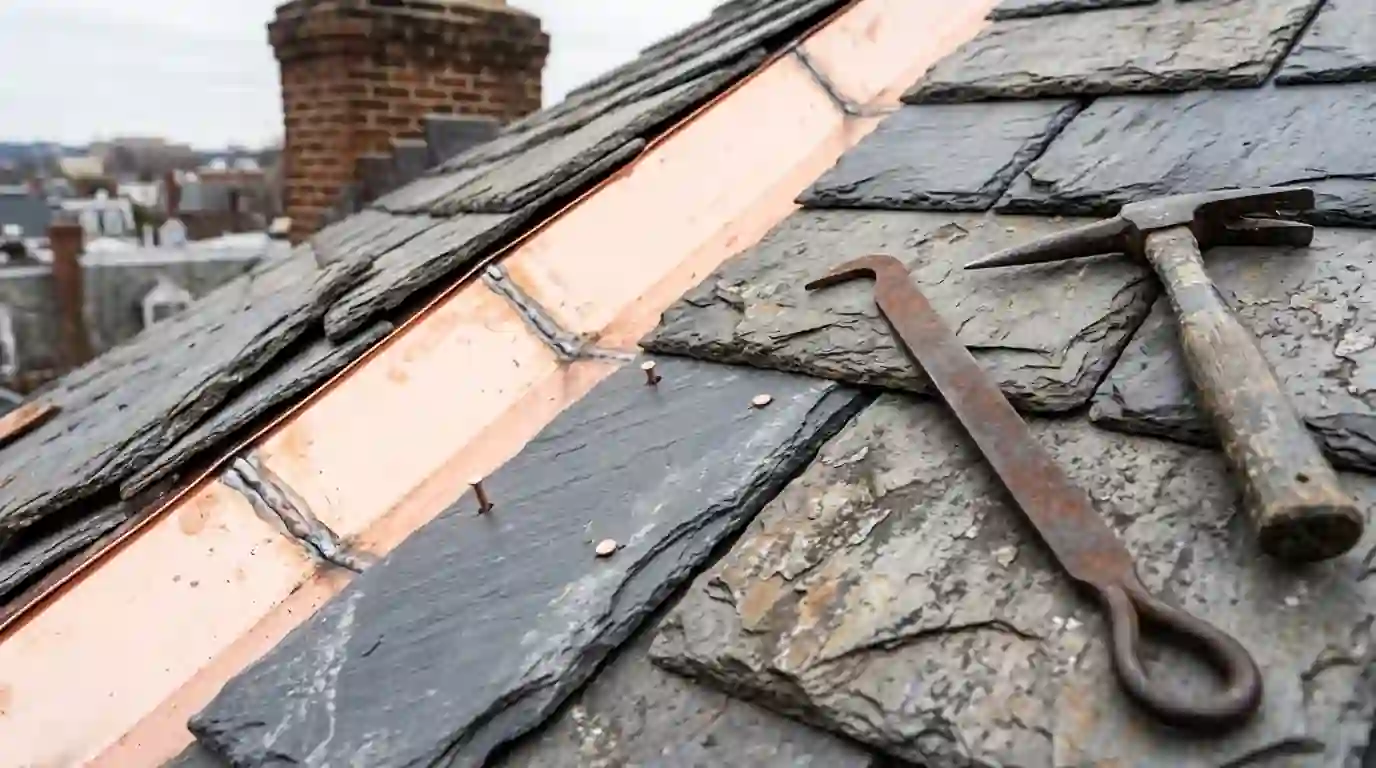
Pieces showing up in the yard or gutter after freeze and thaw means nails are rusting through across the roof.
Roof replacement and new roofs
When slates slide off your mansard every winter and the copper flashing has turned to lace, another round of patches only delays a bigger bill.
Materials we install
Slate roof replacement means stripping a failing slate roof, repairing the deck and laying new or salvaged natural slate with copper nails and new flashing. It is needed when the slate itself has delaminated or the nails have rusted through across large areas. On a DC rowhouse front mansard, expect roughly $17,300-$43,800; full slate roofs on detached homes often run $54,900-$138,600.
Good slate outlasts almost everything around it. Pennsylvania and Vermont slate on Capitol Hill and in LeDroit Park has often been on the roof since the 1890s and can keep going. What usually gives out first are the iron nails holding each slate, the copper or tin valleys and the wood lath behind the mansard face.
So the first step is a hard look at the stone. We pull a few slates from different slopes and tap them. Sound slate rings; slate that thuds, flakes or shows white powder at the edges is delaminating. If the stone is good and only the nails failed, the answer may be stripping and relaying the same slates on new underlayment, which keeps the historic material and saves money.
If the stone itself is soft, a full replacement with new slate is the honest recommendation. Our article on repairing versus replacing slate covers how we draw that line, and smaller problems belong with our slate repair crew.
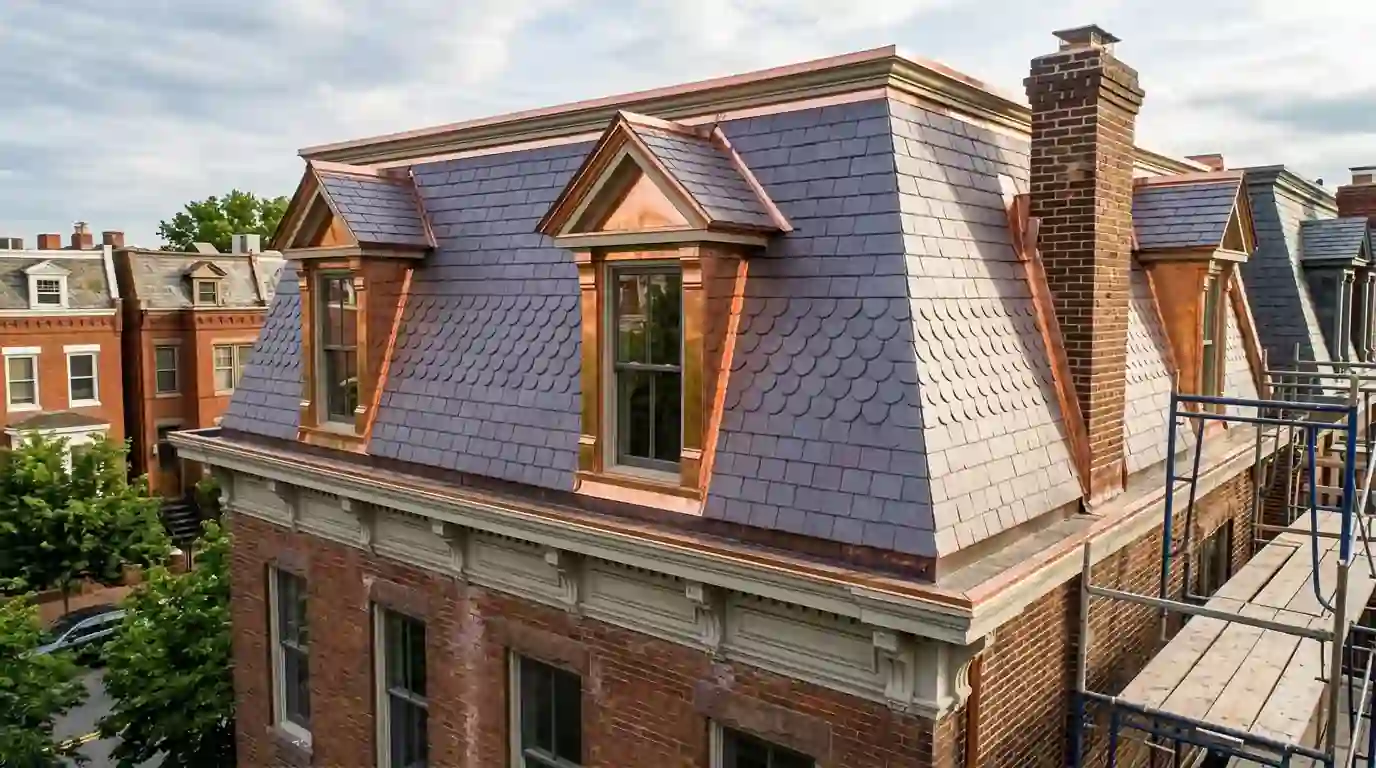
A DC Victorian mansard is a steep, nearly vertical slope across the front of the house, usually with dormer windows set into it and a flat roof behind. The slate is often laid in decorative bands of fishscale, hexagon or diamond shapes, sometimes in two colors. Matching that pattern is part of the job, not an extra.
Turrets and conical bay roofs are harder. Each course gets narrower toward the top, so every slate is cut and holed by hand to taper. We take photos and measurements of the original pattern before stripping, then lay it back course by course.
Where the mansard meets the flat roof above, a copper or terne-coated cap usually covers the transition. That top edge leaks more than any other spot on these houses. We rebuild it with new soldered copper, lapped down over the top slate course and up under the flat roof membrane.
Many slate houses sit inside historic districts such as Capitol Hill, Mount Pleasant, Cleveland Park, Shaw, LeDroit Park, Anacostia, Woodley Park and Takoma DC. In Georgetown, the Old Georgetown Board reviews visible exterior changes. Replacing slate with slate of similar size, color and pattern is generally the path of least resistance through the Historic Preservation Office.
Changing material on a visible slope is harder. Swapping a slate mansard for asphalt shingles is often denied on contributing buildings, and even synthetic slate may need a conversation. We assemble photos, product samples and drawings so the Historic Preservation Office has what it needs. Our permits and historic review guide covers the process.
Outside the District, Old Town Alexandria and Takoma Park MD have their own historic district rules. The DC Department of Buildings permit, or the county permit office outside DC, comes once design questions are settled.
We strip slate by hand, saving any sound pieces for reuse on the same house or for future repairs. The deck gets inspected board by board, and rotten lath on mansards is replaced with new boards. Over that we lay heavy felt or a synthetic underlayment rated for slate, with ice barrier at the eaves and in valleys.
Every slate gets two copper nails, set so the head sits flush without cracking the stone. Each course follows a headlap of about three inches, the overlap that keeps water out. Valleys and step flashings are 16-ounce or 20-ounce copper, so the metal lasts as long as the slate.
Snow guards go on above doorways and walkways, especially on steep Victorian slopes over the front stoop. Sliding snow off a slate roof can bend gutters and hurt someone walking below.
Slate is not only a rowhouse material. Tudor revivals and center-hall colonials in Chevy Chase DC, Cleveland Park, Bethesda and older parts of Arlington often carry full slate roofs with steep gables, hips and cross gables. Those roofs run larger and more complex than a mansard, with long valleys, multiple chimneys and built-in gutters at the eaves.
On these houses, the slate is often fine while the built-in gutters rot out behind the cornice. Replacing slate without fixing that eave detail sends water straight back into the wall. We open the cornice, rebuild the gutter liner in copper, and tie the bottom slate courses into it properly; our box gutter repair work handles the cornice side.
Staging differs too. Detached homes allow roof jacks and planks or a lift on the lawn, and we protect boxwoods and walks under every drop zone. Slate chips are sharp, so we sweep beds and lawns by hand at the end of every day rather than just running a magnet.
Owners who face a full slate tear-off on a large house often ask about alternatives. Outside historic districts, synthetic slate or standing seam can cost less, and we price those side by side when the owner wants to compare.
Pieces showing up in the yard or gutter after freeze and thaw means nails are rusting through across the roof.
Slate that delaminates in layers or crumbles at the edges has reached the end of its stone life.
Lots of sheet metal shims and roofing cement smeared across the slope point to decades of stopgap repairs.
Valley metal that has rusted through leaks into walls and ceilings, and replacing it often means lifting many slates.
A wavy or bowed mansard suggests rotted lath and framing behind the slate.
Stains around dormer windows usually trace to failed cheek and apron flashing.
We photograph patterns, measure exposure and test the stone for soundness.
We prepare materials for the Historic Preservation Office and file with DOB or the county.
Slates come off by hand, and sound pieces are sorted and stacked for reuse.
Rotten boards and mansard lath are replaced, and new underlayment is laid.
Copper valleys, flashings and caps are installed, then slate is laid with copper nails.
We install snow guards where needed, clean up chips and share a full photo record.
Slate is priced by area, pattern complexity and how much copper work is involved. These are typical 2026 ranges around Washington.
| Job | Typical range |
|---|---|
| Rowhouse front mansard, relay existing slate | $14,650-$29,800 |
| Rowhouse front mansard, new natural slate | $17,300-$43,800 |
| Turret or conical bay roof | $11,900-$34,600 |
| Detached home, full new slate roof | $54,900-$138,600 |
| Copper valley replacement under existing slate | $2,840-$7,360 |
Slate origin and color, decorative patterns, turret work, scaffolding over sidewalks and the amount of copper all move the number. Relaying sound slate saves material cost but not much labor.
If they ring when tapped and have no flaking, often yes. We strip, sort and relay them on new underlayment with copper nails. Expect to replace some broken pieces with salvaged slate matched for color and size.
We source new slate from quarries in Pennsylvania, Vermont and New York, and salvaged slate from demolition yards. Faded purples and mottled greens are the hardest to match, so we often move original slates to the street face and use new ones on less visible slopes.
Most rowhouse mansards take one to two weeks of roof work after approvals. Turrets and complex patterns add time. Historic review can add weeks before work starts, so plan ahead.
Usually yes on a rowhouse front. We arrange scaffold with a covered walkway and handle the DC public space permit so pedestrians can pass safely.
Natural slate weighs roughly 800 to 1,500 pounds per square, several times more than asphalt. Houses built for slate carry it fine, but converting a shingle roof to slate needs a framing check first.
These are the places we drive to most for this work. We cover all 45 areas on our service area list.
Slate repair for Victorian mansards, turrets and steep DC roofs: broken slates replaced with copper hooks or nail-and-bib, plus valley and flashing rebuilds.
Slate Roof Repair detailsComposite slate tiles that give colonials, Tudors and non-contributing homes a slate look at a fraction of the weight, with copper or steel flashing.
Synthetic Slate Roofing detailsRepairs to the steep slate fronts of Victorian and Second Empire rowhouses: slipped and broken slates, rusted nails, dormer cheeks, built-in gutters and the flat-to-mansard joint.
Mansard Roof Repair detailsSoldered and standing seam copper for bay roofs, turrets, dormers, cupolas and entry roofs, plus copper valleys, caps and built-in gutter liners.
Copper Roofing detailsCall and a roofer will answer, any hour of any day. We stop the leak first and fix it properly once the roof is dry.