Cluster townhouses
Rows of 1970s and 1980s units with shared roof planes, firewalls and cluster color rules.
Northern Virginia
Much of Burke was built as planned clusters in the 1970s and 1980s, and the townhouse rows of its big planned community east of Burke Lake Road and single-family loops each answer to a cluster board on what a new roof can look like. The approval process is often the longest part of the job.
In Burke, a typical townhouse roof replacement runs $6,900-$11,700 per unit, and single-family homes about $12,300-$22,900, depending on size, layers and decking. Before work starts, Burke's cluster boards and most nearby HOAs want approval of the shingle color and style. We help with the request. Leak repairs typically cost $380-$1,210. Call (202) 771-7443.
Burke's largest planned community is divided into conservancies and clusters, each with its own architectural standards. For a roof, that usually means the shingle color, sometimes the specific product line, and occasionally the color of drip edge and gutters. Some clusters ask every unit in a row to use the same color so the building reads as one.
We bring physical samples of shingles that match your cluster's approved list, give you the product spec sheet and a short scope, and you file the request. Once approval comes back, we schedule. If several neighbors in a row want to replace at once, we can coordinate a single schedule and handle the party wall joints in one go.
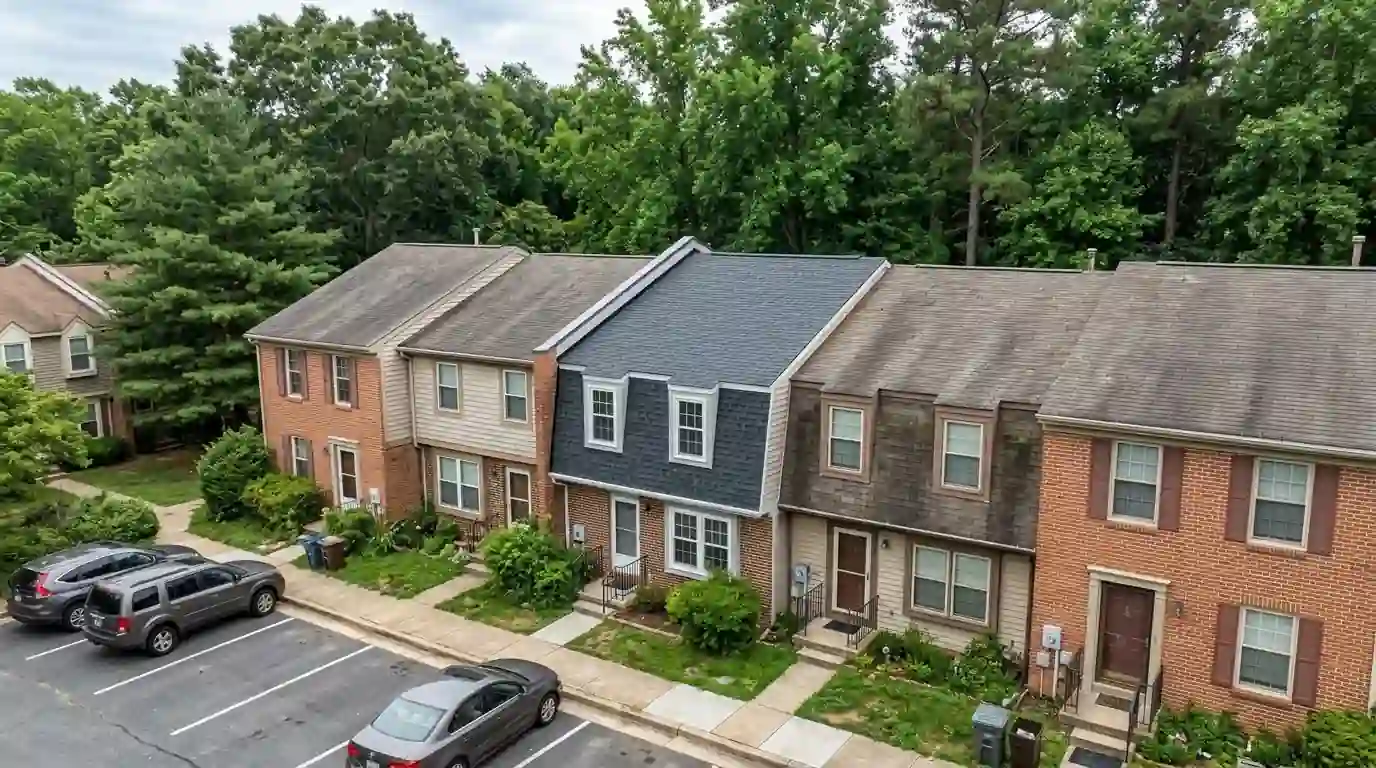
Burke townhouses share roof planes, and the line between units sits over a firewall. When one unit is reroofed and its neighbor is not, the transition is often done poorly: shingles butted together, underlayment stopped short, and a bead of sealant doing all the work.
We cut back to a clean line, lap our underlayment several inches onto the neighbor's deck under their shingles and weave the courses so water flows over the joint rather than into it. On rows where firewalls rise above the roof, we cap them with new metal and flash the sides. Our blog post on party wall leaks explains the same problem on DC rowhouses.
Outside the clusters, Burke has two-story colonials and split-levels from the 1970s and 1980s on wooded lots near Burke Lake Park and Lake Braddock. Their roofs are steeper, with more valleys, and the surrounding hardwoods drop a lot of leaves.
We see many original or second-generation roofs here that are wearing out at the same time. Decking is usually plywood or OSB, and it holds up well unless gutters overflowed for years. Pairing a new roof with gutter guards cuts down on ladder climbs every fall.
Burke also sits close to the VRE station and the Fairfax County Parkway, and some of the older streets near Burke Road still have 1960s ramblers with low roofs and exterior chimneys. Those houses usually need the full treatment: two layers off, boards replaced at the eaves, new chimney flashing and soffit vents added so the attic can breathe.
Townhouse parking courts in Burke's clusters are tight, and many have assigned spaces. We talk to the cluster manager about where a trailer can sit, keep it there only during work hours and sweep the court with a magnet at the end of each day. Shingles go up by ladder hoist, so no one is carrying bundles across your neighbor's patio.
Single-family homes have more room, but we still lay plywood over driveways when a loaded trailer sits there and tarp beds and decks. Permit questions for a Burke address go to the county permit office, and we get that answer before any shingles come off.
Rows of 1970s and 1980s units with shared roof planes, firewalls and cluster color rules.
Detached homes inside conservancies that still need HOA approval for roof color and style.
Steeper roofs near Burke Lake with several valleys that fill with leaves every fall.
Transitions between reroofed and original units are a common leak point when not lapped correctly.
Assigned spaces and narrow courts mean careful staging and daily cleanup.
Full tear-off and new roof systems for DC rowhouses, Victorians and suburban colonials, from low-slope membranes to shingle, slate and metal.
Roof Replacement detailsArchitectural shingle roofs for colonials, Cape Cods and split-levels, with ice barrier at eaves, new valley metal and balanced ridge venting.
Asphalt Shingle Roofing detailsShared roofs on condo buildings, co-ops and small apartment buildings repaired or replaced with clear reports for boards and simple notices for residents.
Condo and Multifamily Roofing detailsWe trace roof leaks from the ceiling stain back to the real entry point, then fix that cause: seams, flashing, vent boots, skylights, parapets and drains.
Roof Leak Repair detailsStainless micro-mesh and solid-hood guards fitted for oak, tulip poplar and pine cover, so the gutters keep flowing between cleanings.
Gutter Guards detailsSpring and fall roof visits that clear gutters and drains, reseal flashing and vents and catch small failures before they turn into ceiling stains.
Roof Maintenance detailsIt varies by cluster and meeting schedule. We suggest starting the request a few weeks before you want work done, and we provide samples and specs so it is complete when you submit it.
Yes. We replace your unit alone and tie into the neighbor's roof with a lapped joint and new flashing, so your new roof is sealed even though theirs is older.
Yes, including Lake Braddock, Fairfax Station, Springfield and the City of Fairfax. The phone is answered 24/7 at (202) 771-7443.
After approval, we tear off to the deck, replace any soft OSB, install ice and water membrane at the eaves and synthetic underlayment over the rest, then new drip edge, pipe boots, shingles and ridge vent. Most single units are done in a day, weather permitting.
Call any hour. We answer 24/7 and tell you when a roofer can be at your house.