Lifting laps
Seam edges that you can slide a fingernail under mean the old adhesive has failed.
Roof replacement and new roofs
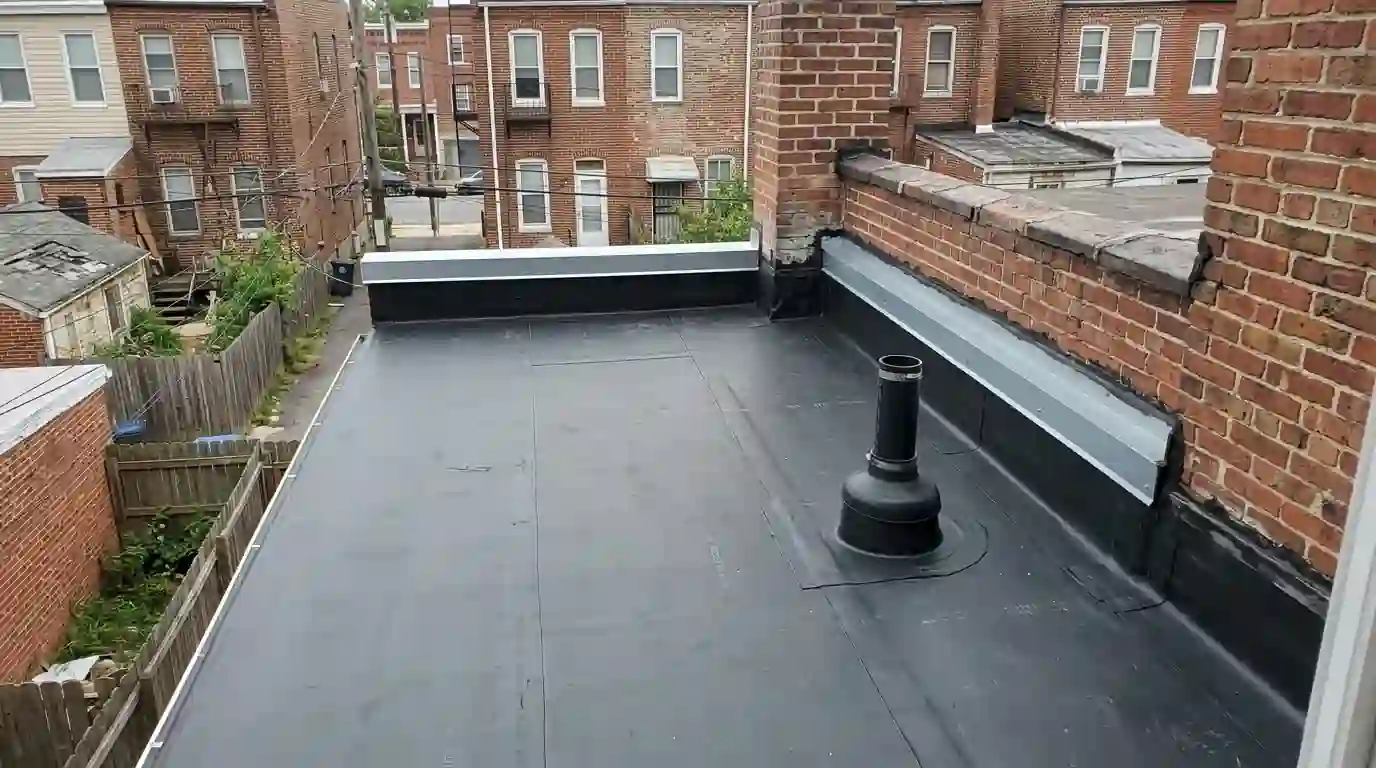
Old rubber roofs give up slowly, with laps lifting at the edges, the sheet pulling back from the parapet and patches of tape that no longer stick.
Materials we install
EPDM is a synthetic rubber membrane laid in large sheets and joined with factory seam tape. It flexes with temperature swings, handles odd shapes and many penetrations, and is easy to patch later. On a DC rowhouse or addition, a tear-off and new fully adhered 60-mil EPDM roof usually runs about $8,960-$16,700, with white EPDM, insulation and parapet work adding cost.
EPDM has been on Washington roofs since the 1980s, and plenty of first-generation sheets are still up there, chalky and shrunken but mostly dry. That track record is one reason we still install it. The material stays flexible in January cold, tolerates hail and branches better than you might expect, and doesn't care much about UV.
It shines on roofs with lots of interruptions. A Columbia Heights rowhouse with a chimney, three plumbing vents, a skylight, a hatch and an old exhaust stack becomes a maze of small welds in TPO. In EPDM, the same roof gets a few large sheets and pre-molded pipe boots, which means fewer seams to watch.
EPDM is also simple to repair years later. Any roofer with the right primer and cover tape can patch a puncture neatly, which matters on porches and back additions where tree limbs drop every winter.
Standard EPDM is black, and black roofs absorb heat. On a garage, a shaded back porch or a small addition, that may not matter much. On a main rowhouse roof facing full sun, a black sheet keeps the top floor noticeably warmer in summer.
DC energy rules push reflective cool roof surfaces on most low-slope replacements, so for main roofs inside the District we usually install white-on-black EPDM or recommend white TPO instead. In the Maryland and Virginia suburbs, the county permit office sets its own expectations, and black EPDM is still common on porches and additions there.
Coating black EPDM white after installation is possible but rarely a good trade. Coatings need upkeep and can complicate future repairs. If reflectivity matters, it makes more sense to buy it in the sheet from day one.
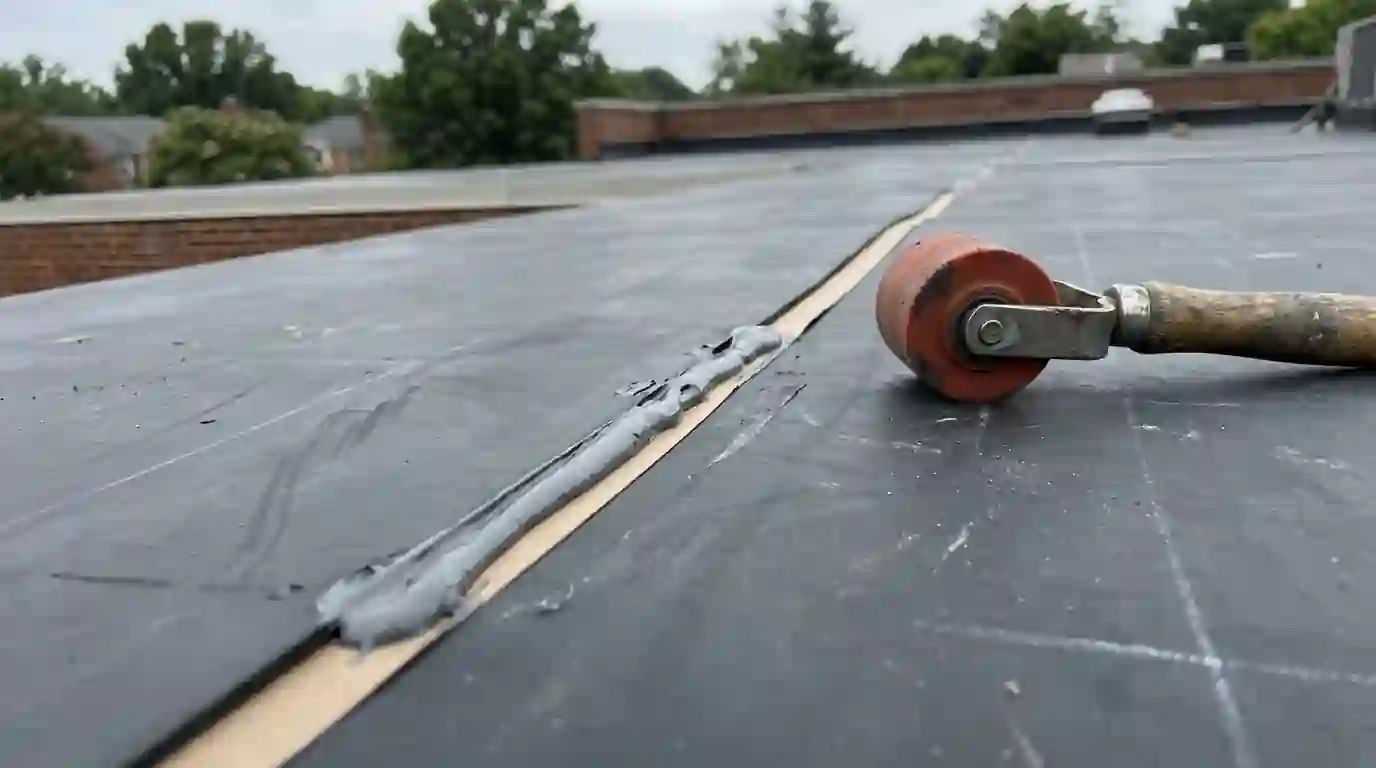
Most EPDM failures come from seams and edges, not the rubber itself. Older roofs were glued with liquid splice adhesive that dried out and let go. We use factory-applied seam tape on clean, primed laps, roll every seam with a silicone roller, and finish each lap edge with lap sealant.
We fully adhere the field sheet with bonding adhesive over polyiso and a cover board rather than relying on ballast or loose laying. On a rowhouse, fully adhered rubber doesn't billow in wind and stays tight against the deck where foot traffic happens.
Edges get new metal. The drip edge at the front and rear is stripped in with cured cover tape, and at the parapet the rubber runs up the brick and terminates with a termination bar and counterflashing. Corners get pre-formed pieces, not hand-folded rubber that splits after a few winters.
Pulling an old rubber roof often reveals the real reason it leaked. Fiberboard insulation from the 1980s soaks up water like a sponge and stays wet for years, quietly rotting the boards beneath. We cut out every wet section, dry or replace the decking, and start over with polyiso that resists moisture far better.
Rowhouse decks in Mount Pleasant and LeDroit Park are often original 1x6 or 1x8 planks laid across joists that have sagged a little over a century. Where the sag creates a pond, we shim the low area or build it up with tapered board before the cover board goes down. That keeps water moving toward the scupper instead of sitting on a seam.
A cover board, usually a thin gypsum or high-density panel, goes on top of the insulation. It gives the rubber a hard, smooth surface to bond to and protects it from heel dents when someone steps on it to service a condenser.
Front porch roofs on Wardman-style rowhouses in Petworth and Brightwood often have very low slope and tie into the brick facade under a window. That joint is where water gets in. A single piece of EPDM run up behind new counterflashing handles it cleanly, and the sheet is easy to dress over the curved front edge.
Rear additions and sleeping porches built in the 1920s and 1950s often have shallow pitches that shingles can't handle. EPDM is a sensible fix for those, especially where a skylight or a kitchen exhaust interrupts the surface.
Bay roofs are a different story. On Victorian homes, a visible bay or turret usually wants metal for historic and visual reasons. We keep EPDM to the hidden low-slope surfaces and point owners toward copper or terne-coated steel where the roof shows from the street.
Rubber roofs need little attention, but they need some. Keep leaves out of the scupper and gutter, and check that the downspout runs freely after storms. Water that backs up against the parapet is the most common reason an otherwise sound EPDM roof leaks.
Avoid petroleum products on the sheet. Old roofing cement, oil-based paint and some solvent cleaners soften EPDM. If a contractor needs to set something on your roof, ask that they use EPDM-compatible tapes and sealants, or call us to flash it.
A yearly look costs little and catches most problems early. In fall, after the leaves drop, walk the roof or have us do it: check the pipe boots for splits, press along the parapet flashing for loose spots, and look for branches that have scraped the sheet. Catching a small tear in October beats finding it on a bedroom ceiling in February.
Seam edges that you can slide a fingernail under mean the old adhesive has failed.
Rubber shrinking back from the parapet leaves a gap at the base flashing where water enters.
Membrane stretched tight across inside corners, not lying flat, shows shrinkage and stress.
Bubbles in an adhered sheet point to moisture or failed adhesive below.
Surface cracking you can see when the sheet is folded slightly means the rubber is near the end.
Multiple layers of tape at the same spot usually mean the area beneath is wet.
We check layer count, wet spots, drains and every penetration, and photograph the parapets.
We lay out the largest practical sheets to keep seams away from low spots and the outlet.
Old roofing comes off, and boards or plywood are repaired or replaced as needed.
Polyiso and cover board go down, then the EPDM is fully bonded to the base.
Laps are primed and taped, and all edges, pipes and curbs are flashed with matching pieces.
We inspect every seam, clear the drains and send you the finished photo set.
Rubber roof pricing depends on sheet color, insulation and how many penetrations need flashing. Expect numbers like these on area jobs this year.
| Job | Typical range |
|---|---|
| Rowhouse main roof, black 60-mil EPDM | $8,960-$13,280 |
| Rowhouse main roof, white EPDM with insulation | $11,450-$16,700 |
| Front porch roof in EPDM with new counterflashing | $1,940-$4,360 |
| Rear addition or sleeping porch roof | $3,180-$6,470 |
| Re-taping lifted seams on a sound sheet | $465-$1,290 |
Wet insulation, rotted decking, parapet coping and limited access raise cost. Roofs with few penetrations and easy alley staging come in lower.
Well installed EPDM often lasts 25 to 30 years here, and some older sheets last longer. Seams and edge details usually wear out before the rubber does. Taped seams hold up much better than the old liquid adhesive.
Often yes, if the deck is dry and the leak is a puncture or one open lap. We clean, prime and apply cured cover tape. When multiple seams are lifting and the sheet has shrunk from the walls, replacement is the better value, and our flat roof repair page covers the patch option.
DC energy rules push reflective surfaces on low-slope replacements, so main rowhouse roofs usually get white EPDM or white TPO. Black EPDM may still fit small shaded areas, and we confirm what the permit requires before ordering.
Older EPDM sheets lose some plasticizers over the decades and pull inward, especially if they were not fully adhered. That tension lifts the base flashing at the wall. New fully adhered sheets with termination bars resist that movement.
These are the places we drive to most for this work. We cover all 45 areas on our service area list.
Tear-off and new low-slope roofs for rowhouses and flats, with tapered insulation for ponding, new parapet flashing and reflective cool roof membranes.
Flat Roof Replacement detailsHeat-welded white TPO membranes for rowhouse and low-slope roofs, built to meet DC cool roof expectations and shrug off ponded water.
TPO Roofing detailsLow-slope roof repair for DC rowhouses and additions: modified bitumen, EPDM, TPO and coated roll roofing, plus ponding areas, curbs and parapet base flashing.
Flat Roof Repair detailsTear-off and new low-slope roofs for DC rowhouses, with party-wall parapets, rear ells, neighbor tie-ins and the rear scupper that carries all the water handled properly.
Rowhouse Roofing detailsCall and a roofer will answer, any hour of any day. We stop the leak first and fix it properly once the roof is dry.