High ground
Tenleytown includes the highest natural point in DC, and its roofs take stronger wind gusts.
Washington, DC neighborhoods
Tenleytown sits on the highest natural ground in the District, near Fort Reno Park, and that height shows up on its roofs. When storms push in from the west, the wind reaches these detached houses before anything else in the city slows it down.
Tenleytown roof calls spike after summer thunderstorms and winter wind events: lifted or creased shingles, ridge caps blown off, and branches through the deck. Many homes are 1920s to 1950s Colonials and Cape Cods with asphalt roofs. Wind repairs often run $480-$2,190; a full architectural shingle replacement typically lands between $11,350 and $19,640, depending on size, layers and decking.
Elevation matters. Houses on the rise around Fort Reno and along Wisconsin Avenue catch gusts that lose strength by the time they reach lower neighborhoods. Shingles take it at the edges first: rakes, eaves and the ridge. Once the adhesive strip lets go, a shingle creases at the nail line and can tear loose in the next storm.
We check for creased shingles after storms by lifting tabs gently along the rakes and ridge. A creased shingle can look fine from the ground and still leak. Our storm damage repair work starts with a roof-level check, photos of every damaged area and a same-day seal or tarp where the deck is exposed.
Older three-tab shingles fail first. Many Tenleytown homes still have them, or a first-generation architectural shingle laid in the 1990s.
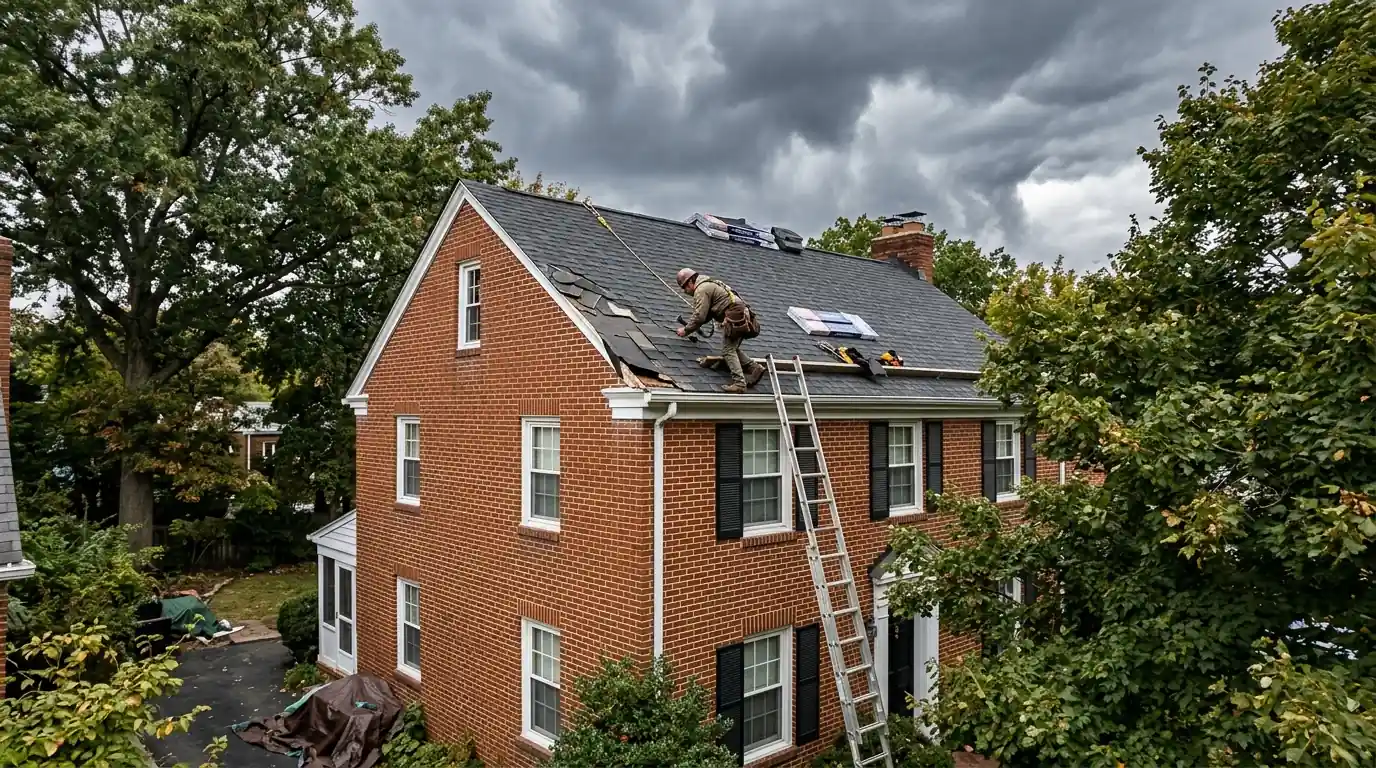
When we replace a roof here, we treat wind as the main design load. That means a starter strip with adhesive along every eave and rake, six nails per shingle instead of four, and a ridge cap product rated for high wind. We also hand-seal the first course on the rake edges, where uplift is strongest.
Ice and water underlayment goes along the eaves, in every valley and around chimneys and skylights. Drip edge is fastened under the underlayment at the eaves and over it at the rakes. Small choices like these are why some roofs on a block lose shingles in a storm and others do not. Our asphalt shingle roofing page lists the materials we use.
If you prefer metal, standing seam with concealed clips holds up very well against wind and suits some of the more modern houses near American University.
Tenleytown has mature street trees and big backyard oaks, especially on the blocks between Nebraska Avenue and Rock Creek. Storms that bring down limbs can puncture decking and crush gutters. After a tarp goes up, we document damage with photos and measurements and write a scope your insurance adjuster can use.
Insurers look for storm-created damage, not wear. We separate the two in our notes so the claim reflects what actually happened.
You do not need to climb a ladder to spot most wind damage. Walk the yard and the sidewalk the morning after a storm and look for the signs below. Any one of them is worth a call, because a small opening left alone through the next rain usually turns into wet insulation and ceiling stains.
Driveways and side yards are common here, so we can usually park a trailer at the house and get a ladder up within the hour of arriving. Narrow streets near Tenley Circle and the Metro fill with cars during the school day, which is why we aim for early starts there.
Tenleytown includes the highest natural point in DC, and its roofs take stronger wind gusts.
1920s to 1950s Colonials, Cape Cods and some bungalows with asphalt roofs fill the residential streets.
Many roofs carry three-tab or early architectural shingles that lose adhesion with age.
Apartment and commercial buildings along the corridor have flat membrane roofs with parapets.
Most of Tenleytown is outside DC's designated historic districts, so standard DOB permits apply.
Repairs after thunderstorm gusts, nor'easters, hail and fallen limbs: lifted membrane, creased shingles, cracked slate, torn flashing and punctured decking around DC.
Storm Damage Roof Repair detailsArchitectural shingle roofs for colonials, Cape Cods and split-levels, with ice barrier at eaves, new valley metal and balanced ridge venting.
Asphalt Shingle Roofing detailsFull tear-off and new roof systems for DC rowhouses, Victorians and suburban colonials, from low-slope membranes to shingle, slate and metal.
Roof Replacement detailsDay or night roof emergencies in DC: tarping, temporary membrane patches, tree limb dry-ins and active leak control, with a crew answering (202) 771-7443 around the clock.
Emergency Roof Repair detailsAfter wind or a falling tree, we tarp the roof, document the damage with photos and measurements and meet your adjuster on the roof.
Insurance Claim Roof Help detailsLeaking seams, sagging runs, crushed downspouts and clogged alley tie-ins fixed on the spot, so you keep sound gutters instead of replacing them early.
Gutter Repair detailsNot usually. If the rest of the roof is sound, we replace the missing shingles and reseal creased ones nearby. If the shingles are old and brittle, we will tell you whether repairs will hold.
Many policies cover sudden wind damage but not wear. We document storm damage with photos and measurements so your adjuster can see what happened. Your policy decides the coverage.
Creases are faint horizontal lines across the shingle near the nails. They are hard to see from the ground, so a roof-level check after a big storm is the reliable way.
We answer 24/7 and tarp exposed decking the same day when it is safe. Call (202) 771-7443.
Call any hour. We answer 24/7 and tell you when a roofer can be at your house.