Condo conversions
Many 1900s to 1920s rowhouses now hold two or three units, with roofs managed by small associations.
Washington, DC neighborhoods
A lot of Columbia Heights rowhouses are no longer single homes. Two- and three-unit condo conversions, rooftop decks and pop-up stories have changed what sits on top of these 1900s brick rows, and each change added new places for water to get in.
In Columbia Heights, the most common roof calls involve leaks under rooftop decks, failed flashing where a pop-up wall meets the old roof, and aging membranes on condo buildings with shared budgets. Deck-area waterproofing repairs often run $1,640-$4,280; full low-slope replacement on a converted rowhouse is typically $9,120-$16,450, depending on deck removal, layers and access.
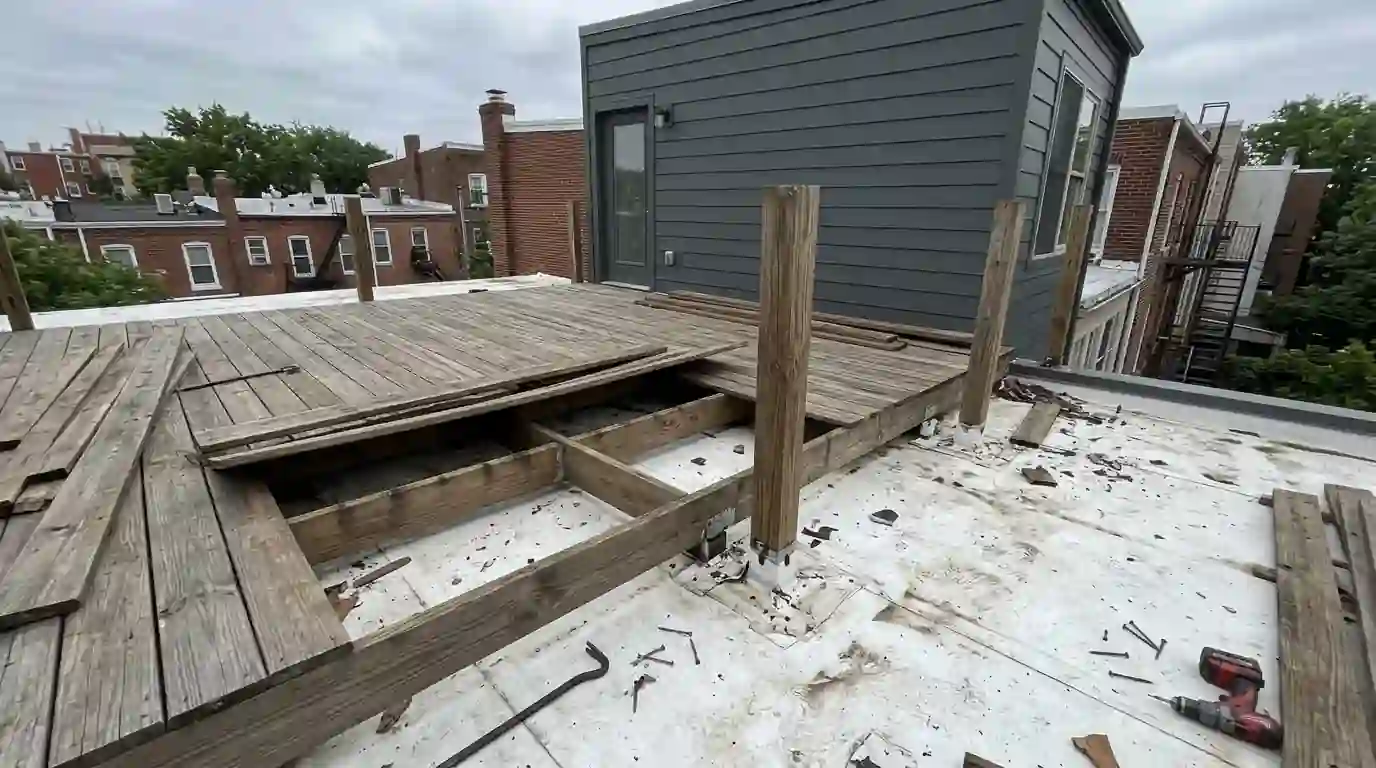
Decks were bolted onto many roofs between Park Road and Florida Avenue during the condo boom. Some sit on sleepers set in pitch pockets, others on posts that pierce the membrane. Each penetration is a possible leak, and the deck hides it until the top-floor ceiling stains.
We start by pulling a few boards near the stain and tracing water back along the sleepers. Often the problem is a post base that was sealed with caulk instead of a proper flashing boot, or a membrane that was never designed to carry foot traffic. If the membrane is near the end of its life, roof deck waterproofing with a protection layer and raised pedestals is usually the longer-lasting answer.
When the deck comes off for the work, we stack it on the roof or in the rear yard, number the sections and put it back once the new roof is down. You should not lose the deck to fix the leak.
A pop-up adds a new third or fourth story, and its side walls rise right off the old roof or the party wall. Where the builder skipped proper base flashing, water runs down the new siding and under the membrane. We see this most on blocks of Harvard, Girard and Kenyon Streets, where additions sit next to original-height houses.
The repair is plain carpentry and flashing work: cut back the membrane, install a cant and base flashing up the new wall at least eight inches, then lap the siding or stucco over a metal counterflashing. Where the neighbor's lower roof meets your taller wall, we flash their side too, with their permission, because that joint drains onto both properties.
In a converted rowhouse, the roof usually belongs to the association, but the leak lands in one owner's unit. We document what we find with photos and a short written scope so the board can decide quickly. When a building needs a full new roof, we can phase the work around move-ins and noise rules.
Larger apartment buildings along 16th Street and near Meridian Hill Park have bigger flat roofs with internal drains, mechanical curbs and parapets on all sides. Our condo and multifamily roofing work covers those, from drain replacements to full membrane tear-offs.
Street parking near the Columbia Heights Metro and the DC USA complex is tight most of the day, so we schedule deliveries early and use rear alleys wherever possible. Many blocks have alleys behind the rows, though some end in garages and fences that leave little turning room. We size the trailer to the alley and carry debris out in more trips when we have to.
Many 1900s to 1920s rowhouses now hold two or three units, with roofs managed by small associations.
Decks on sleepers or posts hide membrane damage and add penetrations that need real flashing boots.
New upper stories create tall side walls along party lines that need base and counterflashing.
Older apartment blocks near Meridian Hill Park have large flat roofs with interior drains and parapets on all sides.
Waterproofing under new and existing rowhouse roof decks: tough membrane, protection board, pedestals and flashed post supports that never puncture the roof.
Roof Deck Waterproofing detailsShared roofs on condo buildings, co-ops and small apartment buildings repaired or replaced with clear reports for boards and simple notices for residents.
Condo and Multifamily Roofing detailsLow-slope roof repair for DC rowhouses and additions: modified bitumen, EPDM, TPO and coated roll roofing, plus ponding areas, curbs and parapet base flashing.
Flat Roof Repair detailsWe trace roof leaks from the ceiling stain back to the real entry point, then fix that cause: seams, flashing, vent boots, skylights, parapets and drains.
Roof Leak Repair detailsRepairs to the brick walls that rise above rowhouse roofs: loose coping, cracked caps, open mortar, failed through-wall flashing and the membrane where it meets the parapet.
Parapet Wall and Coping Repair detailsHeat-welded white TPO membranes for rowhouse and low-slope roofs, built to meet DC cool roof expectations and shrug off ponded water.
TPO Roofing detailsOften yes. We lift the boards around the leak, find the failed flashing or seam and repair it. If the membrane under the deck is worn out across the roof, we will tell you that a removal and full waterproofing is the better spend.
We give the board photos of the problem, a written scope, a price range and an expected schedule. That usually lets them vote at one meeting instead of asking for more information.
The joint between a taller addition and a lower roof needs flashing on both sides. We can repair your side and, with the neighbor's agreement, theirs, so water stops running into the seam.
Yes. Those roofs need drain work, curb flashing and sometimes a full new membrane. Call (202) 771-7443 and we will walk the roof with your building manager.
Call any hour. We answer 24/7 and tell you when a roofer can be at your house.