Postwar ramblers
Low-pitch brick homes from the 1950s and 1960s, often with plank decking and two shingle layers that need to come off together.
Northern Virginia
Fairfax County covers a lot of ground, from the cul-de-sacs of Burke and Annandale to the wooded lots off Route 7 and the newer townhouse rows near Fairfax Parkway. Most of those roofs are asphalt shingle on houses built from the 1950s on, and a large share of them are reaching their second or third tear-off.
In Fairfax County the most common job is a full asphalt shingle replacement on a rambler, split-level or two-story colonial, typically $12,400-$26,900 depending on roof size, pitch and how much decking needs replacing. Storm repairs and leak fixes usually land between $425 and $1,780. Townhouse roofs often need HOA color approval first. Call (202) 771-7443 for a look.
The county's postwar subdivisions along Little River Turnpike and Braddock Road were built in the 1950s and 1960s, mostly brick ramblers and split-levels with low, wide roofs. Those low pitches shed water slowly, and the original plank decking is often hidden under two shingle layers by now.
Two-story colonials from the 1970s and 1980s, common in Burke, Fair Lakes and the streets around Chantilly, usually have plywood or early OSB decking. We find delaminated OSB at the eaves on many of them, where years of minor ice damming and poor attic airflow softened the edges.
Townhouse communities from the 1980s and 1990s bring a different set of issues: shared roof planes, party wall firewalls, and an HOA that has to approve shingle color. Then there are the large custom homes in Great Falls, Oakton and Clifton, where we work with slate, cedar, copper and standing seam metal more than plain shingles.
Thunderstorms roll across the county from the west most summer afternoons, and the wooded neighborhoods near Lake Accotink, Wakefield Park and the Difficult Run valley take the brunt of falling limbs. Wind lifts tabs on older three-tab shingles and breaks the sealant strips, which leaves them flapping in the next storm.
When you call after a storm, we photograph each slope before touching anything, tarp open areas with lumber battens screwed into the deck, and write up the damage for your adjuster. Our storm damage roof repair crews carry tarps, decking and shingles in the truck so a small blow-off can often be closed in for good on the first trip.
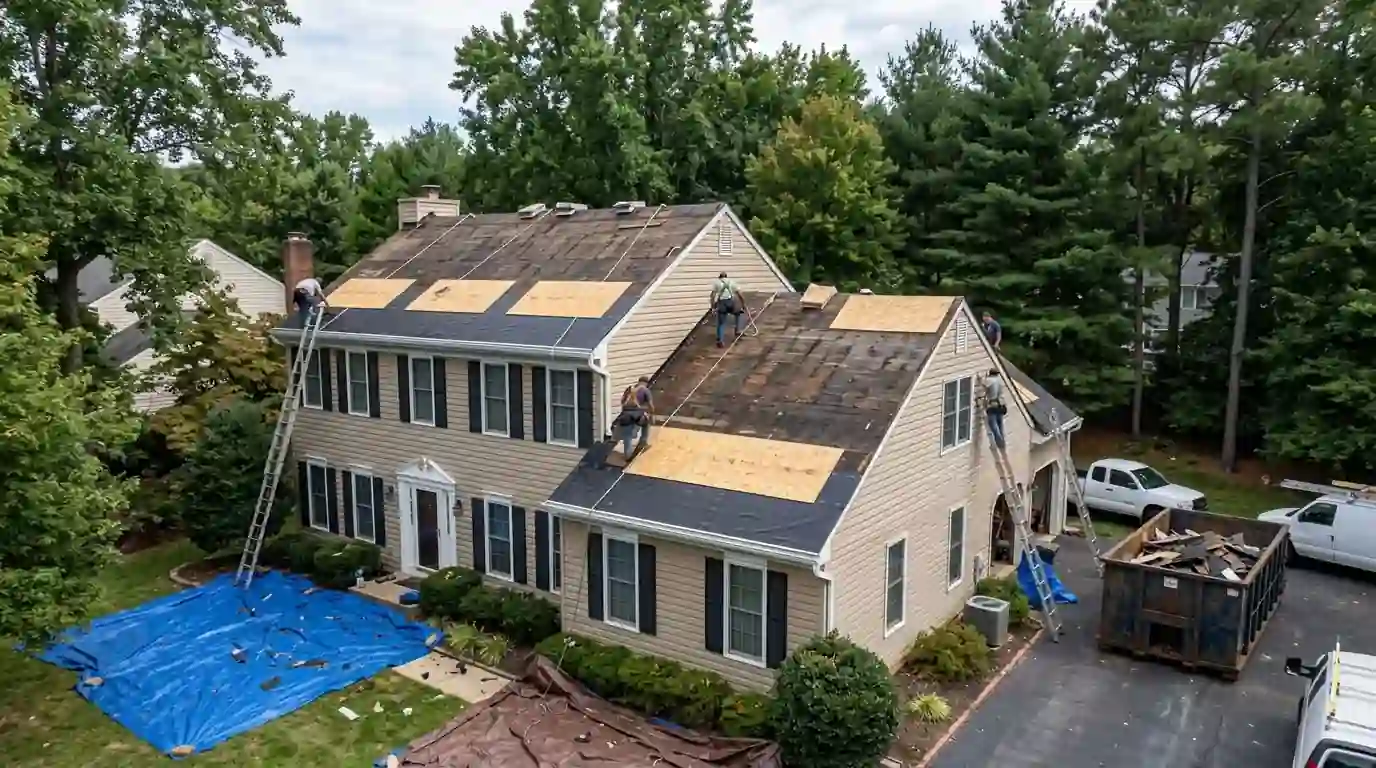
We strip to the deck, every time, so we can see the boards. Soft or delaminated sheets get cut out and replaced, and every nail line on the new deck gets checked for spacing before underlayment goes down.
Ice and water membrane goes along the eaves, in every valley, and around chimneys and skylights. We install new drip edge, pipe boots and step flashing rather than reusing the old metal, and we look at whether the attic has enough intake at the soffits to match the ridge vent. On a 1960s rambler that sometimes means adding soffit vents the house never had, which is where our attic ventilation work comes in.
Whether your project needs a permit depends on the scope, so we check with the county permit office before a full replacement, especially when decking or framing is involved. Towns inside the county, such as Vienna and Herndon, may have their own rules, and we ask about those as well.
For townhouse rows and planned communities, we pull the HOA's approved shingle list and help you put together the request with color samples. Our Woodbridge head office and Washington, DC office put crews within reach of the whole county, from Chantilly to Mount Vernon.
Low-pitch brick homes from the 1950s and 1960s, often with plank decking and two shingle layers that need to come off together.
Steeper two-story roofs with OSB or plywood decking that tends to soften at the eaves when attic airflow is poor.
Shared roof planes, firewalls between units and HOA approval on shingle color and style before work starts.
Great Falls, Oakton and Clifton homes carry slate, cedar shake, copper bays and standing seam that need specialty crews.
Neighborhoods near stream valleys and parkland see more limb strikes, clogged gutters and moss on shaded slopes.
Architectural shingle roofs for colonials, Cape Cods and split-levels, with ice barrier at eaves, new valley metal and balanced ridge venting.
Asphalt Shingle Roofing detailsFull tear-off and new roof systems for DC rowhouses, Victorians and suburban colonials, from low-slope membranes to shingle, slate and metal.
Roof Replacement detailsRepairs after thunderstorm gusts, nor'easters, hail and fallen limbs: lifted membrane, creased shingles, cracked slate, torn flashing and punctured decking around DC.
Storm Damage Roof Repair detailsAttic and roof cavity ventilation for DC rowhouses and suburban homes: ridge and soffit vents, baffles, bath fan ducting and fixes for winter condensation.
Roof and Attic Ventilation detailsStainless micro-mesh and solid-hood guards fitted for oak, tulip poplar and pine cover, so the gutters keep flowing between cleanings.
Gutter Guards detailsAfter wind or a falling tree, we tarp the roof, document the damage with photos and measurements and meet your adjuster on the roof.
Insurance Claim Roof Help detailsMost townhouse associations in the county control shingle color and sometimes the product line. We bring samples that match the approved list and give you a spec sheet for the architectural request so it moves faster.
Building codes have allowed an overlay in some cases, but we almost always recommend a full tear-off. Two layers hide soft decking, add weight to old framing and shorten the life of the new shingles.
All of them, including Annandale, Springfield, Burke, Vienna, McLean, Reston, Herndon, Chantilly, Clifton, Lorton and the Mount Vernon area. The phone is answered at (202) 771-7443 at any hour.
Call any hour. We answer 24/7 and tell you when a roofer can be at your house.